
Shinjuku Kabuki Hall
A Festival-Themed Food Yokocho, Indoors
The 2nd floor of Tokyu Kabukicho Tower: ten regional food stalls, neon matsuri decor, and a ramen station that rotates famous shops every two months. Open to 5am.
Last verified: 2026-05-16
Why Japanese People Love It
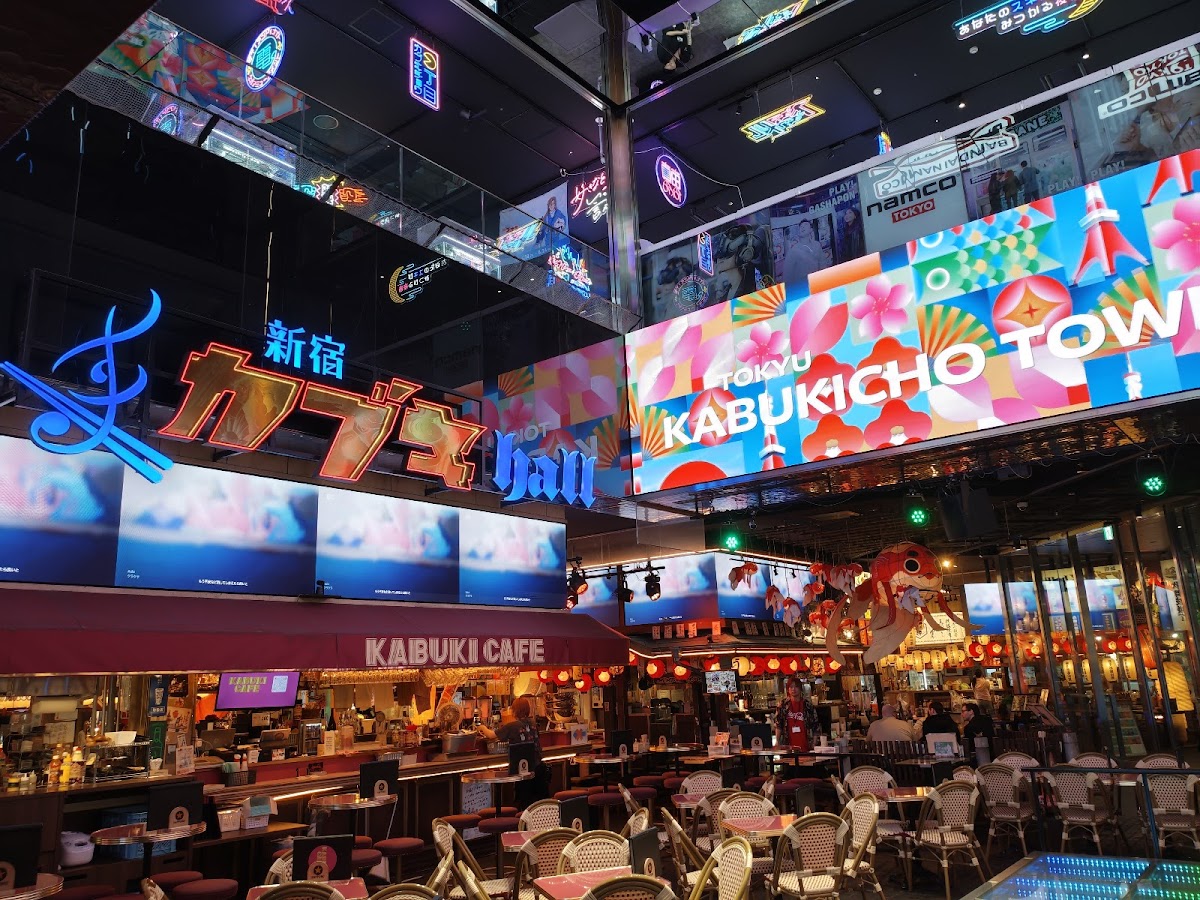
Kabuki Hall — Kabuki Yokocho opened in 2023 on the 2nd floor of Tokyu Kabukicho Tower, the 48-story landmark that anchored Kabukicho's recent redevelopment. It's a manufactured yokocho: about ten food stalls representing different regions of Japan (Hokkaido seafood, Kyushu motsunabe, Okinawa, Tohoku, etc.) arranged around shared seating, under a deliberately maximalist canopy of neon, paper lanterns, and matsuri (festival) decor. It's not an old alley pretending to be timeless — it's an explicitly theatrical, brand-new interpretation of the form.
What makes it work despite the artifice is the operating model. The stalls are run by established regional operators, the food is genuinely regional (Hokkaido stall serves Hokkaido seafood, not generic izakaya fare), and the shared-seating format lets a group order from five different stalls and eat together — which a traditional cramped yokocho physically can't do. The Ramen Station rotates a famous out-of-Tokyo ramen shop every two months alongside permanent slots, so the lineup is never quite the same twice.
For visitors, it solves a real problem: the genuine Kabukicho yokocho (Golden Gai, Omoide Yokocho) are atmospheric but small, smoky, often cash-only, and not always welcoming to non-Japanese-speaking first-timers. Kabuki Hall offers the visual energy of a yokocho with English-friendly logistics, group seating, and a 5am closing time — a controlled-entry version that works as either a first taste or a late-night anchor.
How to Experience It
Take the elevator or escalator to the 2nd floor of Tokyu Kabukicho Tower (one minute from Seibu-Shinjuku Station, seven from JR Shinjuku east exit). The hall is a single large room; you can wander the full loop of stalls before committing. Seating is shared and unassigned — find a spot, then order from whichever stalls you want.
Order stall by stall: most operate on a pay-at-the-stall model (some with their own English menus, some photo-based). Carry your food back to your seat. A group can split up, each hit a different region, and reconvene at the table. Drinks are available from a central bar and several stalls.
Open 6am to 5am — effectively almost always. The energy peaks late (22:00-2:00) when it functions as a Kabukicho nightlife anchor; afternoons are calmer and better if you want to actually taste across stalls rather than drink. It's a strong late-night option precisely because the genuine yokocho nearby close earlier or feel inaccessible at 2am.
What to Order
Graze across regions: a Hokkaido seafood plate (kani/crab, ikura), a Kyushu motsunabe (offal hotpot) or tonkotsu ramen from the rotating Ramen Station, an Okinawa stall item (taco rice or Okinawa soba), and skewers from the yakitori stall. The point is breadth — no single stall is the destination; the cross-section is.
The Ramen Station's rotating guest shop is worth checking on arrival — it cycles a different famous regional ramen every two months, often shops that are otherwise a day trip from Tokyo. If the current guest is one you'd otherwise have to travel for, that's the order to prioritize.
Plan your visit
| Area | Shinjuku |
|---|---|
| Category | Izakaya & Bars |
| Price range | ¥1500-4000 |
| Hours | 6:00-翌5:00 (店舗による) |
| Closed | なし |
| Access | 西武新宿駅から徒歩1分・JR新宿駅東口から徒歩7分・東急歌舞伎町タワー2階 |
| Reservations | Walk-in only — shared seating across stalls |
| English menu | ⚠ Limited Limited — some stalls have English; visual ordering common |
| English support | Limited English; the format is point-and-pay |
| Last verified | 2026-05-16 |
Nearby Experiences
You're in the heart of Kabukicho. Golden Gai (the 200-bar alley) is five minutes east for the genuine tiny-bar experience after the hall's bigger energy; Omoide Yokocho (Memory Lane) is seven minutes southwest for the postwar version. Kabuki Hall works well as the warm-up or the 2am wind-down on either side of those.
For food rather than drinking, Menya Musashi Shinjuku Honten and Tsunahachi Sohonten are both within ten minutes on the quieter west and east sides of Shinjuku Station respectively — the contrast between manufactured yokocho energy and a focused single-dish counter is worth experiencing back to back.