
Milk Stand Akihabara
A Showa Milk Bar on the Sobu Line Platform
One of Tokyo's last station milk stands — around 50 kinds of bottled milk, drunk standing on the Akihabara Sobu Line platform, just as commuters have since the 1950s.
Last verified: 2026-06-13
Why Japanese People Love It
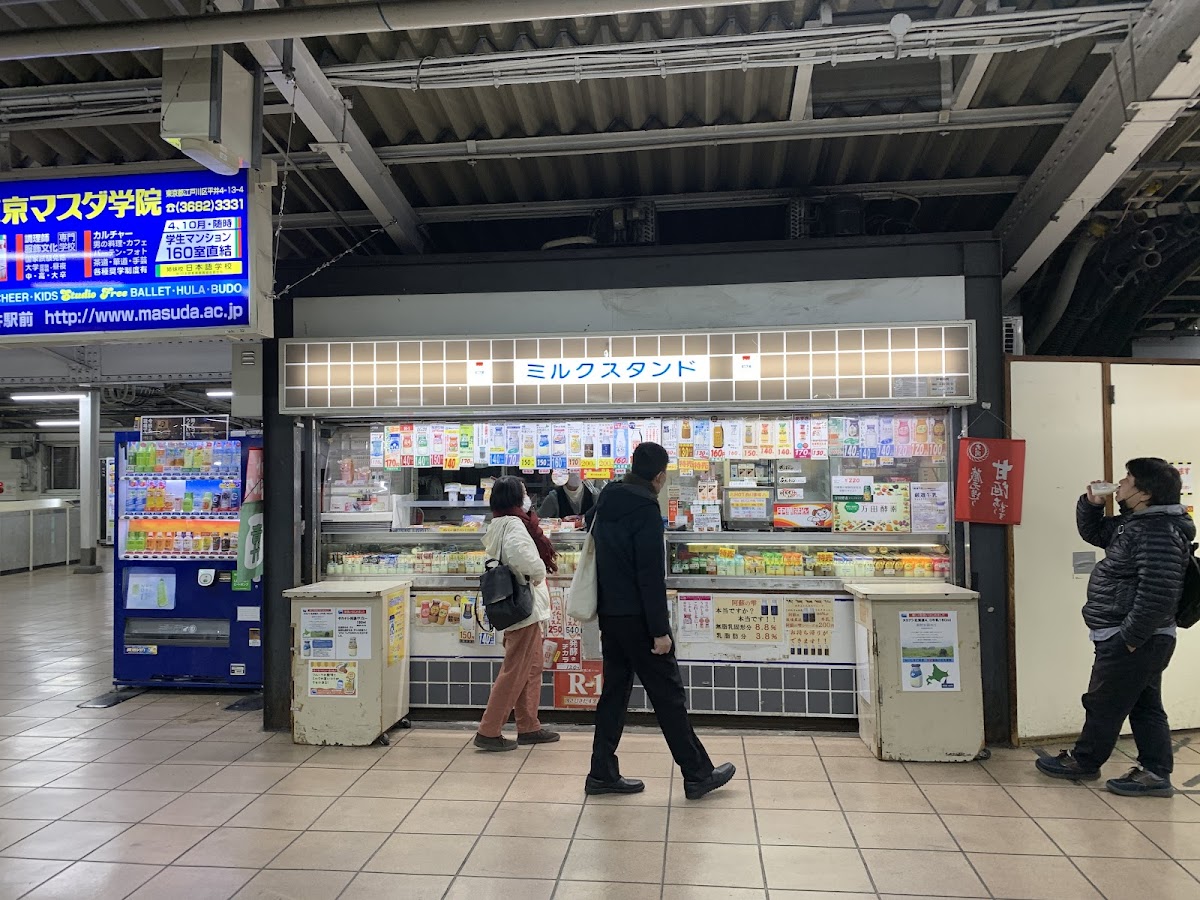
Bottled milk stands were once everywhere in Japan — on train platforms and just inside the door of every public bathhouse. After a hot soak, or while changing trains, you bought a cold glass bottle, drank it standing up with one hand on your hip, and handed the empty back. Almost all of them are gone now. The one on the Akihabara Sobu Line platform — run by Osawa Gyunyu, a dairy that has operated here since around 1950 (Showa 25) — is one of the last and best-loved survivors, in roughly the same spot for some seventy years.
What people come for is the wall of glass: around fifty kinds of bottled milk lined up in the refrigerated case — plain whole milk, the famous coffee milk, fruit milk (furutsu gyunyu), strawberry milk (ichigo milk), and a rotating cast of small-dairy and regional bottles you will not find in a convenience store. The ritual is the point. You cannot take the glass bottle away; you drink it on the spot at the standing counter and return the empty to the staff. For older Japanese it is pure childhood — the taste of after-school and after-bath. For everyone else it is a two-minute time capsule.
That it survives in Akihabara is the quiet joke. The district above the platform is defined by the brand-new — electronics, anime, the next thing. Down on the commuter platform, hiding in plain sight, is its exact opposite: a sensory anchor to Showa-era daily life. It keeps going because regulars, and a growing number of travelers, make a point of buying something rather than letting it fade. It is the temperature of Tokyo made literal — a cold bottle, and a warm piece of the city's memory.
How to Experience It
The stand is on the JR Akihabara Sobu Line platform, the Shinjuku-bound side (around track 5). It sits inside the ticket gates, so the easy way to visit is while transferring between lines. If you are coming specially, tap in with an IC card or buy a platform ticket (nyujoken, about ¥150) at the gate. The opposite platform — the Chiba-bound side, around track 6 — has a sister stand called Milk Shop Luck, so milk fans can do both in one stop.
Hours run roughly 6:30 to 18:45, year-round. Because this is a working commuter platform, the morning and evening rushes bring a steady stream of locals grabbing a bottle between trains; the midday lull is the calmest time to stand and browse the fridge. Hours on a small family stand like this can shift, so confirm before making a special trip rather than a transfer.
Ordering needs no Japanese. Pick a bottle from the case, pay at the counter in cash (most bottles run about ¥170-210), pop the cap on the opener fixed to the counter, and drink it right there. Hand the empty glass bottle back to the staff when you are done — you leave with nothing but the taste. Bread, including classic anpan (sweet red-bean buns), is sold alongside the milk for a quick platform breakfast; the shop's full name is, after all, 'the bread and milk store.'
What to Order
Start with one of the two nostalgic classics: the coffee milk or the fruit milk. Both are lightly sweet, un-carbonated, and taste of mid-century Japan — the flavor most Japanese instantly file under 'after the bath' or 'school milk.' Strawberry milk (ichigo milk) is the other crowd favorite and the brightest of the three. Any one of them delivers the full Showa hit in a single bottle.
Then explore the case. With around fifty bottles, the real fun is comparing milks you simply cannot get from a convenience-store cooler — richer northern-style whole milks, low-temperature-pasteurized bottles that taste closer to the farm, and seasonal one-offs. Pair a bottle with an anpan if you want it to count as breakfast. Whatever you choose, drink it reasonably fast and standing up: the bottle is staying, and so is the line behind you.
Plan your visit
| Area | Akihabara |
|---|---|
| Category | Traditional Specialties |
| Price range | ¥170-300 |
| Hours | 6:30-18:45(目安) |
| Closed | なし(年中無休) |
| Access | JR秋葉原駅 総武線ホーム(新宿方面・5番線側)・改札内 |
| Reservations | Walk-in only — standing counter on the platform |
| English menu | ⚠ Limited Limited — the bottles are visual; point and pay |
| English support | Limited English; the system is self-explanatory |
| Last verified | 2026-06-13 |
Nearby Experiences
Akihabara itself is the electronics-and-anime district stacked above the platform — but for eating, you are one stop from Kanda and two from Ueno. Kanda Matsuya, an 1884 hand-cut soba house, is a short ride or a fifteen-minute walk south for a proper old-Tokyo lunch after your two-minute milk break.
Two stops north in Ueno, Izu-ei Honten serves unagi (freshwater eel) in a 270-year-old institution near the park. Pairing the milk stand's quick Showa hit with that longer dive into pre-modern Tokyo eating shows how much living history sits along this one short stretch of the Sobu and Yamanote lines.