
Tokyo Yokocho Guide: 9 Best Alley Districts + First-Timer Etiquette (2026)
A yokocho is a pedestrian alley packed with tiny izakaya, lit by red lanterns, smelling of grilled chicken and beer. Tokyo has dozens. Seven of them are worth planning a night around.
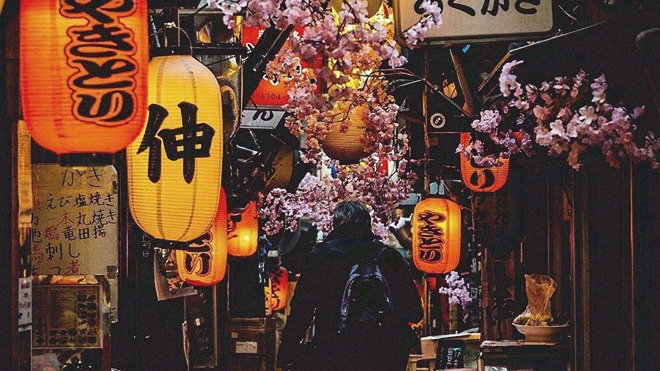
Walk five minutes east from the west exit of Shinjuku Station and you arrive at a covered alley about three meters wide. The alley is lit by red paper lanterns. Smoke from yakitori grills drifts out of doorways. Sixty small restaurants, none larger than a New York studio apartment, line both sides. This is Omoide Yokocho — Memory Lane — and it is one of the iconic spaces of post-war Tokyo.
Yokocho (横丁, literally “side street”) is the Japanese word for these dense pedestrian alleys of micro-restaurants. Tokyo has dozens of them, most of them grew out of black markets in the years after World War II, and visiting a Tokyo yokocho is one of the most efficient ways to experience the city’s drinking and eating culture in concentrated form.
This guide is the practical map for a first-time yokocho visit: what a yokocho actually is, why these spaces persisted into the modern city, the etiquette that makes the experience work, and the best yokocho in Tokyo to plan a night around. We cover nine alleys below, with nearest station, walking time, and typical hours for each, plus a comparison table and an FAQ for first-timers.
What a Yokocho Actually Is
A yokocho has three structural features. First, the alley is pedestrian-only and narrow — usually two to four meters wide. Second, the restaurants on either side are small, most with eight to twenty seats, with the kitchen visible from the alley itself. Third, the place exists primarily for evening drinking, with food as accompaniment. A yokocho is not a tourist attraction with restaurants in it; it is a working drinking district that has, in some cases, also become a tourist attraction.
The dominant food categories are yakitori (grilled chicken skewers), motsu-nikomi (offal stew), oden (winter hot-pot), and small sashimi plates. The dominant drinks are draft beer in small mugs, hot or cold sake, and the working-class staple Hoppy — a low-alcohol beer-flavored mixer combined with shochu (a clear distilled spirit), which became popular in the post-war years when beer was expensive and Hoppy was cheap. A first round of beer plus an order of yakitori and a small plate of sashimi at a yokocho shop typically runs ¥2,000 to ¥3,000 per person.
Where Yokocho Came From
Most of Tokyo’s surviving yokocho were born in the same five-year window — between 1945 and 1950 — as informal black-market drinking quarters in the rubble around major train stations. After the air raids that destroyed roughly half the city, the area immediately outside Shinjuku, Shibuya, Ueno, and Shimbashi stations was occupied by ad-hoc stalls selling food and drink that did not exist on official ration cards. Most of these were illegal. All of them were essential to a population that needed somewhere to eat and drink while the city rebuilt.
By the early 1950s, the city government formalized the surviving stalls into proper structures, gave them addresses, and ran electricity to them. The footprint of those original stalls is the footprint of today’s yokocho. The seats are in the same positions. The aisle is the same width. The reason most yokocho restaurants are absurdly small (eight seats is normal) is that they were built into spaces designed for an even smaller stall.
This is why a Tokyo yokocho feels architecturally specific. It is not a stylistic recreation of post-war Japan — it is the actual built remnant of the post-war city, preserved by the small-business economics of cheap rent and high regulars-driven demand.
How to Visit a Yokocho: Five Rules
The mechanics that distinguish a comfortable yokocho evening from an awkward one.
1. Walk the whole alley first. Most yokocho are 80 to 200 meters long. Walk the full length once, look into doorways, see which shops have an open seat and which have something on the grill that smells right. Then double back to the one you want. Picking the first door you see is how tourists end up at the touts’ shops.
2. Avoid the tout shops. Some yokocho — particularly Shinjuku Omoide Yokocho and Ebisu Yokocho — have shop staff standing in the alley actively pulling tourists into specific restaurants. These shops are not necessarily bad, but they are usually the most expensive in the alley and least frequented by locals. The shops with no tout, where the chef is visible cooking and the seats are filled with regulars, are the ones to choose.
3. Expect the otoshi. Almost every yokocho izakaya will bring an unrequested small dish (otoshi, お通し) within minutes of seating you, and charge ¥300 to ¥800 for it as a seating fee. This is normal — and already counted into the dinner tiers of our Tokyo food budget guide. It is not a scam. Treat it as a cover charge — the price of being there.
4. Order incrementally. Yokocho meals are not one-shot orders. The pattern is: drink, two skewers or small plates, another drink, two more plates, and so on. Ordering a long list at the start crowds the tiny counter and forces the cook to send everything at once. The local rhythm is small batches, regular reordering.
5. Don’t stay forever. Yokocho seats turn quickly. The norm is forty-five minutes to an hour at one shop, then move to another. Spending three hours at one counter takes a seat someone else is waiting for. The fun of a yokocho night is hopping between two or three shops, not anchoring at one.
The 7 Tokyo Yokocho Worth Planning a Night Around
Tokyo has dozens of named yokocho. The nine below are the ones we send people to first — chosen for their character, their density, the quality of their resident shops, and their accessibility from major train stations. The first seven are the core picks; Nonbei and Harmonica round out the list because every comparable Tokyo guide includes them and they answer two different visit windows (late-night Shibuya and daytime-to-night Kichijoji).
The table below is the at-a-glance version. Tourist-friendliness is our 1–5 read on how easy a first visit is (English signage, walk-in ease, alley width); price band is the rough per-shop spend for a first round. Hours and access were checked against operator and Tokyo tourism listings (accessed June 2026); individual shops set their own hours and closed days, so treat these as the alley-level pattern, not a guarantee.
| Alley | Nearest station | Vibe | Food focus | Tourist-friendly (1-5) | Price band |
|---|---|---|---|---|---|
| Omoide Yokocho | Shinjuku (West Exit) | Smoky, canonical, photogenic | Yakitori, motsu | 4 | ¥2,000-3,000/shop |
| Golden Gai | Shinjuku (East Exit) / Seibu-Shinjuku | Themed micro-bars | Drinks (minimal food) | 3 | ¥1,000-1,500 cover + drinks |
| Ebisu Yokocho | Ebisu (West Exit) | Polished, lively, indoor | Mixed izakaya, seafood | 5 | ¥2,500-3,500/shop |
| Ameya-Yokocho (Ameyoko) | Ueno / Okachimachi | Loud market-street, local | Seafood, standing bars | 4 | ¥1,500-3,000/shop |
| Yurakucho Sanchoku Inshokugai | Yurakucho (under tracks) | Salaryman, under-the-arches | Regional yakitori, izakaya | 3 | ¥2,500-3,500/shop |
| Shimbashi Yakitori Yokocho | Shimbashi | Functional, old-school | Yakitori, oden | 2 | ¥2,000-3,000/shop |
| Nakano Sun Mall backstreets | Nakano (North Exit) | Residential, younger | Izakaya, ramen | 3 | ¥3,000-4,000/person |
| Nonbei Yokocho | Shibuya (Hachiko side) | Drunkard’s Alley, tiny | Yakitori, oden, shot bars | 3 | ¥2,000-3,000/shop |
| Harmonica Yokocho | Kichijoji (North Exit) | Day market into night bars | Standing bars, yakitori | 4 | ¥1,500-3,000/shop |
1. Omoide Yokocho (Shinjuku)
Access: Shinjuku Stn, West Exit, ~2 min walk. Hours: shops typically ~17:00-24:00 (some lunch ~11:30-14:00); many closed Sun. Best from 18:30.

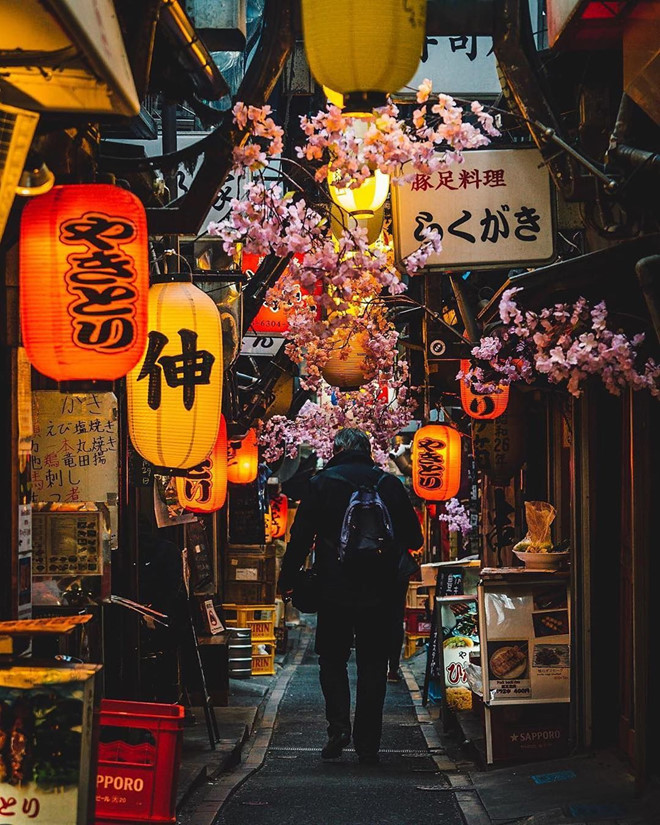
The most photographed yokocho in Tokyo — see our Omoide Yokocho venue guide for the full visit playbook. Roughly 60 shops in two parallel covered alleys immediately west of Shinjuku Station’s west exit. Yakitori-dominant. The smoke is dense by 7 pm. Best for a first visit because the visual texture is canonical — red lanterns, narrow aisle, exposed grills — and because the central walk-through path lets you scout shops without committing. Avoid the most aggressive touts at the front; the better shops are deeper in. Originally nicknamed Piss Alley in the 1940s for the absence of bathroom facilities, rebuilt after the 1999 fire.
2. Golden Gai (Shinjuku)
Access: Shinjuku Stn, East Exit, ~5 min walk (Seibu-Shinjuku Stn ~2 min). Hours: most bars open ~19:00-21:00 and run past midnight; many closed Sun or Mon. Best from 21:00. Mostly cash-only.
Six narrow alleys five minutes east of Omoide Yokocho, packed with about 200 micro-bars — most with five to ten seats, each with its own theme (jazz, punk, photography, literature). The food is minimal here; this is a drinking district, not a dining one. Some bars have explicit cover charges of ¥1,000–¥1,500 for first-time visitors, and some are members-only. Look for the ones with English signage in the window and an open door — those are happy to take walk-in foreigners. Nagi, the 24-hour niboshi ramen counter on the second floor at the southern edge, is the canonical “drink in Golden Gai, then ramen” anchor.
3. Ebisu Yokocho (Ebisu)
Access: Ebisu Stn, West Exit, ~2 min walk. Hours: most stalls open ~17:00 and run late (some to ~04:00). Best from 18:00.
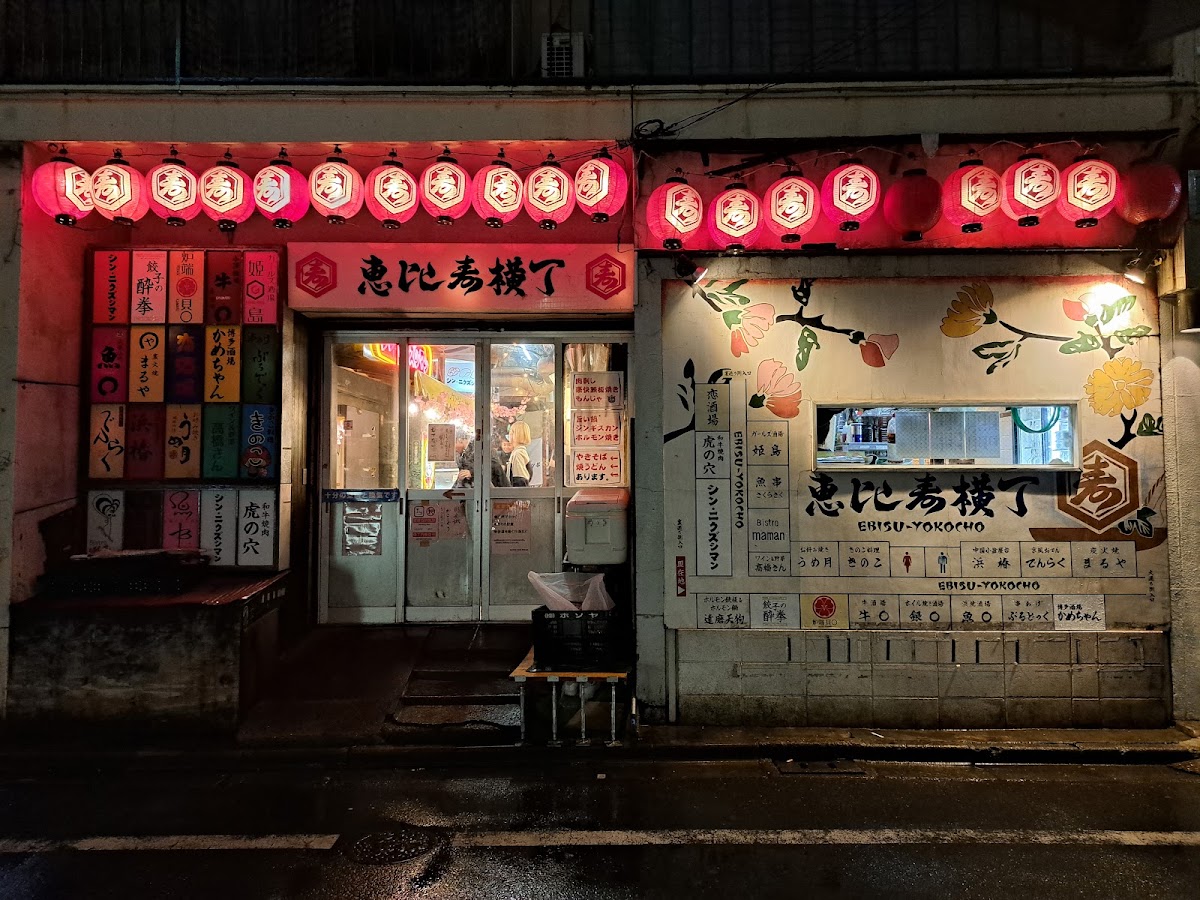
A 100-meter covered alley two minutes from Ebisu Station’s west exit, opened in 2008 in the shell of a former supermarket. 19 shops, 2,500 menu items between them — see our Ebisu Yokocho venue guide for the shop-by-shop breakdown. More polished and tourist-ready than Shinjuku — the lighting is better, the alley is wider, English menus are common — but the structure is the same: tiny counters, draft beer, food cooked in front of you. Best for a first yokocho if you are nervous about the older alleys. The downside is that the touts are aggressive and the prices are above the Shinjuku average.
4. Ameya-Yokocho / Ameyoko (Ueno)
Access: between Ueno and Okachimachi Stns, along/under the Yamanote Line. Hours: market shops ~10:00-19:00/20:00; the under-arch bars run into the evening. Best from 17:00 for the drinking side.
Different in character from the others — a 500-meter open-air market street under the Yamanote Line tracks between Ueno and Okachimachi stations, descended directly from the post-war black market. By day it is a discount shopping street; by 5 pm onwards, it becomes a yokocho-style drinking district with standing bars under the railway arches. The food leans heavily seafood (the shops here have direct relationships with Toyosu Market traders, the kind that supply restaurants like Sushi Dai). The vibe is louder, less polished, and more local than Shinjuku.
5. Yurakucho Sanchoku Inshokugai (Yurakucho)
Access: Yurakucho Stn, ~2 min walk (under the tracks; southern entrance is by the Sushizanmai). Hours: several shops run very late (some reportedly 24h); yakitori counters pack out from early evening. Best from 18:00.
Under the JR Yamanote Line tracks between Yurakucho and Shimbashi stations — a series of yakitori and izakaya shops built into the brick arches of the railway viaduct, dating to the 1910s. The salaryman density after 6 pm is the highest in Tokyo. This is the yokocho you go to if you want the real after-work drinking culture rather than the photogenic alley aesthetic. Most shops have outdoor seating directly under the tracks, and a Yamanote Line train passes overhead every two minutes. Prices are mid-range; the food is consistently good.
6. Shimbashi Tora-no-Mon Yokocho (Shimbashi)
Access: Shimbashi Stn, ~3 min walk (under and around the elevated tracks). Hours: yakitori and oden counters busy ~17:00 onward on weekdays; quieter weekends. Best from 18:00.
Shimbashi is the original Tokyo salaryman drinking district, and the yokocho immediately north of the station — known locally as Shimbashi Yakitori Yokocho — is the densest concentration of after-work yakitori counters in the city. Less photographed than Omoide Yokocho, more functional. The food is not tourist-targeted; the prices are honest; the chefs are old. If you want to drink where Tokyo office workers actually drink rather than where Instagram thinks they do, this is the alley.
7. Nakano Sun Mall Backstreets (Nakano)
Access: Nakano Stn, North Exit (Sun Mall arcade ~225 m, alleys branch off it); ~5 min by Chuo Line from Shinjuku. Hours: izakaya and standing bars ~17:00-23:00 or later. Best from 18:00.
Less famous, more livable. The narrow streets behind Nakano Sun Mall on the north side of Nakano Station are not a single yokocho but a constellation of small alleys with izakaya, ramen counters, and standing bars that locals frequent at all hours. The crowd is younger and more residential than central Tokyo’s salaryman alleys. Worth the seven-minute Chuo Line ride from Shinjuku for an evening that feels like neighborhood Tokyo rather than tourist Tokyo. Dandadan Sake Bar is one of the best counter izakaya in this district.
8. Nonbei Yokocho (Shibuya)
Access: Shibuya Stn, Hachiko side, ~3 min walk (up Miyamasuzaka, on the right). Hours: most shops open ~18:00 and run late; closed days vary by shop. Best from 19:00.
Known locally as Nonbei Yokocho (のんべい横丁, “Drunkard’s Alley”), this is the survivor alley that the rebuilt Shibuya towers grew up around. Two short lanes of roughly 40 micro-shops — yakitori counters, oden bars, and tiny shot bars, most seating only a handful of people — sit a few minutes from the Hachiko crossing on the railway side. It is smaller and more compressed than the Shinjuku alleys, and because the shops are so tiny, the etiquette of one drink, a couple of skewers, then moving on matters more here than anywhere else on this list. Some bars are regulars-only; the ones with a menu in the window and an open door take walk-ins. For oversized skewers in the same district, Toritake Honten is a nearby Shibuya yakitori anchor.
9. Harmonica Yokocho (Kichijoji)
Access: Kichijoji Stn, North Exit, directly in front (~1 min walk). Hours: daytime market ~11:00-17:00; bars from ~17:00-18:00 into the night. Best from 18:00 (or midday for the market).
Harmonica Yokocho (ハモニカ横丁, named for the way the cramped stalls line up like the reeds of a harmonica) is the one alley on this list with two distinct lives in a day. By day the lanes immediately outside Kichijoji Station’s north exit work as a small market — a Showa-era fishmonger, sweets makers, clothing stalls. From late afternoon the same lanes turn over into standing bars, yakitori counters, and izakaya. That day-to-night switch makes it the most flexible entry on this list: you can scout it at lunch and come back when it opens up. Kichijoji sits at the western end of the Chuo Line, so pair it with Inokashira Park rather than central Tokyo if you make the trip.
Yokocho vs. Modern Izakaya: When to Choose Which
A serious modern izakaya in Roppongi or Daikanyama will give you a higher quality individual meal than most yokocho shops — better-sourced fish, more refined cooking, more comfortable seating. What it cannot give you is the spatial experience: the alley itself, the smoke from a dozen grills at once, the sense that thirty other shops are within thirty meters of you. The yokocho is not really competing with the polished izakaya. It is a different category of evening.
The right pattern, if you have one Tokyo evening to spend on this: dinner at a yokocho, then a more focused drink at one good cocktail bar afterwards. The yokocho gives you the urban texture; the cocktail bar (a place like Bar High Five in Ginza) gives you the precision. The two together are the full vertical of Tokyo drinking culture in three hours.
A Final Note on the Photography
Yokocho are exceptionally photogenic, and you will see hundreds of phones out at any major one. Two small etiquette points: do not photograph the inside of any individual shop without asking the staff first (some prefer that the inside not be on Instagram), and do not block the alley to set up shots — yokocho aisles are working pedestrian routes, not photography sets. The best yokocho photos are taken from the edges of the alley, looking down its length, when the shops are open but you are not standing in front of one.
The deeper experience, though, is not the photograph — it is sitting at one of those eight-seat counters with a draft beer and a plate of skewers, listening to a city that has been doing this in roughly the same form for seventy-five years.
Tokyo Yokocho FAQ
What is a yokocho?
A yokocho (横丁, literally “side street”) is a narrow, pedestrian-only alley packed with tiny izakaya and bars, most seating eight to twenty people, with kitchens visible from the alley. Most of Tokyo’s surviving yokocho grew out of post-war black-market drinking quarters around major train stations between roughly 1945 and 1950, and they remain working evening drinking districts first, tourist sights second.
Are yokocho foreigner-friendly?
Yes, with one rule of thumb: shops with English signage in the window and an open door are happy to take walk-in visitors, and covered alleys like Ebisu Yokocho and Omoide Yokocho are used to non-Japanese guests. The exception is parts of Golden Gai, where some bars charge a cover of ¥1,000–¥1,500 for first-timers and a few are members-only — those are easy to spot and easy to skip in favour of the open-door bars next door.
How much does a yokocho night cost?
Budget roughly ¥2,000–¥3,000 per shop for a first round (a drink plus a couple of small plates), plus a ¥300–¥800 otoshi seating charge at most izakaya. A typical hop across three shops therefore lands around ¥6,000–¥9,000 per person. Golden Gai is the outlier: add the cover charge where it applies.
Which yokocho is best for first-timers?
Ebisu Yokocho is the easiest first visit — it is covered, well-lit, the alley is wider, and English menus are common, so the format is approachable. If you want the canonical smoky-alley look instead, Omoide Yokocho in Shinjuku is the most photogenic and has a central walk-through that lets you scout shops before committing. Pick Ebisu for comfort, Omoide for atmosphere.
What is the otoshi charge?
The otoshi (お通し) is a small unrequested dish brought to your seat within minutes, charged at roughly ¥300–¥800 as a seating or cover fee. It is standard at Japanese izakaya and is not a scam — treat it as the price of the seat. We explain the full logic of it in our otoshi explainer.