
The Unspoken Rules of Eating Late in Tokyo
Eating late in Tokyo runs on rules locals follow without thinking and visitors learn on a platform at 1:40am. The last-train clock, the grammar of the shime meal, the tiers of “open late,” and the timing trick that means you queue less.
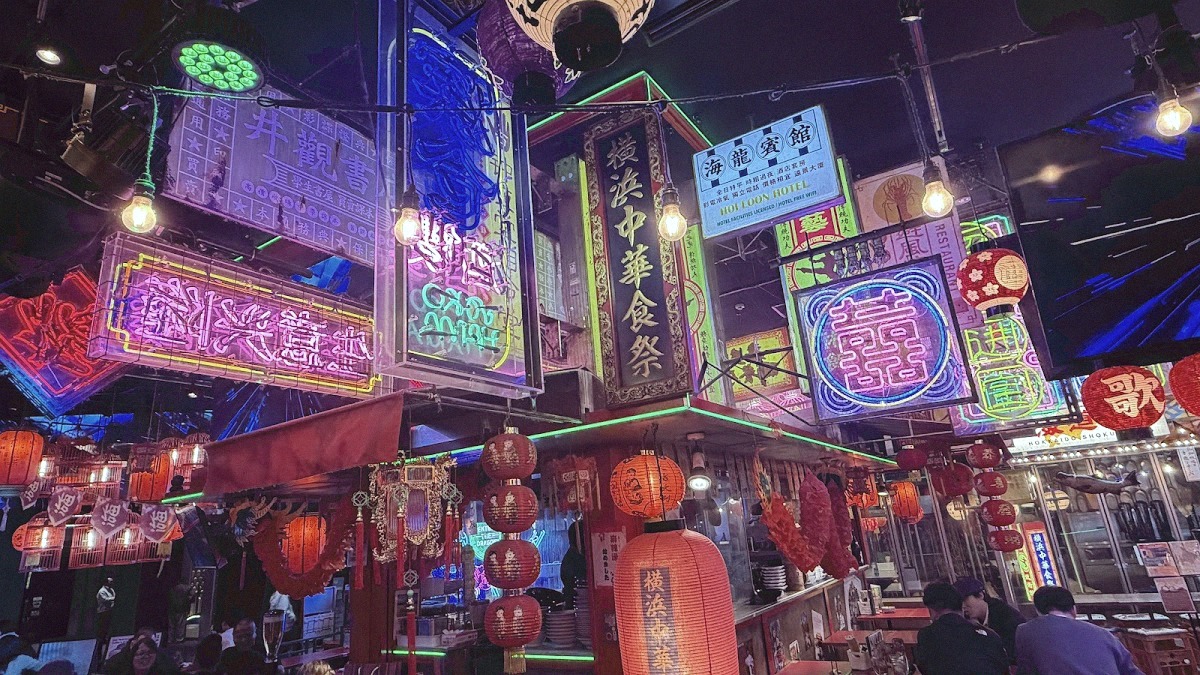
Most “Tokyo at night” articles are lists of bars. This is not that. Eating late in Tokyo runs on a set of rules that locals follow without thinking and visitors discover the hard way — usually at 1:40am, on a platform, watching the last train leave. The rules are not about where the cool places are. They are about how the night is actually structured, what the meals mean, and what is open when everything you planned for has closed.
Seven rules, each with the logic underneath it, and one at the end that only people who live here tend to know.
What to Eat After the Last Train in Tokyo (The Short Version)
If you have already missed the last train and want the answer in one breath: the reliable late floor is a 24-hour gyudon (牛丼, gyudon, beef-over-rice) counter — Sukiya, Yoshinoya or Matsuya, where a regular bowl runs about ¥450–¥498 (accessed June 2026) and there is one within roughly three minutes of the east exits at Shinjuku, Shibuya and Ueno. Above that floor sit the genuine destinations that stay open: AFURI in Ebisu pours a yuzu-salt bowl until 5:00am, Sushi Zanmai’s Tsukiji flagship runs sushi for 24 hours, and Nagi in Golden Gai serves niboshi ramen around the clock. And when the food runs out, the night does not — the manga café, karaoke free-time, a capsule, or a 24-hour super-sento carry you to the first train at roughly 4:26am. The rest of this piece is why all of that is structured the way it is.
Rule 1: The Last Train Is the Real Clock
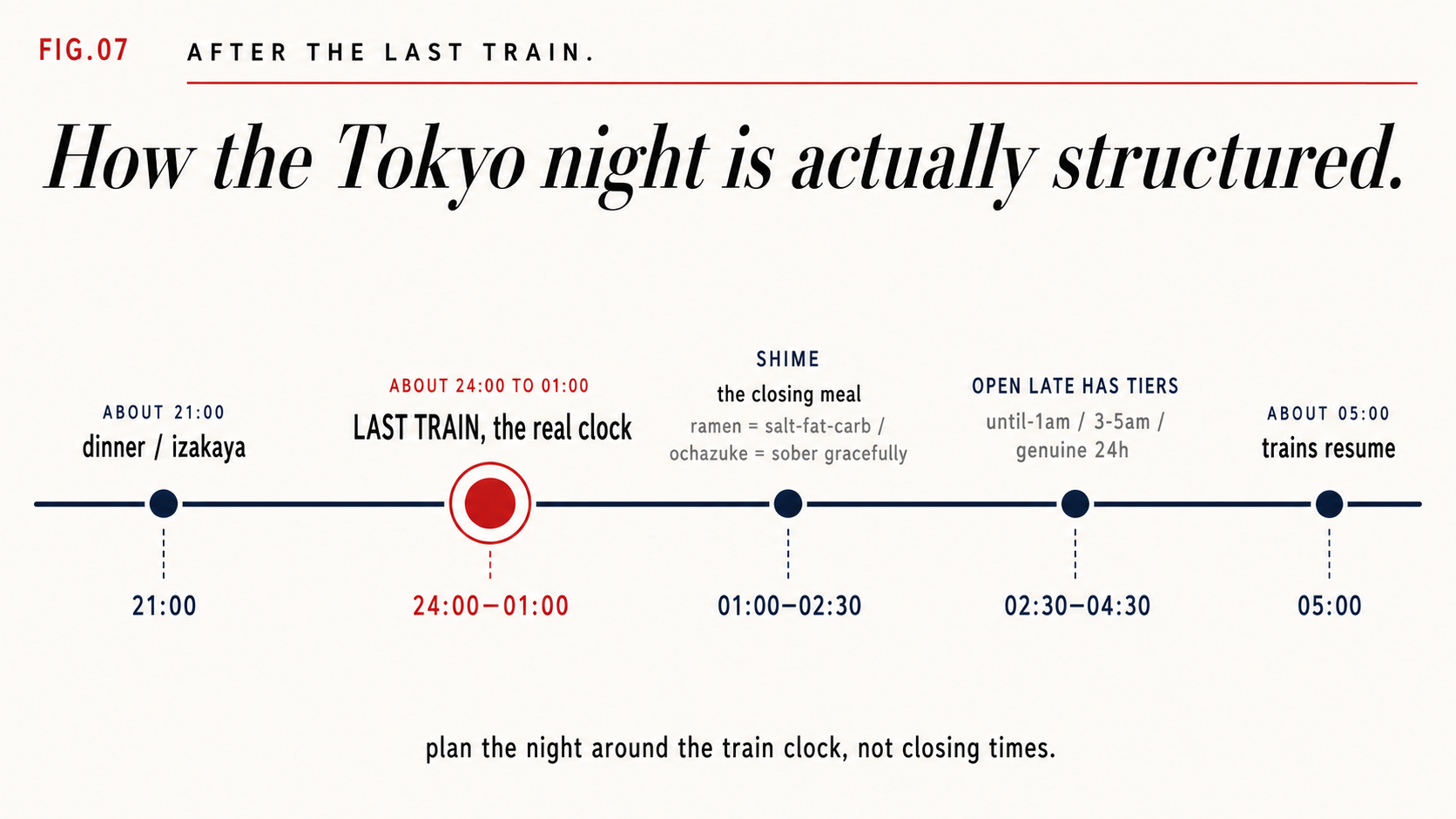
Tokyo’s night has a hard edge most visitors underestimate. Trains stop around midnight to 1am and do not resume until roughly 5am. That gap is not a quiet period — it is the engine of the entire late-night economy. Once you have missed the last train, the rational move is often to simply stay out until 5am, because a taxi across central Tokyo runs ¥2,000 to ¥5,000 and a capsule hotel is not always findable at 2am. Almost everything that follows — the all-night izakaya, the 3am ramen queue, the gyudon counter at 4am — exists because a few million people a week are structurally committed to being awake until the trains start again. Plan the night around that clock, not around closing times.
Rule 2: The Last Meal Has a Grammar
The post-drinking meal has a name, shime (締め, “the close”), and it is a ritual with meaning, not just hunger. What you order is a small statement. Ramen is the iconic choice because the body, after alcohol, wants salt, fat, and carbohydrate, and a rich bowl delivers all three. Ochazuke (お茶漬け, rice with tea or dashi poured over it) is the opposite signal: light, quieting, a decision to sober up gracefully and wake clear rather than battered. Choosing the gentle bowl over the heavy one is a way of saying the night is genuinely ending. Locals read this. Ordering a shime is not optional punctuation; it is how a Japanese night out is closed.
Rule 3: “Open Late” Has Tiers
“Open late” is not one category. There is open-until-1am (most izakaya), open-until-3-to-5am (the late tier — serious ramen, yakitori, the Kabukicho ecosystem), and genuinely 24-hour (a small, specific set). Confusing the tiers is how you end up hungry at 3:30am outside a place that closed at one. The all-nighter is legally possible because venues registered under the late-night operation rules face no restriction on serving through the night — but registration is the exception, not the norm, so the 3am map is much shorter than the 11pm map. Know which tier a place is in before you rely on it.

The reason the late map is short is written into Japanese law, not into the restaurants’ moods. Under the Fueiho (風営法, the Act on Control and Improvement of Amusement Businesses) and its shinya shurui teikyo inshokuten (深夜酒類提供飲食店, “late-night alcohol-serving restaurant”) rules, any venue that wants to serve alcohol after midnight must file a separate notification with the prefectural public safety commission — in Tokyo, the Metropolitan Police Department (警視庁, Keishicho) — at least 10 days before it opens, and operating without that filing carries a fine of up to ¥500,000 (Keishicho, accessed June 2026). Most small izakaya never file it, which is exactly why the 3am map is so much shorter than the 11pm one. A place that serves a recognised meal — a ramen shop, a gyudon counter — sits outside that alcohol rule, which is part of why food, not drink, is what actually stays open through the middle of the night.
| Tier | Closes | What it is |
|---|---|---|
| Open until ~1am | last train | Most izakaya — they empty as the trains stop |
| Open until 3–5am | pre-dawn | The late tier: serious ramen, yakitori, the Kabukicho food halls |
| Genuinely 24-hour | never | A small set: gyudon chains, a few ramen counters, 24h sushi |
So before you commit to a 3am plan, confirm the place is in the 24-hour or 5am tier — not the open-until-1am one that quietly emptied with the last train.
Rule 4: The Chain Is the Safety Net, Not the Destination
At 4am, the thing that is reliably open is a 24-hour gyudon counter — Sukiya above all, with Yoshinoya and Matsuya alongside, clustered within minutes of every major station. A beef bowl at 4am is not a culinary event and is not meant to be one. It is infrastructure: cheap, fast, ticket-machine, no language, always there. The local logic is to treat these as the floor, not the plan — the thing that guarantees you will not go hungry, freeing you to gamble on a better late option first. The conbini is the same idea one notch down: a 4am 7-Eleven onigiri-and-hot-food run is a legitimate Tokyo meal, not a failure.
Concretely: Sukiya, Yoshinoya and Matsuya each cluster within about three minutes of the east exits at Shinjuku, Shibuya and Ueno, and a regular beef bowl runs roughly ¥450 at Sukiya, ¥460 at Matsuya and ¥498 at Yoshinoya (chain menus, accessed June 2026) — order from the ticket machine, point if you have to, eat in ten minutes. A conbini run is the rung below: a 7-Eleven onigiri sits around ¥150–¥250 and the hot-case fried chicken near ¥250, which is a real, cheap, no-queue meal at 4am rather than a defeat.
Rule 4.5: The Place You Wait Is the Same Economy as the Place You Eat
And when the food runs out, the wait does not. The eating economy and the waiting economy are the same economy — both exist because a few million people a week are stuck out until the first train. The local floor for the 1am-to-5am gap has four standard options. The manga kissa (漫画喫茶, manga café) sells an overnight “night pack” booth for roughly ¥1,500–¥3,000, with a reclining seat, free drinks and a shower. Karaoke free time — many chains run an 11pm-to-5am all-night block — runs about ¥1,500–¥3,000 flat per person with unlimited soft drinks, which is often the cheapest warm room in the city after midnight. A capsule hotel is ¥3,000–¥5,500 a night if you can still find a bed at 2am. And a 24-hour super-sento like Thermae-Yu (テルマー湯) in Shinjuku’s Kabukicho lets you bathe and wait it out — standard entry is around ¥2,700 on weekdays, with an added late-night surcharge of roughly ¥2,000 if you stay past 1am (Thermae-Yu, accessed June 2026). All four prices are per person, all four are walk-in, and all four exist for exactly the same reason the 4am ramen does.
| Option | Cost (per person) | Best for |
|---|---|---|
| Manga café night pack | ¥1,500–¥3,000 | Sleeping flat, a shower, free drinks |
| Karaoke free-time (11pm–5am) | ¥1,500–¥3,000 | A group, warmth, the cheapest room |
| Capsule hotel | ¥3,000–¥5,500 | An actual bed, if one is left |
| 24h super-sento (e.g. Thermae-Yu) | ~¥2,700 + ~¥2,000 late surcharge | Bathing the night off before the first train |
Rule 5: Kabukicho Is a 2am Ecosystem, Not a Detour
Shinjuku’s Kabukicho and the surrounding yokocho do not wind down after midnight — they change function. Once the salaryman drinking parties end, the alleys become a dense late-night food system: ramen, yakitori, the larger food halls that run to 5am. This is not the same as “bars stay open.” It means the area is engineered for the missed-last-train crowd, with eating, not just drinking, available straight through. If the night has gone long, the move is to relocate into that ecosystem deliberately rather than wander looking for a single open door.
The concrete anchors here are Shinjuku Kabuki Hall, a festival-themed indoor food yokocho that runs to 5am and gives you a dozen counters under one roof, and — two minutes away in Golden Gai — Nagi, whose niboshi (煮干し, dried-sardine) ramen is one of the few genuinely 24-hour bowls in the area. For the wider map of which alleys do what, our guide to Tokyo’s seven yokocho covers the places; this piece covers the timing.
Rule 6: Late-Night Sushi Is Real, and Specific
Visitors assume sushi is a daytime, market-adjacent thing. A small set of counters break that assumption entirely and run 24 hours, which makes them one of the few places in the city where you can eat genuinely good food, not just fuel, at 3am. This is the rare late-night category that is a destination rather than a safety net — and it is worth knowing exactly which rooms qualify, because most sushi shuts with the lunch market.
The clearest example is Sushi Zanmai’s Tsukiji flagship, which holds a counter open for a full 24 hours beside the old market — real nigiri at 3am, not a vending-machine compromise. If you want the same all-night logic without raw fish, Tsurutontan in Roppongi serves hand-made udon from 11am until 8am the next morning, which is why its 5am crowd is half club-goers and half night-shift workers. Both are destinations you choose, not floors you fall back on.
Rule 7: The Hidden One — Eat Before, Not After, the Crowd
The rule locals rarely say out loud: the best late meal is timed against the drinking crowd, not with it. The shime rush hits famous ramen and the Kabukicho alleys roughly between the last train and 2am, as everyone arrives at once. Eat your serious late meal slightly before that wave — around last-train time — and use the 24-hour floor for the genuine middle of the night, after 3am, when the crowd has thinned and the queue you would have stood in at 1:30 has evaporated. The people who do this eat better and queue less, every single time.
Where this is already easy on The Ondo Tokyo: AFURI in Ebisu runs until 5am — a clean yuzu-salt bowl is one of the best possible shime, and one of the few that is genuinely good rather than merely open. Sushi Zanmai’s Tsukiji flagship is the 24-hour sushi answer to Rule 6. Shinjuku Kabuki Hall runs to 5am and is the Kabukicho ecosystem of Rule 5 in a single room; Gonpachi Nishi-Azabu holds until 3:30am for a sit-down version. For the cultural backbone under all of this, our piece on what shun means sits alongside this as the other half of how Tokyo thinks about when, not just what, to eat.
FAQ
What is open to eat after the last train in Tokyo?
The always-open floor is the 24-hour gyudon chains — Sukiya, Yoshinoya and Matsuya — at roughly ¥450–¥498 a bowl, within about three minutes of Shinjuku, Shibuya and Ueno’s east exits (accessed June 2026). Above that, AFURI Ebisu runs ramen until 5:00am, Sushi Zanmai Tsukiji is 24-hour sushi, and Nagi in Golden Gai serves ramen around the clock.
I missed the last train — where do I wait until the first one?
A manga café night pack (¥1,500–¥3,000), karaoke free-time on an 11pm–5am block (¥1,500–¥3,000), a capsule hotel (¥3,000–¥5,500 if a bed is left), or a 24-hour super-sento like Thermae-Yu in Shinjuku (around ¥2,700 plus a roughly ¥2,000 late-night surcharge). The first Yamanote train is around 4:26am.
What time does the last train in Tokyo run?
On the JR Yamanote line the last service runs until roughly 1:04–1:20am depending on station and direction, and the first train starts around 4:26am — so the dead window you are planning around is only about three hours (JR East timetables, accessed June 2026).
Why are so few places actually open at 3am?
Because serving alcohol after midnight requires a separate notification to the police under the Fueiho (風営法) late-night-alcohol rules, and most small izakaya never file it. Venues that serve a proper meal — ramen, gyudon, sushi — sit outside that rule, which is why food, not drink, is what stays open.
Sources & Further Reading
- Tokyo Metropolitan Police Department (警視庁) — notification of late-night alcohol-serving restaurant operations under the Fueiho (the 10-day notification; the legal basis for the late tier; accessed June 2026)
- JR East — official line timetables (last ≈ 1:04–1:20am / first ≈ 4:26am on the Yamanote line) (accessed June 2026)
- GOOD LUCK TRIP — AFURI Ebisu hours (11:00–5:00 daily, cashless) (accessed June 2026)
- Snack Yokocho — The “Shime” Culture: Japan’s tradition of closing a night out
- Tokyotheque — The Nocturnal Economy (24-hour gyudon as infrastructure; the all-night economy)
Tokyo after dark has its own rules and its own openings. We send one Tokyo eating dispatch a week. Join the ONDO Tokyo newsletter.