
Conveyor vs Counter Sushi: What You Actually Give Up
Cheap-and-touristy vs real-and-scary is the wrong frame. The belt was a 1958 democratising machine, it's quietly going digital, and the conveyor-vs-counter choice is an honest two-way tradeoff — not a better sushi and a worse one.
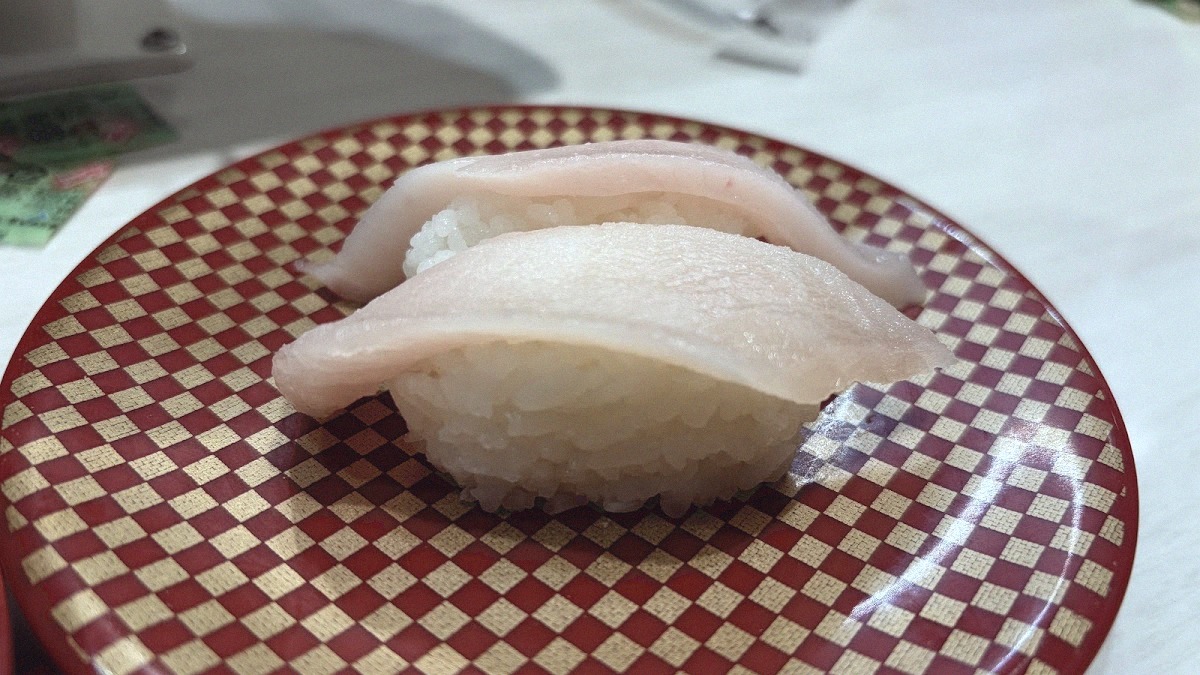
Visitors arrive in Tokyo with sushi sorted into two boxes: the conveyor place, which is cheap and for tourists, and the counter place, which is real and expensive and slightly frightening. The boxes are wrong. They describe a price gap accurately and a quality gap badly, and they completely miss that the two are not opposites at all — they are two ends of the same hundred-year project to get good fish and vinegared rice to as many people as possible. Knowing what actually separates them is the difference between ordering well and ordering by anxiety.
This piece traces where the conveyor came from, what it is quietly turning into, what you genuinely give up by sitting at it instead of a counter — and, the part nobody states plainly, what you give up by doing the reverse.
What the Conveyor Actually Was
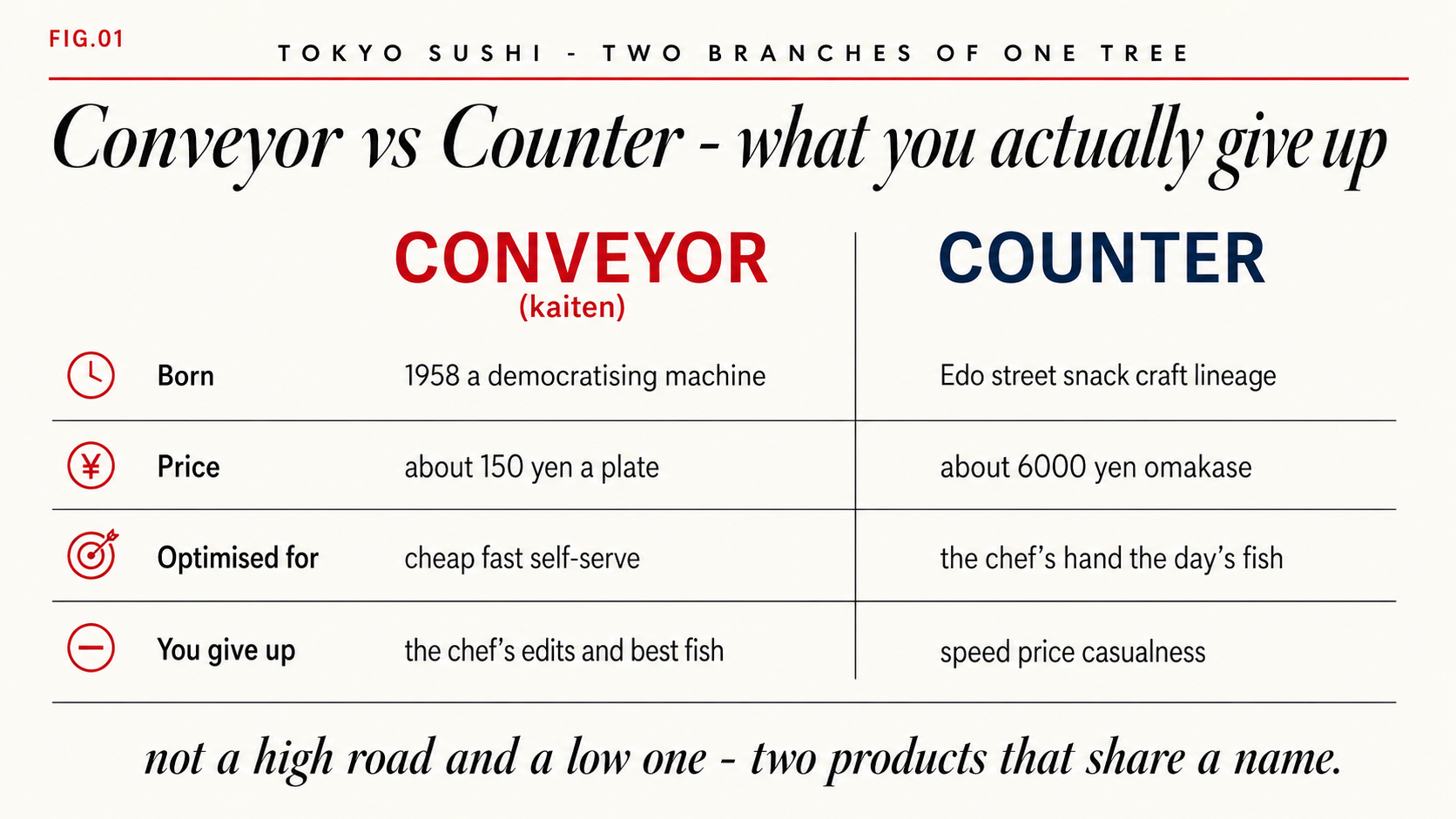
The belt is not a gimmick bolted onto sushi. It is sushi solving its own economics. In 1958 an Osaka restaurateur, Yoshiaki Shiraishi, could not staff enough chefs to serve sushi at the volume and price ordinary workers could afford. Watching bottles move along a brewery conveyor gave him the mechanism: put the sushi on the belt, let the room serve itself, and the labour cost per plate collapses. Kaitenzushi (回転寿司, rotating sushi) was, from its first day, a democratising machine — the same impulse that took sushi from an Edo street snack to something a family could afford on a weeknight. Counter sushi did not lose that argument; it simply kept a parallel lineage alive, the one where the craft, not the price, is the point. Two branches of one tree, not a high road and a low one.
This is why the snobbery misfires. A ¥150 plate of farmed salmon off a belt and a ¥6,000 omakase are not the same food at different honesty levels; they are two deliberately different products that happen to share a name, built for two different jobs. The belt was engineered to be cheap and fast on purpose. Judging it for succeeding at that is like faulting a bicycle for not being a car.
What the Belt Is Becoming
Here is the part that dates most travel writing: the conveyor is disappearing from conveyor sushi. At the big modern chains the open belt of up-for-grabs plates is shrinking every year, replaced by a touch-panel at the table and a dedicated express lane that delivers only what you ordered, freshly made, straight to your seat. The reasons are freshness, hygiene, and waste, and customers have largely chosen it. One chain has gone as far as replacing the moving plates with an animated screen — a “virtual” procession standing in for the thing the format was named after. So the mental image of grabbing whatever drifts past is now, increasingly, nostalgia. Modern kaitenzushi is closer to a fast, screen-ordered kitchen than to the carousel in the photos. The continuity is intact — same goal, more efficient machine — but the romance of the belt is being quietly retired by the very industry that invented it.
What You Actually Give Up
Now the honest ledger, both directions. Choosing the conveyor (or its touch-panel descendant) over a counter, you give up sequencing and timing: an itamae (板前, sushi chef) at a counter builds an order — lighter to richer, warming the rice to body temperature, shaping each piece seconds before you eat it, reading your pace. Off a belt the rice has often sat, the order is whatever you grabbed, and nobody is composing the meal. You also give up the room itself: the counter is a conversation and a lesson; the chain is a screen and a chute. What you give up going the other way is just as real and far less discussed — you give up the price, the speed, the total absence of pressure, the not-needing-any-Japanese, and the freedom to eat nine plates of exactly what you like with a child beside you. A counter is a performance you attend on its terms. A belt is a meal you control entirely on yours.
Framed that way, neither is a downgrade. The conveyor trades craft for access; the counter trades access for craft. The mistake is not picking one — it is picking one while believing you chose the better sushi rather than the better fit for that hour of your trip.
Which One, When
Decide by what the next ninety minutes are for, not by prestige. For a fast, cheap, low-stakes meal with kids, jet lag, or a tight gap, the modern conveyor is the right tool: Uobei in Shibuya is the touch-panel express-lane format in its purest form, Heiroku Sushi is the old-school belt still running on the Omotesando fashion mile, and Maguro Bito by Senso-ji shows how good a tuna-focused conveyor counter can actually be. When the meal is the event — and you want the sequencing, the hand, the room — go to a counter: Sushi Dai in Toyosu is the market-counter omakase people queue hours for, Sushi Zanmai at old Tsukiji is the accessible, 24-hour, no-fear counter, and Midori Sushi is the famous big-cut counter that rewards the wait. If you want the etiquette and the logic of the counter before you sit at one, our pieces on how to behave at a sushi counter and what omakase actually means are the companion reads; for why this food was built to scale in the first place, see the birth of Edomae sushi.
The one rule that survives all of it: choose the format for the job, order with intent at either, and stop believing the belt is a lesser version of the counter. It is a different answer to the same question Tokyo has been asking about sushi since 1958 — how do you give this to everyone?
Sources & Further Reading
- Japan-guide.com — Kaitenzushi (conveyor belt sushi restaurants) (plate-colour pricing; how to order fresh off the panel)
- tsunagu Japan — inside Japan’s oldest conveyor belt sushi restaurant (Yoshiaki Shiraishi; the 1958 brewery-conveyor origin)
- Japan Today — will virtual plate procession become the new normal? (touch-panel express lane displacing the open belt)
- SoraNews24 — Sushiro’s Digital Sushi Vision (the animated ‘virtual conveyor’ replacing moving plates)
- PLAZA HOMES — Kaitenzushi: what to know about conveyor belt sushi (modern chain systems; ordering mechanics)