
Why Real Soba Costs ¥1,800 and Cheap Soba Costs ¥600
The soba you eat at a station-counter chain and the soba you eat at a serious shop are not the same dish — they share a name and almost nothing else. The price difference is not arbitrary. It tracks specific decisions about wheat, technique, and time.
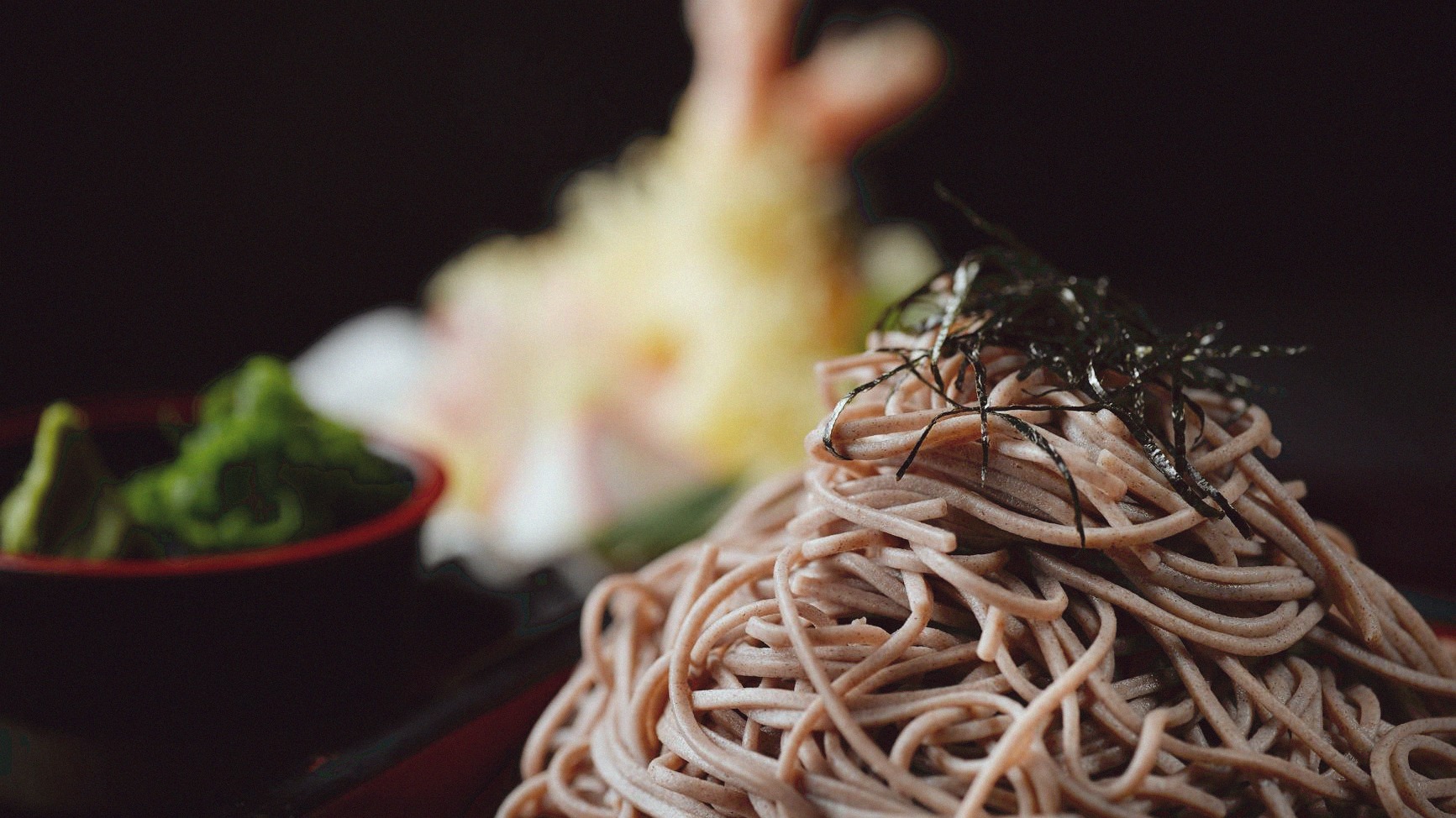
Walk past Tokyo Station’s underground concourse and you can buy a hot bowl of soba for ¥600 — a quick lunch for a salaryman with twenty minutes. Walk five minutes south to Ginza and you can sit at a wooden counter and eat soba for ¥1,800 a portion, or ¥3,500 if you want the cold tasting course. Both are called soba (蕎麦). One bears almost no relationship to the other.
This piece is about the gap. It explains what specifically makes serious soba expensive — and why the cheap version is not just a worse copy, but a different food.
The Soba Price Ladder: What Each Step Adds
Five decisions separate the ¥600 bowl from the ¥1,800 one. Each one adds cost — and flavor — in a specific, traceable way. Read the table top to bottom as a ladder: every rung is one choice a shop makes before you ever sit down.
| Decision | Cheap soba (~¥600) | Serious soba (~¥1,800) | What it adds |
|---|---|---|---|
| Buckwheat ratio | 30–40% buckwheat, rest wheat | 80% (ni-hachi) to 100% (juwari) | Buckwheat aroma and flavor |
| Buckwheat origin | Imported, unlabeled | Domestic, often farm-named | Concentrated aroma, complexity |
| Milling | High-speed steel rollers | Stone-milled, often on-site daily | Aroma retained, heat damage avoided |
| Cutting | Machine-cut, uniform | Hand-cut (te-uchi), variable | More interesting chew |
| Time | Days old, frozen/refrigerated | Cut within ~4 hours, sold same day | Texture and aroma before they fade |
The rest of this piece walks each rung in order.
What Soba Actually Is
Soba is buckwheat. The plant — kuro mugi (黒麦, “black wheat”) — is not actually a wheat at all; it’s a flowering plant in the rhubarb family that grows in cool, marginal soil where rice and wheat won’t. Japan has been growing soba in mountainous regions since at least the 8th century, and the noodle form (cut from rolled dough) emerged in the 16th century when stone-grinding techniques improved enough to make the flour fine enough.
The buckwheat plant produces small triangular seeds. Each seed has three layers: an outer hull (inedible), a thin inner skin called the bran layer (where most of the protein and aroma live), and a starchy core. How a soba flour is milled — what fraction of which layer ends up in the bag — determines almost everything about the noodle that follows.
The First Decision: Buckwheat Ratio
Pure buckwheat dough is fragile. It has no gluten — buckwheat is gluten-free — so the only thing holding the noodle together is the binding action of starch and a small amount of water. The result is delicate and breaks easily, and forming long noodles from 100% buckwheat requires real technical skill.
Most commercial soba is mixed with wheat flour to add gluten and stabilize the dough. The ratio is the first signal of quality:
- Ni-hachi (二八, “two-eight”): 80% buckwheat, 20% wheat. The standard at most serious shops. Buckwheat-forward but technically manageable.
- Juwari (十割, “ten parts”): 100% buckwheat. The premium category. Requires expert hand-work; portions cost ¥1,500–¥2,500.
- Ku-ichi (九一, “nine-one”) or even higher wheat ratios: cheap soba. The dough holds easily, but the buckwheat flavor is almost gone.
- Sanrokushi and similar names with even higher wheat content: the supermarket and chain-restaurant default. The noodle is essentially wheat with buckwheat coloring.
The ¥600 station soba is typically 30–40% buckwheat, often less. The ¥1,800 shop soba is typically 80% (ni-hachi) or 100% (juwari). The flavor difference is not subtle.
The Second Decision: Where the Buckwheat Comes From
Japan grows on the order of 30,000–40,000 metric tons of buckwheat a year, mostly in Hokkaido, Nagano, and Fukui prefectures (MAFF crop statistics put the 2023 domestic harvest near 35,600 tons). It also imports a comparable or larger volume — recent trade data shows roughly 35,000–50,000 tons a year, mainly from China, Russia, and the United States — and by most estimates imports cover the clear majority of buckwheat consumed in Japan. Per USDA and MAFF-range figures, imported buckwheat lands at well under half the price of domestic, which is the whole reason the cheap bowl can exist.
Domestic buckwheat tends to be more aromatic — the cooler growing climate and shorter season concentrate flavor. Within domestic, mountain-grown varieties from places like Togakushi (Nagano) or Izushi (Hyogo) are the most prized.
A serious shop will typically post the origin of the buckwheat, sometimes the specific farm. The ¥600 chains use imported flour without comment. This is not necessarily inferior in calorie terms, but in aroma and complexity it is a different ingredient.
The Third Decision: Milling
How the buckwheat is ground matters as much as where it comes from. The traditional method is stone milling — slow rotation between two flat stones, which preserves aroma and produces a fine but uneven flour. Modern industrial milling uses high-speed steel rollers that produce uniform but heat-damaged flour with reduced aroma.
The most prestigious shops mill their own flour daily, on-site, from whole buckwheat seeds. The mill is often visible from the dining room. The reason is freshness: buckwheat flour begins losing aroma within hours of milling, and significantly within days. Pre-bagged commercial buckwheat flour has typically been milled weeks or months before it reaches the noodle dough.
The Fourth Decision: Hand-Cut vs. Machine-Cut
Soba dough, once mixed and rolled, is cut into long thin strips. The technique is one of the visible markers at a serious counter — many shops have a window onto the noodle-cutting station so customers can watch.
Hand-cut soba (te-uchi, 手打ち) uses a long flat knife pressed against a wooden guide. A trained noodle-maker cuts roughly two noodles per second, producing strips that are uniform but not identical — slightly variable in thickness, which results in a chewing texture that’s more interesting than machine-cut soba.
Machine-cut soba is uniform to a millimeter. The noodle is consistent but flat in mouthfeel.
The Fifth Decision: Time
Buckwheat dough is fragile and must be cooked and served quickly. A serious soba counter typically holds noodles in the refrigerator for at most 4 hours after cutting; after that, they break too easily and the flavor degrades.
This is why the best soba shops do limited covers: they sell out by 15:00 and close. The shop that’s open all day from 11:00 to 22:00 is using pre-made noodles produced earlier; the shop that closes when it sells out is making fresh batches throughout service.
Serious shops sum this whole sequence up in one word: santate (三たて) — the Edo principle of three freshnesses. As GO TOKYO’s official gourmet guide frames it, santate means hiki-tate (挽きたて, freshly milled), uchi-tate (打ちたて, freshly cut), and yude-tate (茹でたて, freshly boiled). Each “tate” in the price ladder above is one of these. The ¥600 bowl typically scores zero of the three; the ¥1,800 bowl aims for all three on the same morning. GO TOKYO points to artisans like Hosokawa, who stone-grind only the day’s quantity in-house to protect the aroma of freshly milled flour — santate made literal.
What ¥600 Actually Buys
A ¥600 station-counter soba is, by structure: 30–40% imported buckwheat flour mixed with wheat, machine-milled, machine-cut into uniform strips, frozen or refrigerated for several days, dropped into boiling water for 90 seconds, served in a broth made from instant dashi base. None of this is bad. It is a fast, hot, calorie-dense lunch for the right price.
What it is not is the dish that the word soba originally referred to. The flavor profile — buckwheat aroma, dashi depth, subtle umami of the broth — is largely absent.
What ¥1,800 Buys
A ¥1,800 portion at a serious Tokyo soba shop typically delivers: 80–100% domestic stone-milled buckwheat, hand-cut within the previous 4 hours, served with a dashi tsuyu (dipping sauce) made from-scratch with bonito flakes and dried kelp from a specific producer, accompanied by mountain wasabi grated on the spot, and finished with soba-yu — the cooking water from the noodles, which contains dissolved buckwheat protein and is drunk with the remaining tsuyu as a closing course.
The ¥1,200 difference is paying for: the buckwheat origin, the hand-milling, the hand-cutting, the from-scratch tsuyu, the mountain wasabi, the time-limited service window. Roughly 60% of that price is labor — not the noodle-maker’s labor visible to you, but the hours of preparation that happen before the shop opens.
Where to Try the Real Thing
Tokyo’s serious soba shops cluster in two areas: Kanda (the area north of Akihabara) and Asakusa-Asakusabashi. Asakusa in particular has multiple shops with hand-milling operations visible from the dining room.
A few specific Kanda institutions, with the practical detail you actually need:
- Kanda Matsuya (神田まつや, Awajicho, est. 1884): soba cut by hand throughout the day in a two-story wooden shop the Tokyo Metropolitan Government has designated a historical building (the current 1925 structure survived both the 1923 earthquake’s aftermath and WWII air raids). A portion runs roughly ¥800–¥1,500. Hours are reportedly 11:00–20:30 on weekdays and shorter on Saturdays; closed Sundays and holidays (confirm before you go).
- Kanda Yabu Soba (かんだやぶそば, Awajicho, founded 1880): the headquarters of the Yabu lineage — bran-forward, greenish noodles and the saltiest dipping sauce of the three Edo schools. A few minutes’ walk from Kanda Matsuya, so you can taste both styles in one outing. Portions sit in the ¥1,000–¥2,000 band.
- An Asakusa hand-milling shop: several shops near Senso-ji stone-grind on-site and post the buckwheat’s origin. Look for the mill visible from the dining room and a lunch service that ends before 15:00 — the sign that the kitchen is making fresh batches rather than reheating pre-made noodles.
One vocabulary note that helps you read a soba menu in Tokyo: the city’s serious shops descend from three Edo lineages, and the names still signal style. Per GO TOKYO, Yabu (薮) is the bran-forward, dark, strong-sauced school that started in Edo; Sarashina (更科) uses only the pale starchy core of the seed (ichiban-ko, “first flour”), producing near-white, delicate noodles; and Sunaba (砂場), the oldest, traces back to Osaka and runs to thin white noodles. If a shop calls itself “Yabu,” “Sarashina,” or “Sunaba,” it’s telling you which of those three flavors to expect — not just a brand name.
Outside the city, the Togakushi region of Nagano (3 hours by bullet train + bus) is the country’s most famous soba-growing area, and the destination shops there are worth the trip if you’re already in central Nagano.
The general rule for finding a serious soba shop in Tokyo: look for a wooden facade, a short menu (cold soba, hot soba, two or three toppings), a window onto the noodle-cutting station, and lunch hours that end before 15:00. The shop that fits all four is usually serving the dish the word originally meant.
FAQ
Why is good soba so expensive in Tokyo?
The price tracks five compounding choices: a higher buckwheat ratio (ni-hachi at 80% or juwari at 100% versus 30–40% in cheap soba), domestic rather than imported buckwheat, stone-milling rather than steel rollers, hand-cutting rather than machine-cutting, and same-day service rather than days-old frozen noodles. Roughly 60% of a ¥1,800 portion’s cost is the labor that happens before the shop opens.
What is santate (三たて)?
Santate is the Edo principle of three freshnesses — hiki-tate (freshly milled), uchi-tate (freshly cut), and yude-tate (freshly boiled). GO TOKYO’s official gourmet guide treats it as the defining ideal of serious Tokyo soba. The cheap station bowl meets none of the three; the serious shop tries to meet all three on the same morning.
What’s the difference between ni-hachi and juwari soba?
Ni-hachi (二八) is 80% buckwheat, 20% wheat — the standard at most serious shops, buckwheat-forward but stable enough to work easily. Juwari (十割) is 100% buckwheat, with no wheat to bind it; it takes expert hand-work and usually costs more, with portions reported around ¥1,500–¥2,500.
Where can I eat serious soba in Tokyo?
Kanda is the densest cluster: Kanda Matsuya (hand-cut since 1884, in a Tokyo-designated historic building) and Kanda Yabu Soba (the 1880 headquarters of the Yabu lineage) are a few minutes apart. Asakusa has several shops that stone-mill on-site. The general rule: a short menu, a window onto the cutting station, and lunch hours that end before 15:00.
Two more soba-adjacent reads: where to eat new-crop shin-soba in autumn, and why the best small shops sell out by early afternoon.
Sources
- MAFF (農林水産省) — Statistical Yearbook, buckwheat (soba) crop statistics; domestic harvest figures (accessed June 2026)
- USDA Foreign Agricultural Service / UN Comtrade-based trade data — Japan buckwheat import volumes and prices (accessed June 2026)
- GO TOKYO (Tokyo Metropolitan Government official gourmet guide) — “Tokyo’s Soba Culture: The Living Spirit of Edo,” on santate (三たて) and the three Edo lineages (Yabu / Sarashina / Sunaba)
- Tokyo Metropolitan Government — historical-building designation and history of Kanda Matsuya (est. 1884; current 1925 building); hours reportedly 11:00–20:30 weekdays, closed Sun (accessed June 2026)
- Chiyoda Tourism Association / shop history — Kanda Yabu Soba, founded 1880, headquarters of the Yabu lineage