
What the Awards on a Tokyo Restaurant Wall Actually Mean
The three plaques by the register aren't the same kind of thing. One is a professional verdict with a price ceiling, two are popularity votes — and a wall badge can be a demotion, not a promotion. How to read the wall, and why the empty one means nothing.
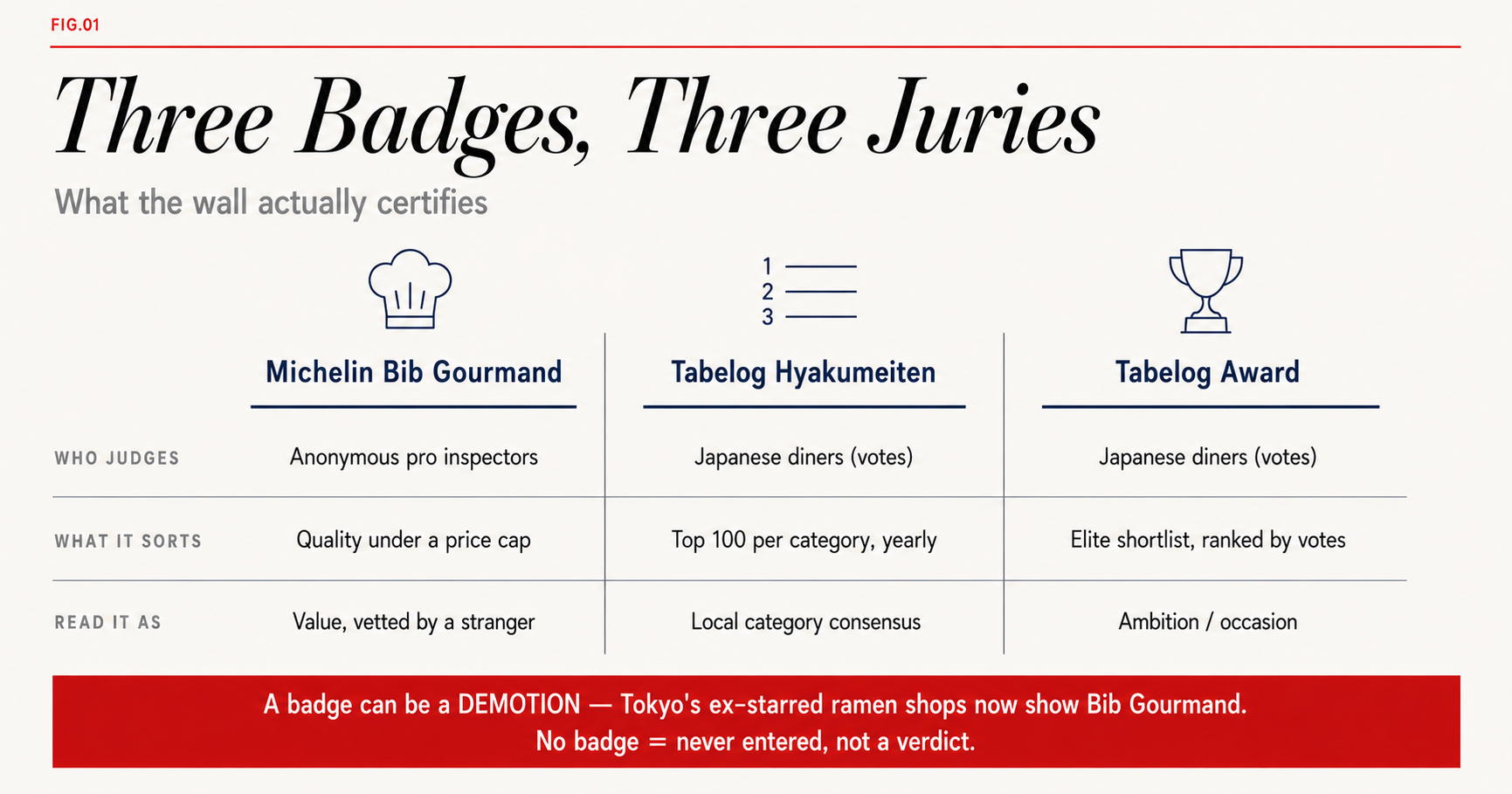
The three plaques by the register at a Tokyo restaurant look like a matched set. They are not. A Michelin Bib Gourmand plaque, a Tabelog Hyakumeiten (百名店, hyakumeiten, “hundred famous restaurants”) sticker, and a Tabelog Award certificate are three completely different instruments, measuring three different things, awarded by three different kinds of people. One is the verdict of anonymous professional inspectors working under a fixed price ceiling. The other two are popularity votes by Japanese diners. Knowing which is which changes how much you should trust the wall — and here is the fact that reframes the entire genre: as of the 2024 Michelin Guide, there is not a single starred ramen shop anywhere on earth. Tokyo’s three former star-holders were moved down to Bib Gourmand. So a wall badge can be a demotion, not a promotion. It tells you a restaurant was good enough to be noticed once. It never tells you the bowl in front of you tonight will be good.
The Bib Gourmand is a professional verdict with a price ceiling
Start with the badge most travelers recognize and most misread. The Michelin Bib Gourmand is not a “lesser star.” It is a separate category for high-quality food at a moderate price, and the price is the whole point. Michelin’s inspectors dine anonymously, pay their own bill, and apply the same standards of ingredient and technique they use for stars — but capped by a local cost ceiling. That ceiling is set by local economics, not a single fixed number; in Tokyo it works out to a high-quality three-course meal at roughly ¥5,000 as an approximate benchmark, not a hard rule. The Michelin Guide Tokyo 2026 lists 114 Bib Gourmand restaurants, 16 of them newly added for the 2026 edition.
What this means in practice: the Bib Gourmand is the badge to trust for value. It is a stranger with a trained palate telling you the food clears a professional bar and the bill will not wreck your day. It is also the only one of the three awarded by someone who is paid to be unimpressed by a queue, a hashtag, or a famous chef’s name on the door.
A Bib Gourmand plaque can be a demotion, and the ramen shops prove it
Here is the structural fact every listicle skips. Ramen first got a Michelin star in 2015, when Tsuta (蔦, Tsuta) in Sugamo earned one. For a few years Tokyo had a small cluster of starred ramen shops. Then Michelin reclassified them. As of the 2024 Tokyo guide, no ramen shop in the world holds a star, and Tokyo’s three former star-holders — Nakiryu, Konjiki Hototogisu, and Ginza Hachigo — were retained as Bib Gourmands instead.
Read that again. The Bib Gourmand plaque now on the wall at Nakiryu (Otsuka) represents a step down from the star it once held, not a step up. The same is true at Konjiki Hototogisu (Shinjuku). The food did not get worse; Michelin simply decided ramen belongs in the value category. That is not a one-off — it is a systematic call about an entire genre. Which is exactly why a badge can never tell you “this is the best.” It tells you a guide noticed the place and filed it under a label. The label moved. The tantanmen (担々麺, tantanmen, “sesame-chili ramen”) at Nakiryu did not.
The Tabelog badges are popularity votes, and the numbers are brutal
Now the two badges that look the same and aren’t. Both come from Tabelog (食べログ, Tabelog), Japan’s dominant restaurant-review platform, and both are driven by diner votes rather than professional inspection — but they sort different things.
The Tabelog Award is the prestige tier. To even be nominated, a restaurant must record a score of 4.00 or higher on at least two separate update dates within the qualifying window — for the 2026 cycle, November 5, 2024 through October 21, 2025. Only a fraction of one percent of the roughly 890,000 restaurants on Tabelog clear that bar, because the platform’s scoring compresses hard near the top and a 4.00 is genuinely rare. From that shortlist, winners are chosen by votes from Tabelog users who actually visited, then stratified by vote count into Gold, Silver, and Bronze. For 2026 that produced 36 Gold, 160 Silver, and 537 Bronze. Gold is described as “masterpieces you remember for a lifetime” — diner-voted, explicitly not critic-judged.
Hyakumeiten is the other Tabelog program, and it answers a different question. Instead of one elite list, it publishes category-by-category top-100s — ramen, sushi, tonkatsu, soba, curry, izakaya, and on — drawn from the highest user-rated shops in each genre and refreshed every year. Tabelog introduced it around 2017 as its casual-dining answer to the Bib Gourmand. A Hyakumeiten sticker is therefore the best signal of local, category-specific consensus: it tells you that among the thousands of ramen shops Japanese diners rate, this one sits in the top hundred. For a high-volume genre like ramen, Tabelog actually splits the list by region — Tokyo, East Japan, West Japan and more — so the badge a Tokyo shop carries is the Tokyo-region top-100, not a single nationwide hundred. The key word is category. A “Ramen Hyakumeiten” sticker and a “Tonkatsu Hyakumeiten” sticker are unrelated lists — a shop only competes against others in its own genre, never across them. That is why the badge is so useful and so easy to over-read: it does not say “one of the best restaurants in Tokyo,” it says “one of the hundred ramen shops Japanese diners rate most highly this year,” which is a far more honest and far narrower claim. A shop like Kagari (Ginza), with its tori-paitan (鶏白湯, tori-paitan, “creamy chicken broth”) ramen, is exactly the kind of place you’ll find carrying a Tabelog honor rather than a Michelin plaque — same building, different jury, different question being answered.
How to weight each badge, and why the empty wall means nothing
So you’re standing at the counter, reading the wall. Here is how to weight what you see. Treat a Bib Gourmand as your value signal: professional judgment, capped price, trustworthy for “good food, fair bill.” Treat Hyakumeiten as category-specific local consensus: if you want the ramen Japanese ramen-obsessives rate, this is your most honest filter. Treat the Tabelog Award tiers as ambition and occasion — Gold for a once-a-trip meal, Bronze for a reliably excellent neighborhood pick. Each is “vetted by someone.” None of them certifies the specific bowl, plate, or counter session you are about to have tonight, because none of them was tasted by an inspector this week.
Make it concrete. Say you’re deciding between two ramen counters on the same Shinjuku block. One has a Bib Gourmand plaque; the other has a Ramen Hyakumeiten sticker and nothing else. The plaque tells you a professional thought the food was worth its price within the last guide cycle. The sticker tells you thousands of Japanese diners ranked it in the genre’s top hundred this year. Neither is “better” — they answer different questions, and on a night when you want value with a pro’s stamp, the plaque wins; on a night when you want the bowl locals obsess over, the sticker wins. Now add a third door with a blank wall and a queue out front. That blank wall is the one most travelers misread as a downgrade. It is not.
And now the part the SERP never tells you: the missing badge means nothing. Most of Tokyo’s best neighborhood counters were simply never entered. A shop like Fuunji (Shinjuku) — a tsukemen (つけ麺, tsukemen, “dipping noodles”) counter with a queue down the block — is beloved by Japanese diners and rated accordingly on Tabelog, yet local consensus and professional inspection measure such different things that the two verdicts often don’t overlap at all. Go further: Tsunahachi Shinjuku So-honten (Shinjuku) has fried tempura at the counter since 1924, and a bare wall there is not a verdict on the tempura. It is a verdict on nothing. Plenty of specialists that good were never submitted, never voted on, never inspected — sometimes because the owner declined, sometimes because the genre simply isn’t tracked, often because nobody got around to it. The blank space beside the register, the curtain at the door, the noren (暖簾, noren, “shop curtain”) with no certificate pinned behind it — none of that is information about the food.
The practical landing is the one piece of literacy that survives every annual reshuffle: read a badge as “vetted by someone, once” — useful as a starting filter, useless as a guarantee — and never walk past a no-badge counter on the assumption that the wall already told you everything. The best tempura on your block may have a blank wall precisely because nobody ever filled out the form.
If you want to go deeper on how the user-vote machinery actually behaves, read Tabelog vs Google Maps — which Tokyo restaurant rating actually matters. And for the specific question this article raises about whether a professional verdict is worth standing in line for, see Is Michelin Ramen Worth the Queue in Tokyo in 2026?
Sources & Further Reading
- MICHELIN Guide Tokyo 2026 — Bib Gourmand announcement (114 total / 16 new for 2026; Bib Gourmand criteria and price ceiling; accessed May 2026)
- MICHELIN Guide — Nakiryu restaurant page (former star, current Bib Gourmand; ramen reclassification)
- The Tabelog Award 2026 — Official Guide (4.00+ on at least two update dates as nomination criterion, qualifying window, diner-vote mechanics; accessed May 2026)
- The Tabelog Award 2026 — Gold / Silver / Bronze lists (36 Gold, 160 Silver, 537 Bronze; accessed May 2026)
- Tabelog — Award & Hyakumeiten program pages (Hyakumeiten category top-100 structure; high-volume genres such as ramen split by region — Tokyo / East / West; accessed May 2026)