
Where to Eat Sanma in Tokyo This Autumn (And Why It Costs More)
Every guide tells you what sanma is and stops there. This one routes you to actual Tokyo izakaya with yen prices, pins down the two-month window when the fish is genuinely fatty, explains why a once-cheap fish now costs what it does, and decodes why the "Meguro sanma festival" won't feed a tourist.
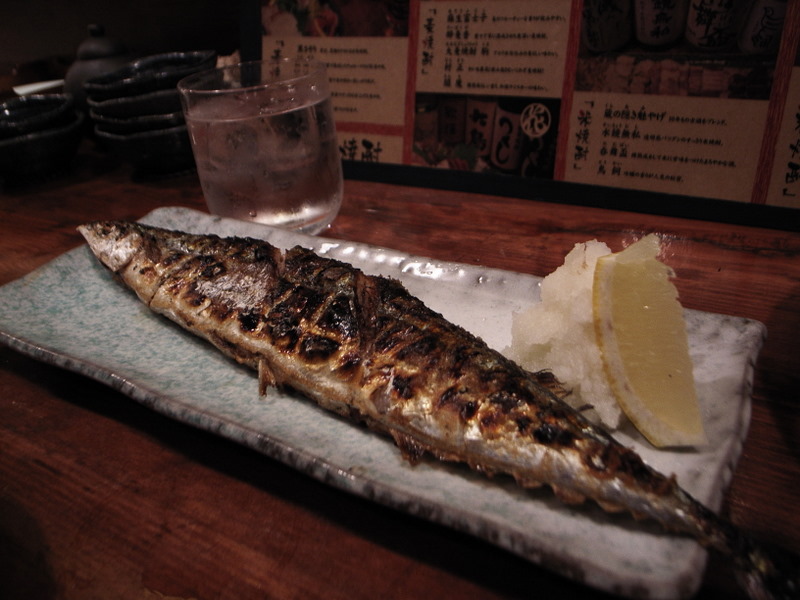
The reliable way to eat sanma (秋刀魚, “pacific saury”) in Tokyo this autumn is to walk into a seasonal izakaya, find it on the daily blackboard, and order it salt-grilled — at Isomaru Suisan in Shinjuku you grill it yourself at the table — a salt-grilled sanma for around ¥400, or the seasonal fresh-grilled set near ¥800 — with the head, the bitter guts, and a wedge of citrus. The atmospheric move is a charcoal alley like Omoide Yokocho on an October night, where the smoke from salt-grilled fish drifts down the lane. What you should not do is plan your trip around the famous “Meguro sanma festival” — the free grilled fish there is mostly reserved for local residents.

That is the whole answer most guides refuse to give. They tell you sanma is “rich and savory” and a “symbol of Japanese autumn,” then leave you with no address, no price, and no idea which week of autumn actually matters. It does matter — a lot. The fish on a Tokyo plate in late September is a different, fattier animal than the one in early August, it costs more per fish than it did a generation ago, and there is a real reason for both. This is a guide to walking into a Shinjuku izakaya in October, recognizing a good sanma, knowing roughly what it should cost, and understanding why.
The Fattiest Sanma Is a Two-Month Window, Not a Whole Season
“Autumn” is not precise enough. Sanma spawn far out in the North Pacific and migrate south as the water cools, and they put on fat on that southward run — fattest as they pass the cold grounds off eastern Hokkaido and down the Sanriku coast. Nemuro (根室), on Hokkaido’s far eastern tip, lands more sanma than any port in Japan; fish caught off Kushiro (釧路) just before the mid-October southward push are prized for high fat. That migration sets the calendar. The genuinely oily fish — the ones worth the trip — run roughly from mid-September to late October.
The Japanese seasonal vocabulary maps this almost perfectly. We’ve written elsewhere about what shun actually means — its three phases of hashiri (the first arrivals), sakari (the peak), and nagori (the fading end). For sanma, early-September hashiri fish are lean, scarce, and expensive — the Kushiro fishermen’s cooperative notes the season’s first catch can sell at roughly double, dropping to about half once landings stabilize mid-month. The sakari window, late September into October, is when the fat content peaks and the price settles. A May or August “sanma” — frozen, imported, or simply caught too early — is a leaner thing wearing the same name.
So the practical rule: if you’re in Tokyo in October and you see sanma shioyaki (秋刀魚塩焼き, “salt-grilled saury”) chalked on a board, that is the fish at its best. The visual tell at the table is the sheen — fat beading and spitting off the skin as it grills, the belly soft enough that the bitter guts spread like a sauce. That bitterness is the point, not a flaw; eaten with grated daikon and a squeeze of sudachi or kabosu (small green citrus), it’s the whole dish.
Why a Workingman’s Fish Now Has a Workingman’s Price Problem
Sanma was, for most of the twentieth century, the cheap fish of autumn — grilled whole over coals at home, sold by the boxful, the smell of it in the air a marker of the season changing. That history is exactly why the price now surprises people. Japan’s sanma catch has collapsed. From a late-1950s peak, the national landed catch has fallen to record lows — under 20,000 tonnes in 2021, down nearly 40% on the year before — and the North Pacific stock is now officially assessed as depleted. Some recent years have rebounded a little, but the long decline is the story. Japan, once the world’s top sanma producer, has slipped to third behind Taiwan and China.
The management response shapes what you’ll pay. For 2025 the North Pacific Fisheries Commission cut the overall total allowable catch about 10 percent, to 202,500 tonnes (20.25万トン) — of which 121,500 tonnes (12.15万トン) is set on the high seas — and Japan’s national quota came down to about 95,600 tonnes (~9.6万トン), the first time it has been set below 100,000 tonnes; a harvest-control rule agreed at the 2024 meeting now auto-adjusts the limit up or down with the size of the stock. The Fisheries Agency’s mid-2025 outlook forecast another low-abundance year — but with individual fish running a little larger, one-year-olds trending past 110 grams against the prior year’s 80–100 gram range. Fewer fish, in other words, but bigger and fattier ones.
Connect those numbers to the blackboard. A single grilled sanma that an Asakusa laborer once treated as everyday food is now a constrained resource, which is why an izakaya might list a salt-grilled sanma for around ¥400 in a good year and quietly drop it from the board in a lean one. We won’t promise you a price or that it’ll be there — in a thin season it sells out, and the cost rises. That’s not a markup; it’s the stock story reaching your table. The honest read is the one the catch figures give you, sourced from the Fisheries Agency, the NPFC, and the Hokkaido fishing cooperatives, rather than a guess.
The “Meguro Sanma Festival” Is Two Festivals, and the Free Fish Isn’t for You
Search “where to eat sanma in Tokyo” and you’ll hit the Meguro festival, usually described as one event. It’s two — held by two different wards, in two different months, with fish from two different ports. Shinagawa Ward runs the Meguro no Sanma Matsuri (目黒のさんま祭り, “Meguro saury festival”) in September, grilling sanma landed at Miyako (宮古) in Iwate, served with grated daikon from Tochigi and sudachi from Tokushima. Meguro Ward runs its own Meguro Kumin Matsuri (目黒区民まつり, “Meguro residents’ festival”), also called the Meguro SUN Festival, in October, using sanma from Kesennuma (気仙沼) in Miyagi with kabosu from Oita. Both lean on the Edo-period rakugo comic tale “Meguro no Sanma,” in which a lord decides the cheap fish tastes best in Meguro — which is, of course, nowhere near the sea.
Here’s the part the listicles skip. The 2025 Meguro Ward festival, held on October 12, received about 2,000 fresh sanma from sister-city Kesennuma and grilled out roughly 1,500 of them — distributed mostly to Meguro residents through advance-application “grilled-sanma tickets.” A tourist showing up cold is not the audience for the free fish. Treat both festivals as cultural context and street atmosphere, with paid stalls if you want to eat, not as a meal plan. The reliable plan is the one we opened with: buy your sanma at an izakaya.
Where to Actually Eat It — Chain, Alley, or Sit-Down
Three registers, depending on the night you want. The dependable one is a grill-your-own seafood izakaya: at Isomaru Suisan‘s Shinjuku 3-chome and Nishi-Shinjuku branches, the daily board carries seasonal fish, and in autumn that means a whole sanma you char yourself over a tabletop grill, English menu on hand — a salt-grilled sanma for around ¥400, or the seasonal fresh-grilled set near ¥800. It’s the most walk-in-able answer to “where do I eat sanma tonight.” One caveat: sanma is a seasonal board item, not a year-round fixture, so look for it on the autumn board rather than expecting it in spring.
The atmospheric register is a postwar alley. At Omoide Yokocho in Shinjuku, charcoal grills run open to a lane barely two people wide, and in season a salt-grilled fish belongs there as much as the yakitori smoke. Across the river, Hoppy Street in Asakusa is daytime-and-early-evening shitamachi drinking — grilled fish and a Hoppy at a plastic stool, the old working-class autumn rather than a tourist set-piece. Both are stops on our wider guide to Tokyo’s seven yokocho alleys, if you want to build a night around the smoke instead of a single dish.
If you’d rather sit down and pair the fish with a drink, Yanaka Beer Hall occupies a pre-war wooden house in quiet Yanaka, craft beer on tap and a kitchen that leans seasonal — a calmer counterpart well away from festival crowds. And for the west side, Ebisu Yokocho is a retro indoor lane of izakaya stalls where a seasonal grilled-sanma special fits naturally, convenient if you’re basing yourself around Ebisu or Meguro. Treat every stall menu as variable — frame sanma as the autumn special you watch for on the board, not a guarantee. Know the window, know why the price moves, skip the festival queue, and you’ll eat the fish the way the city actually does.
Sources & Further Reading
- 水産庁・水産研究教育機構『国際漁業資源の現況 サンマ 北太平洋』 (stock depletion; North Pacific basin-wide total a record-low 9.3万t in 2021; Japan now third producer)
- 水産庁『さんま漁獲量』統計 (Japan’s national landed catch under 20,000t in 2021, down nearly 40% year-on-year)
- 磯丸水産 メニュー(秋刀魚塩焼き/秋刀魚炭火焼定食) (Isomaru Suisan menu pricing — salt-grilled sanma ~¥400, fresh-grilled set ~¥800/1 fish; menu as published, accessed May 2026)
- WWFジャパン「北太平洋漁業委員会(NPFC)2025結果報告」 (2025 ~10% overall TAC cut to 202,500t; 121,500t on the high seas; harvest-control rule)
- 水産庁プレスリリース「サンマの長期漁海況予報」(2025-07)・国別配分 (2025 low-abundance outlook; larger individual fish; Japan quota ~95,600t, first time below 100,000t)
- 釧路市漁業協同組合『釧路サンマの美味しい訳』ほか産地一次情報 (Nemuro/Kushiro landings; fat content; hashiri price swing)
- しながわ観光協会『目黒のさんま祭り』/目黒区公式『目黒区民まつり』 (the two festivals; ports; 2025 residents-only ticket distribution)
- dancyu/NHK「あさイチ」旬特集・JNTO seasonal calendar (preparation, citrus pairing, autumn timing)