
What the Handwritten Blackboard in a Tokyo Izakaya Is Actually Telling You to Order
Most guides treat the handwritten izakaya blackboard as a language problem to work around. It's the opposite: in Japanese restaurant practice the chalk exists for one reason a printed menu can't serve — proof of freshness. Here's how to read what it's actually telling you to order.
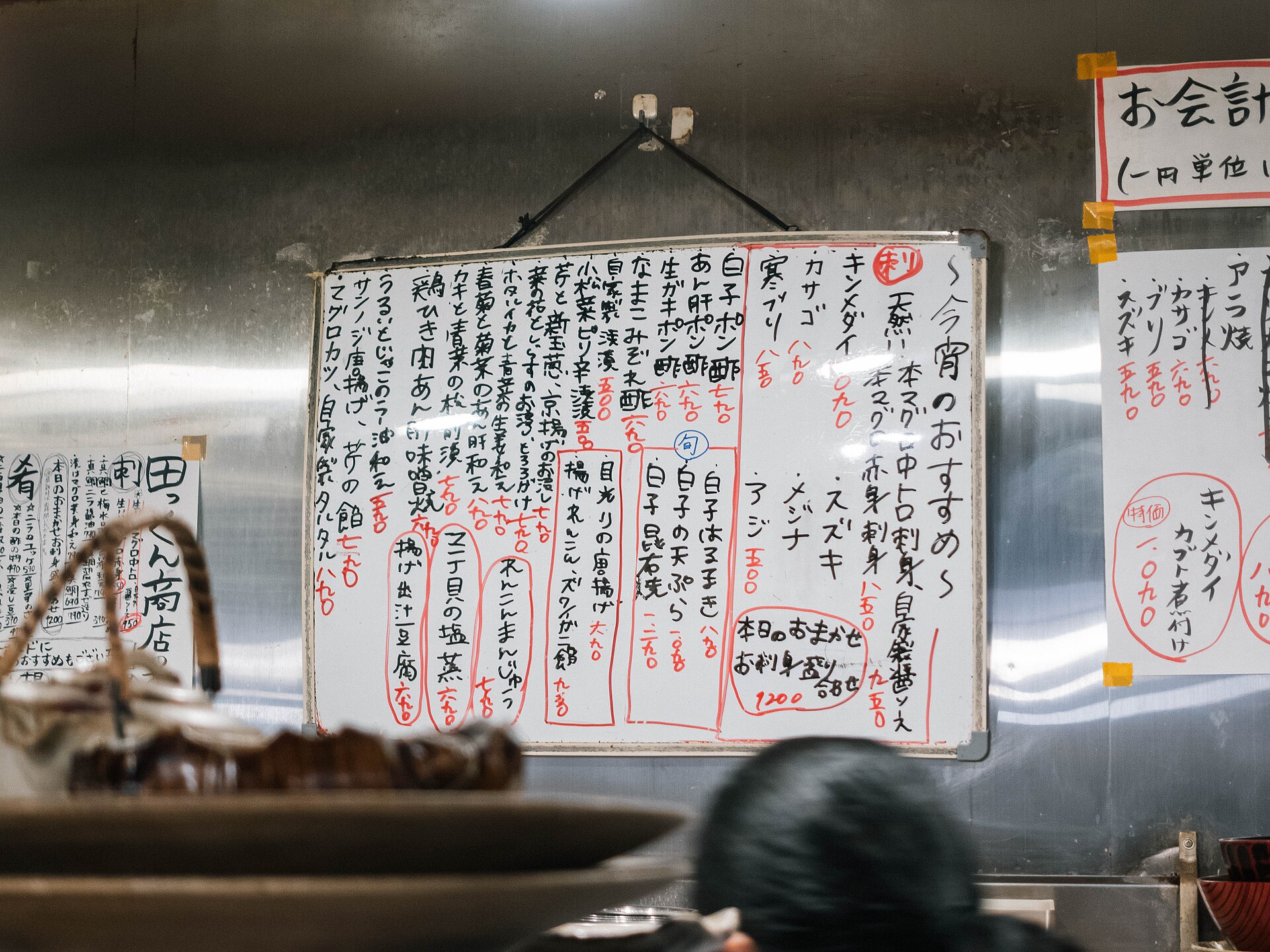
You sit down at a Tokyo izakaya (居酒屋, izakaya, “stay-drink-place”), get handed a laminated menu, and then notice the wall: a black chalkboard covered in handwriting you can’t read. Most English guides tell you to treat that board as a problem — ask a neighbor, point, or just say osusume and hope. That advice gets it exactly backwards. The handwritten board is not a language barrier you have to survive. It is the single most useful object in the room, and the reason is something Japanese restaurant-marketing manuals state plainly to their own operators: the chalkboard exists to project sendo-kan (鮮度感, “a sense of freshness”).

Here is the whole decode in one sentence. The board is rewritten by hand every single day precisely because the act of rewriting is the cheapest possible proof that the ingredient turned over since yesterday. A laminated menu can’t make that claim — it’s the same in March and August. Chalk can. So when a kitchen chalks something onto the wall this morning, it is telling you: we bought this well today, and we’re staking our own handwriting on it. The board is the chef pre-ranking the fridge for you. You don’t need to read every character. You need to recognize four signals and one piece of seasonal grammar — and after that, ordering off the chalk is on average the freshest move you can make.
The medium is the message: handwriting is a freshness claim a printed menu literally cannot make
Japanese marketing guides that coach izakaya owners on how to write a chalkboard are unusually blunt about why the board exists. The first stated advantage is freshness: a board that is hand-rewritten over a short cycle — ideally daily — reads as fresh, which is exactly why it’s the right tool for any shop whose whole concept is that the ingredients are new today. The reasoning is almost mechanical. If you went to the trouble of erasing yesterday’s chalk and writing today’s by hand, the message inside the gesture is “this changed.” A printed menu, by definition, is fixed; it can’t perform that turnover. The handwriting is the freshness statement, before you’ve parsed a single word of it.
Those same guides list two more reasons handwriting beats print: shitashimi (親近感, “warmth,” the human-hand signal that builds trust) and funiki (雰囲気, “atmosphere”). But freshness is the load-bearing one for how you order. The corollary that no English guide spells out is the filter logic: the kitchen only chalks up what it bought well. Nobody handwrites “the frozen stuff we always have.” The board is a self-selecting list — it’s the chef showing you which corner of today’s purchasing (仕入れ, shiire) they’re proud of. That’s why operators are specifically taught that a honjitsu no osusume board is a major advantage for izakaya whose buying changes every day: it lets the kitchen broadcast, by hand, “this is the part of today worth your money.”
You can see this most literally at a seafood izakaya like Isomaru Suisan (Shinjuku), where the whole concept is the day’s catch and you grill it yourself over a tabletop flame. The board there isn’t decoration; it’s the inventory of what came in fresh enough to write down. But the same logic runs in a non-seafood room. At Shirubee (Shimokitazawa), the beef-tendon nikujaga (牛すじ肉じゃが, gyusuji nikujaga, “beef tendon and potato simmered together”) is reportedly prepped fresh every day because it’s ordered that constantly — a daily-made special is the same freshness signal in a simmered-pot register rather than a sashimi one.
Four signals do almost all the work — and “sold out” is the best one
You will not read the whole board, and you don’t have to. Four short character groups carry nearly all the signal, and three of them are headers — the labels the kitchen writes precisely so you’ll hunt for them.
本日のおすすめ (honjitsu no osusume, “today’s recommendation”) is the flag itself. Operators are coached to title their board with exactly this, or with tencho ichioshi (店長イチオシ, “the manager’s top pick”) or kisetsu no ippin (季節の逸品, “seasonal specialty”). When you see those four characters 本日, you’ve found the part of the menu that didn’t exist yesterday. 旬 (shun, “in season”) marks an ingredient at its peak — more on what that single character actually claims below. 限定 (gentei, “limited”) signals scarcity, usually paired with a number; a line like “10食限定” (ju-shoku gentei, “10 servings only”) is a deliberate nudge, the manuals admit, designed to “push the customer’s back” toward ordering now. Treat it as information, not pressure: it means the kitchen committed to a small batch of something it didn’t want to over-buy.
The fourth signal is the one travelers misread. 売切 (urikire, “sold out”) looks like a disappointment — the thing you wanted is gone. Flip it. On a freshness board, urikire is a tell: it means the kitchen bought a finite amount of something perishable and ran through it, rather than holding a freezer’s worth to sell all night. A board with a couple of items crossed out by 9pm is a board you can trust. It’s proof the place isn’t faking scarcity — they genuinely sold out of the good stuff. The same chalked-up daily board runs at newer, chain-adjacent izakaya too, not just old-guard rooms: Dandadan (Nakano), a modern gyoza-and-sake spot near the station, keeps a honjitsu no osusume corner, which tells you the practice is a working tool, not nostalgia.
If you want the broader character set — the dozen-odd kanji that unlock most printed Tokyo menus, not just the board — our companion piece on the 30 characters that cover 80% of Tokyo menus is the next step. For the board specifically, the four above are enough.
That single 旬 character is a more specific claim than “in season”
English flattens shun to “in season,” but Japanese cooking splits a season into three phases, and a board can flag which one you’re in. はしり (hashiri, “the runners”) is the first early arrival of the year — the hatsumono (初物, “first thing”), prized for novelty and priced for it. さかり (sakari, “the peak,” also written 旬) is the abundant middle, when the ingredient is cheapest, fattest, and best. 名残 (nagori, “the remnant”) is the tail end — the last of something, written to say “enjoy it one final time before it’s gone for the year.”
This matters at the board because the kitchen is making a phase-specific claim, not a vague one. A hashiri item is the chef showing off the season’s first; a sakari item is the value play; a nagori item is the one to order tonight because it won’t be there next month. The three-phase grammar is the deeper logic under that one chalked 旬, and it’s worth knowing well enough that the character stops being decoration — we unpack the full framework in what “shun” actually means. On the board itself, the practical version is simpler: a seasonal item chalked up today is, by the kitchen’s own hand, the thing that tastes most like right now.
When in doubt, order off the chalk — and what to do when there’s no board at all
Here’s the actionable inversion. You walked in worried you couldn’t read the board. The move is to let the board read for you. Because it’s self-selecting — only the well-bought items make it up there — anything on the chalk is, on average, the freshest and best-sourced thing the kitchen has tonight. You don’t need to decode every line. Find honjitsu no osusume, scan for 旬 and 限定, notice what’s already 売切, and order one thing from that zone. It is, on average, the smartest order in the room, and you made it without speaking. If a staff member is nearby, pointing at a board line and saying “kore” (“this one”) is a complete, fluent order.
Two honest caveats. First, “freshest” is not the same as “the single best dish you’ll eat” — what the board guarantees is that the kitchen bought it well today and is willing to put its handwriting behind it, which is a real signal but not a promise of perfection. Second, the format varies. Some older shitamachi (下町, “old downtown”) shops don’t use chalk at all but paper strips wall-posted above the counter — at Toritake Honten (Shibuya), a yakitori institution open since 1963, the giant skewers and seasonal sides ride the wall on faded paper rather than a laminated card, and the reading logic is identical: the handwritten wall outranks the printed menu. And at a tiny neighborhood skewer counter like Yakitori Nonki (Koenji), the daily board is simply the move. Wherever the handwriting is — chalk, paper, or a marker scrawl by the register — that’s where the kitchen put today. Read that, and you’ve stopped being a tourist who can’t read the menu and become someone ordering exactly what a regular would.
Sources & Further Reading
- 創客POPマーケティング (urupop.com) — 居酒屋の黒板メニューの書き方 (backs the 鮮度感 freshness rationale, the 本日のおすすめ / 店長イチオシ / 季節の逸品 board headers, and the 限定 “push the customer’s back” framing; accessed May 2026)
- MenuDesignLab / MEDIY — 手書きメニューの効果 (backs the three handwriting advantages — freshness, warmth, atmosphere — and seasonal/limited framing; accessed May 2026)
- クックパッドニュース — 食材の「はしり」「旬」「名残り」とは (backs the three-phase hashiri / sakari / nagori seasonal grammar behind 旬; accessed May 2026)
- テンミニッツ・アカデミー — 「はしり」「さかり」「なごり」 (corroborates the three-phase seasonal framework; accessed May 2026)
- Tabelog — 鳥竹 総本店 (Toritake Honten) (confirms 1963 founding, Shibuya/Dogenzaka location, ~12:00–23:00 hours, no regular closing day; accessed May 2026)
- Tabelog — 汁べゑ 下北沢店 (Shirubee Shimokitazawa) (confirms ~17:00 open, daily-prepped beef-tendon nikujaga; accessed May 2026)