
How to Read a Japanese Menu — The 30 Characters That Cover 80% of Tokyo Restaurants
You don't need to learn Japanese to eat well in Tokyo. You need thirty characters. Here's the shortlist that decodes most menus, why menu apps still fail you, and the five phrases that finish the job.
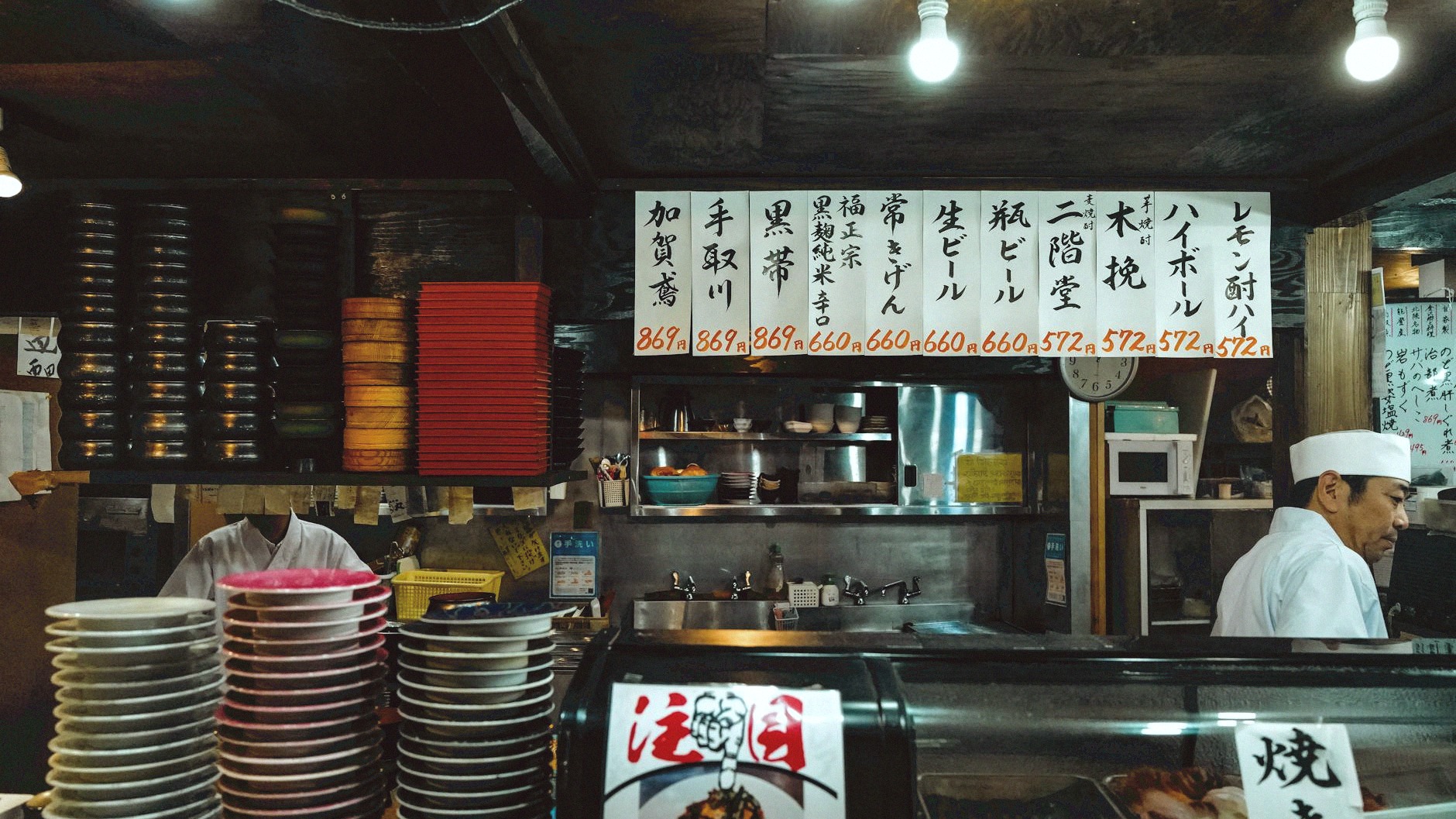
You walk into a Tokyo restaurant and a Japanese menu lands in front of you. There is no English. The server is patient but does not speak yours. The translation app on your phone reads 飯 as “meal,” 定食 as “set meal,” and お通し as “pass-through” — none of which actually tells you what to order.
This is the gap most Tokyo travelers fall into. Translation apps know dictionary meanings; they do not know menu conventions. The good news is that learning how to read a Japanese menu requires far less vocabulary than learning the language itself. About thirty characters cover roughly 80% of what you will see at the kind of place a serious Tokyo eater goes — small izakaya, ramen shops like Ichiran Shibuya and Fuunji, soba counters, teishoku diners, and even most kaiten-zushi.
Memorize the list below and you can order with confidence at any restaurant in the city that matters. This guide is the practical shortlist on how to read a Japanese menu: it groups the characters by function, gives the reading where it helps, and finishes with the five spoken phrases that close the loop when the menu still doesn’t.
Why “Just Use a Translation App” Doesn’t Work
Apps like Google Translate and Papago will get you a literal English gloss of each character. The problem is that menus are not literal text. They are shorthand. 定食 (teishoku) means “set meal,” but knowing the word does not tell you that a teishoku always includes rice, miso soup, and pickles, and that the price quoted on the menu is for the whole set rather than just the protein. お通し (otoshi) translates as “pass-through dish,” which is meaningless unless someone has told you it is the small plate of food the izakaya brings out automatically and charges ¥300–¥800 for as a seating fee.
Reading a menu in Tokyo is less about translation and more about pattern recognition. The same fifteen or twenty characters reappear across thousands of restaurants. Once you can recognize the shapes, you stop translating and start ordering.
Group 1: Cooking Methods (5 Characters)
These five tell you what was done to the protein before it reached your plate. Each appears at the end of a dish name (“chicken fried,” “pork grilled” — the Japanese order is reverse from English).
- 焼 (yaki) — grilled or pan-fried. 焼き鳥 = yakitori (grilled chicken skewers). 焼魚 = grilled fish. If you see this character, expect char and smoke.
- 揚 (age) — deep-fried. 唐揚げ = karaage (Japanese fried chicken). 天ぷら uses the character 天 but is the same family. Hot, crisp, oil.
- 煮 (ni) — simmered, usually in soy and dashi. 煮物 = nimono (simmered vegetables and protein). 豚の角煮 = pork belly braised until it falls apart.
- 蒸 (mushi) — steamed. 茶碗蒸し = chawanmushi (savory egg custard). Lighter, no fat added.
- 刺 (sashi) — sliced raw. 刺身 = sashimi. Almost always means the protein arrives raw on a platter, no rice attached.
Group 2: Proteins (10 Characters)
The ten characters that account for nearly every protein you will see on a Tokyo menu. Memorizing five of these will get you most of the way; ten is comprehensive.
- 肉 (niku) — meat in general. Almost always pork or beef in context.
- 豚 (buta / ton) — pork. 豚カツ = tonkatsu (breaded pork cutlet, the dish that made Maisen Aoyama a Tokyo institution). 豚骨 = tonkotsu (pork bone broth, the foundation of Hakata-style ramen).
- 鶏 (tori / kei) — chicken. 鶏肉 is just “chicken meat.” 親子丼 (oyakodon) literally means “parent and child rice bowl” — chicken and egg over rice.
- 牛 (gyu) — beef. 牛丼 = gyudon (beef rice bowl). 和牛 = wagyu, the high-end domestic beef most travelers come to Tokyo for.
- 魚 (sakana / gyo) — fish, generic. Used when the species is on the menu somewhere else.
- 鮪 (maguro) — tuna. The single most important fish character at sushi counters and izakaya.
- 鮭 (sake / shake) — salmon. Confusingly written with a kanji that also means alcohol; context makes it clear.
- 海老 (ebi) — shrimp / prawn. Two characters together. Appears in tempura, sushi, and rice bowls constantly.
- 卵 (tamago) — egg. 卵焼き = tamagoyaki (rolled omelet). 温泉卵 = onsen tamago (slow-poached egg).
- 蛸 (tako) — octopus. Easy to spot once you know it. たこ焼き = takoyaki (octopus dumplings).
Group 3: Carbs and Bowls (5 Characters)
What ends up under or around your protein. Knowing these tells you whether you are getting a soup, a rice bowl, or noodles.
- 飯 / ご飯 (gohan / meshi) — rice. Plain steamed rice, included in most teishoku.
- 丼 (don / donburi) — a rice bowl topped with something. 牛丼, 親子丼, 天丼, カツ丼. The character itself is a pictograph of a bowl with food on top.
- 麺 (men) — noodles, generic.
- 蕎麦 (soba) — buckwheat noodles. Appears in cold (もり, ざる) and hot (かけ) variants. We have written about why a serious bowl of soba costs ¥1,800 when the cheap one costs ¥600 — the price reflects how the buckwheat is milled, mixed, and cut.
- うどん (udon) — thick wheat noodles. Written in hiragana, so easier to recognize than its kanji 饂飩 (almost never used).
Group 4: Service and Portion Words (10 Characters)
These are the menu mechanics — how the dish is sized, presented, and combined. Understanding these is what separates someone who can read a menu from someone who can order from one.
- 大 (dai / oo) — large. 大盛り = oo-mori (large portion). Often free or +¥100 at ramen and donburi shops.
- 中 (chu) — medium. Default size at most chains.
- 小 (sho / ko) — small. 小盛り for a smaller portion if you want to try multiple things.
- 並 (nami) — “regular” or standard. The middle option when there are tiers.
- 上 (jo) — “upper” — a step up in quality from regular. 上寿司 = a better sushi set. Expect to pay 30–50% more.
- 特 (toku) — “special” — the top tier. 特上 = the highest grade. Expect to pay double the regular.
- 定食 (teishoku) — set meal. Always includes rice, miso soup, and pickles alongside the main dish. The price on the menu is for the whole set.
- セット (setto) — set, written in katakana. Used at modern restaurants for combo deals.
- 単品 (tanpin) — à la carte, single item. The opposite of a set.
- おかわり (okawari) — refill. Often free for rice and miso soup at teishoku restaurants. A useful word at any meal.
The Three “Everyone Gets Confused” Characters
These show up on bills, on signs at the door, and in waitstaff conversation. Translation apps mishandle all three.
お通し (otoshi) — the small dish of food the izakaya brings unprompted. It is not free. Most izakaya charge ¥300 to ¥800 for it as a seat fee, and refusing it is awkward. Treat it as a cover charge — the price of being there. The food itself (a small plate of pickles, simmered vegetables, or marinated seafood) is usually decent and worth eating. You will encounter this at almost every izakaya, including yokocho-style alley spots like Dandadan Nakano.
お任せ (omakase) — “I leave it to you.” At a sushi counter, this means the chef chooses every piece, in their own order, at a price you accept in advance. We have written about what omakase actually means — the short version is that it is a contract more than an order, and using it casually at the wrong shop wastes both your money and the chef’s time.
テイクアウト / 持ち帰り (takeout / mochi-kaeri) — to-go. The first is katakana for “takeout”; the second is the Japanese phrasing. If you see イートイン on the same menu it means “eat in.”
How These Combine in Real Menus
Three live examples, decoded.
From a tonkatsu shop: 特上ロースかつ定食 大盛り. Decode: 特上 (top tier) + ロースかつ (loin cutlet) + 定食 (set meal) + 大盛り (large portion). You are ordering the highest-grade pork loin cutlet, with rice, miso soup, pickles, and a large portion of rice. Likely ¥2,500–¥3,500.
From a soba counter: かけ蕎麦 並 単品. Decode: かけ (hot, in broth) + 蕎麦 (buckwheat noodles) + 並 (regular size) + 単品 (à la carte, no set). You are ordering a regular-sized hot soba with no rice or sides. Likely ¥600–¥900.
From an izakaya: 鶏の唐揚げ・刺身盛り合わせ・お通し. Decode: 鶏の唐揚げ (Japanese fried chicken) + 刺身盛り合わせ (sashimi assortment) + お通し (the seating-charge appetizer). You are ordering fried chicken and a sashimi platter, and you will be charged the otoshi fee whether you wanted that small plate or not.
The Five Phrases That Finish the Job
The menu gets you to the order. These five spoken phrases get you through the rest of the meal.
- すみません (sumimasen) — “excuse me.” Used to call the server. The single most useful word in any Japanese restaurant.
- これ、お願いします (kore, onegai shimasu) — “this one, please,” while pointing at the menu. Solves the entire ordering problem.
- お会計お願いします (okaikei onegai shimasu) — “the check, please.” At most izakaya you ask for the check at the table; at smaller shops you bring it to the register.
- 水ください (mizu kudasai) — “water, please.” Tap water (お冷) is always free and often comes automatically — but if it doesn’t, this gets it.
- ごちそうさまでした (gochisousama deshita) — “thank you for the meal,” said on the way out. Not strictly required but always appreciated.
When the Menu Has Pictures
Many Tokyo restaurants — especially those near tourist areas, train stations, and family-style chains — now use illustrated menus or laminated photo menus. These solve the recognition problem entirely. If a restaurant has photos, you can ignore everything above and just point. The ability to read the kanji is most useful at small, no-frills shops where the menu is hand-written on a wooden board on the wall, often the places where the cooking is best.
The shops we recommend most highly at The Ondo — counter-only soba places, single-chef sushi shops, neighborhood izakaya — tend not to translate. That is where this list earns its keep.
A Note on Hiragana and Katakana
The thirty characters above are all kanji — the Chinese-derived characters that carry meaning. The other two writing systems, hiragana (the curved script) and katakana (the angular script), are phonetic and do not require translation if you sound them out. Katakana is especially useful for foreigners because it is reserved for foreign loanwords: コーヒー = coffee, ビール = beer, ピザ = pizza, ハンバーガー = hamburger. If you can read katakana, you can read most drinks menus and a surprising amount of the food menu at modern cafés. Both systems can be learned in about three hours and pay back the investment within a single trip.
What This Doesn’t Cover
This is a practical shortlist, not a language course. It will not get you through a kaiseki menu (where the language is poetic and seasonal), the wine list at a serious restaurant, or the multi-course tasting menu at a Michelin-starred kappo. For those you need either someone who reads Japanese with you, or a restaurant that has built an English service for high-end tourists — and many of the best ones now do.
The menu is not the only thing worth decoding. The window display speaks too — what the plastic food models outside a Tokyo restaurant actually tell you.
Some of the best dishes never reach the printed menu — they live on the handwritten daily board, which is its own freshness signal.
It will, however, get you through about 80% of the restaurants in Tokyo where the food is good and the price is reasonable. Which is most of them.