
Which Tokyo Restaurants You Can Actually Walk Into
Tokyo isn't a reservations city or a walk-in city — it's a spectrum, from “just sit down” to “you cannot get in without an introduction.” How to read which band a restaurant is in, and why almost everything you want is walk-in.
Two opposite anxieties arrive with the same trip. One traveller assumes Tokyo runs on reservations, panics that the good places are booked solid months out, and over-plans a rigid itinerary of confirmed slots. Another assumes Tokyo is a walk-in city, turns up at a famous sushi counter at 8pm, and is turned away — not because it is full, but because it does not seat people it has never met. Both are working from a single rule. There is no single rule. There is a spectrum, and knowing where a given restaurant sits on it is the actual skill.
This piece maps that spectrum from “just walk in” to “you cannot get in at all,” explains the logic behind each band, and ends where it matters: the large, genuinely walk-in category that most of Tokyo’s best everyday eating lives in — and that this site is mostly built from.
The Five Bands of Getting In
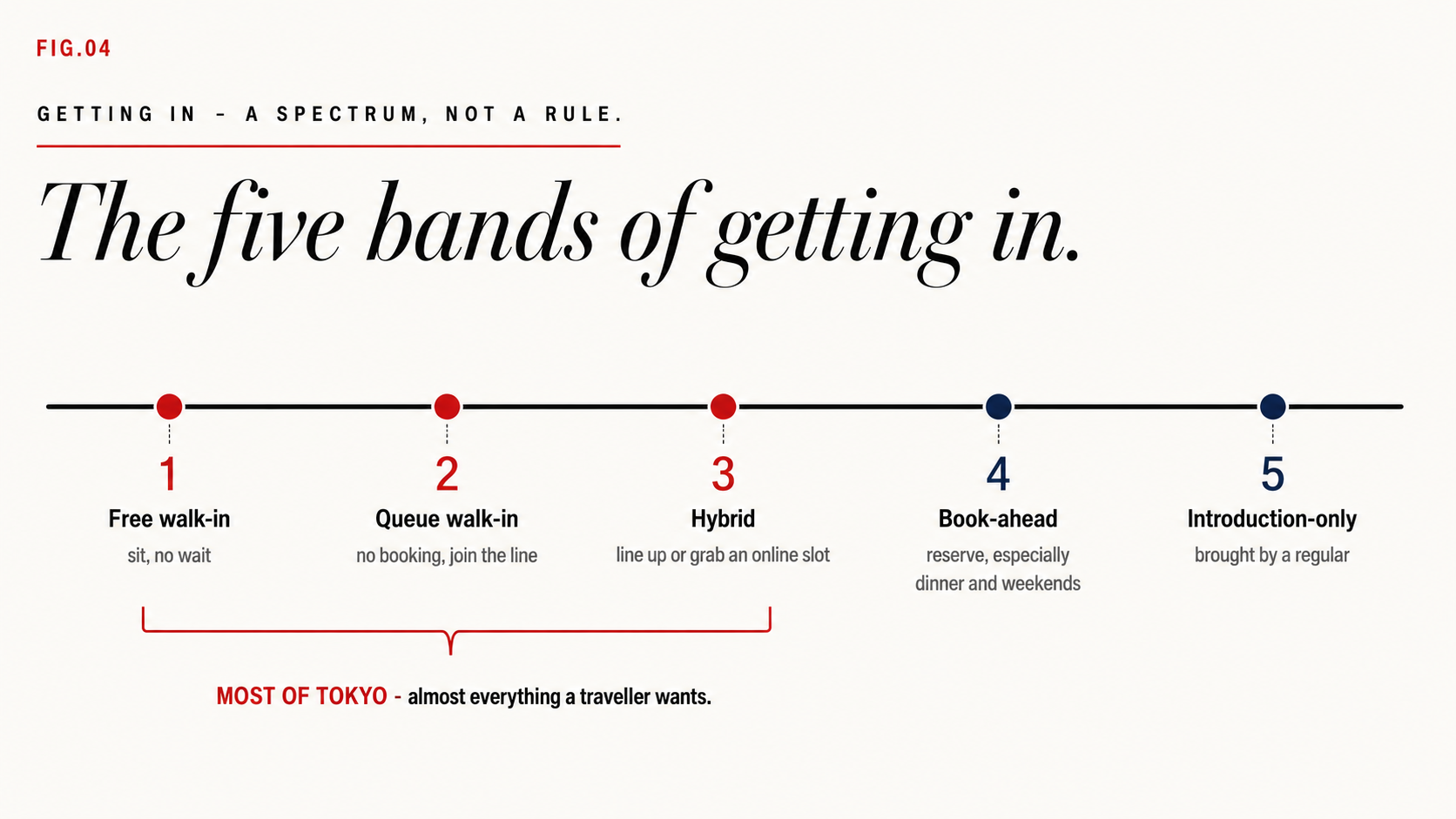
Tokyo restaurants fall into roughly five access bands. Free walk-in: you arrive, you sit, no wait — most cafes, depachika, family restaurants, off-peak izakaya. Queue walk-in: no reservation taken; you join a line and it moves — the default for serious ramen and many counter specialists. Hybrid: line up or grab an online slot, increasingly common as prestige shops manage crowds. Book-ahead: reservation strongly advised, especially dinner and weekends — mid-to-high sukiyaki, kaiseki, yakiniku, teahouse rooms. Introduction-only: you cannot book at all without being brought by an existing customer. Most of the city — and almost everything a normal traveller wants to eat — lives in the first three bands. The panic is usually about the last two, which a normal traveller rarely needs to touch.
The mistake is treating the top of the pyramid as the whole pyramid. The restaurants people fret over — the three-seat sushi rooms, the Tabelog Gold counters — are a statistically tiny tier. Sushi Saito, once a three-Michelin-star room, was removed from the guide partly because, with eight seats and only returning customers, it had effectively closed itself to the public. SugaLabo operates on a private phone number and undisclosed hours. These exist, and they are not your problem unless you make them your problem. The food that defines how Tokyo actually eats is almost entirely walk-in.
| If the format is… | Assume this band |
|---|---|
| Ramen counter, kaiten-sushi, standing bar, kissaten, depachika, yokocho stall | Walk-in (a queue only if it is famous) |
| Famous ramen shop or prestige specialist counter | Queue or hybrid (line up, or grab an online slot) |
| Mid-to-high sukiyaki, kaiseki, teppanyaki, wagyu yakiniku | Book-ahead (reserve dinner, especially on weekends) |
| No-website room praised on Tabelog Gold | Introduction-only — let it go |
Why the Door Policy Exists
The introduction-only custom has a name — ichigensan okotowari (一見さんお断り, “no first-time guests without an introduction”) — and an old Kyoto logic that is not snobbery. A counter of eight seats, one chef, no written menu and a settle-the-bill-later trust system cannot run on strangers; it runs on a known relationship where the guest understands the room and the room knows the guest. Once you have been brought once, you are “introduced,” and you can return freely. It is a trust mechanism scaled to a tiny room, not a wall built to keep tourists out.
The queue and hybrid bands have a newer, more practical cause: prestige outran capacity. When Japanese Soba Noodles Tsuta became the first ramen shop to win a Michelin star, the line became a genuine nuisance for the residential block around it. Reservation and ticket systems followed across the upper tier of ramen — Ginza Hachigou now lets you either line up in timed waves or take an online TableCheck slot. The same pressure is reshaping izakaya: a Tokyo resident quoted in the reporting describes booking a favourite izakaya two weeks ahead for a Thursday that, five years ago, was a walk-in. Reservation creep is real — but it is concentrated in the famous and the trend-heavy, not the neighbourhood standard.
How to Read a Place Before You Go
Format predicts the band with surprising reliability — and the walk-in formats are also the budget backbone of our Tokyo food budget guide. A ramen counter, a conveyor-sushi shop, a standing bar, a depachika, a kissaten, a yokocho stall: assume walk-in, and assume a queue only if it is famous. A mid-to-high sukiyaki, kaiseki, teppanyaki, or wagyu yakiniku house: assume book-ahead, especially for dinner and especially on a weekend. A no-website room praised on Tabelog Gold: assume you are not getting in casually, and let it go. The timing levers are equally mechanical — arriving fifteen to thirty minutes before opening, eating early lunch around 11:30, or going late after 20:30 collapses most queues that would otherwise cost an hour. Party size is its own lever: a walk-in for two is almost always findable, four is harder, and six-plus effectively requires a booking even at otherwise walk-in places.
Season changes the math. In the two peak travel windows — cherry-blossom season (late March to early April; the 2026 bloom was forecast to open around March 21) and autumn foliage (mid-to-late November into early December) — the famous shops draw their heaviest crowds, and lines that normally run twenty minutes can reportedly stretch past an hour, sometimes closer to two at the most-photographed counters. In those windows, treat any queue-walk-in place you actually care about as effectively book-ahead: go at off-peak times (early lunch, late evening), or pick the equally good shop two streets over that no one is queuing for.
When a booking is needed, the access problem for non-residents is mostly solved by the English-language platforms: TableCheck, Toreta, Pocket Concierge, OMAKASE, and Tabelog’s own English reservation flow handle the upper-mid tier without a phone call in Japanese. How far ahead matters as much as which app: for the book-ahead band, one to two weeks out covers most sukiyaki, yakiniku, and kaiseki dinners; popular counters want thirty to sixty days; and the few internationally famous sushi rooms typically open reservations about a month ahead and fill within minutes — Sukiyabashi Jiro, for one, has reportedly run a one-month-ahead lottery with an acceptance rate near 5%. A capable hotel concierge remains the highest-leverage tool for anything genuinely hard, because a concierge relationship can function as the “introduction” that the top band actually requires. The single reframing that removes the anxiety: you do not need to crack the closed tier. You need to know which band each place is in, and aim your effort only where it changes the outcome.
Which Booking App for Which Place
When you do need to book from abroad, the platform you reach for depends on the kind of room. Five cover almost everything an English-speaking traveller will want, and each has a sweet spot:
| Platform | Best for |
|---|---|
| TableCheck | The broadest mid-to-high net and the default for hotel restaurants. Full English UI, no booking fee, takes overseas cards. Start here for most book-ahead dinners. |
| Toreta | The booking engine behind a lot of izakaya and mid-tier independents. You often meet it as the restaurant’s own “reserve” link rather than as a destination app. |
| Pocket Concierge | High-end and omakase, prepaid. Owned by American Express since 2019; skews to the establishments English-speaking foodies travel for. |
| OMAKASE | Counter fine dining — sushi, kaiseki, tempura, yakiniku. An official Michelin Guide partner, so it is where many starred counters actually live. |
| Tabelog (English flow) | The widest coverage by raw count, because Tabelog lists nearly everything. The catch: the booking confirmation is sometimes Japanese-only, so read carefully before you rely on it. |
The rule of thumb: TableCheck or Toreta for an everyday book-ahead dinner, Pocket Concierge or OMAKASE for a counter you have travelled for, and a capable hotel concierge for anything that resists all of them — because a concierge relationship can act as the “introduction” the closed tier actually requires.
The Band Most of Tokyo Lives In
The everyday greatness of eating in Tokyo is overwhelmingly walk-in, and that is the category this site is built from — small independents you can simply enter. Fuunji in Shinjuku and Ichiran Shibuya are queue-walk-in: no booking, just timing. Tonki in Meguro takes your name at the door and seats you in counter order. Kurand Sake Market and Uobei are free walk-in. The Michelin-starred ramen of Konjiki Hototogisu and Nakiryu are still ticket-machine, queue-walk-in — a one-star meal you reach by lining up, not by knowing someone.
The book-ahead band is small and predictable: Asakusa Imahan for sukiyaki and Han no Daidokoro for wagyu yakiniku are the kind of dinner worth reserving — and both are reachable through normal channels, no introduction required. The practical conclusion is the one this whole site is organised around: build the trip from the walk-in city, reserve the handful of sit-down dinners that reward it, and ignore the closed tier entirely. Every venue on The Ondo Tokyo lists its actual reservation status, so the band is never a guess. If you want the deeper version of why eating alone makes the walk-in city even easier, our piece on solo dining in Tokyo is the companion read.
FAQ
Do you need reservations to eat in Tokyo? For most of the city, no. Cafes, ramen counters, conveyor sushi, standing bars, depachika, and neighbourhood izakaya are walk-in — you may wait in a line, but you do not need to book. Reservations matter mainly for the book-ahead band: mid-to-high sukiyaki, kaiseki, teppanyaki, and wagyu yakiniku, especially for dinner and on weekends.
How far in advance should I book a restaurant in Tokyo? For ordinary book-ahead dinners, one to two weeks is usually enough. Popular counters want thirty to sixty days. The handful of internationally famous sushi rooms open reservations roughly a month ahead and fill within minutes — and a few, like Sukiyabashi Jiro, reportedly run a lottery rather than first-come booking.
What is ichigensan okotowari? Ichigensan okotowari (一見さんお断り, “no first-time guests without an introduction”) is the introduction-only custom at the very top tier. A tiny counter with no written menu and a pay-later trust system runs on known relationships, not strangers. Once a regular brings you once, you can return freely. A normal traveller rarely needs to touch this tier.
Which app should I use to book a Tokyo restaurant in English? TableCheck is the broadest and the default for hotel restaurants; Toreta sits behind many izakaya; Pocket Concierge and OMAKASE handle high-end and counter dining; Tabelog’s English flow has the widest coverage but a sometimes Japanese-only confirmation. A hotel concierge remains the strongest option for anything genuinely hard.
Can a group of six walk in anywhere? Rarely. A walk-in for two is almost always findable and four is manageable, but six-plus effectively requires a booking even at places that otherwise seat walk-ins. Larger parties should reserve, or split across counters. In cherry-blossom and autumn-foliage peaks, treat even smaller groups at famous shops as book-ahead.
Sources & Further Reading
- onegai-kaeru — Ichigen-san Okotowari: understanding Japan’s exclusive entry system
- CNN Travel — inside one of Tokyo’s invite-only restaurants (SugaLabo)
- Tokyo Weekender — Reservation Ramen: Worth It or Not?
- Japan Today — Tokyo Michelin ramen starts a reservation system (Ginza Hachigou hybrid)
- byFood — How to Make Restaurant Reservations in Japan (English booking platforms; concierge as introduction)
- Real Japan Guide — Tokyo Restaurant Reservation Guide for Foreigners: 8 Apps Compared (2026) (booking-app use cases; mid-tier 2–4 weeks, Michelin sushi 2–3 months — accessed June 2026)
- TableCheck — The best restaurant reservation system for Japan visitors (platform language support and overseas-card handling — accessed June 2026)
- Go Tokyo (official) — Tokyo cherry-blossom guide (2026 bloom timing late March–early April — accessed June 2026)