
Where to Eat Kan-buri in Tokyo: Winter Yellowtail, January 2027
Searched for kan-buri and got pushed toward Toyama? You don't need to leave Tokyo. The same wild winter yellowtail reaches Toyosu every morning. What decides your bite is when in the December-to-February window you go, and whether you can read what the counter is offering — including the naming trap that has you paying buri money for inada.
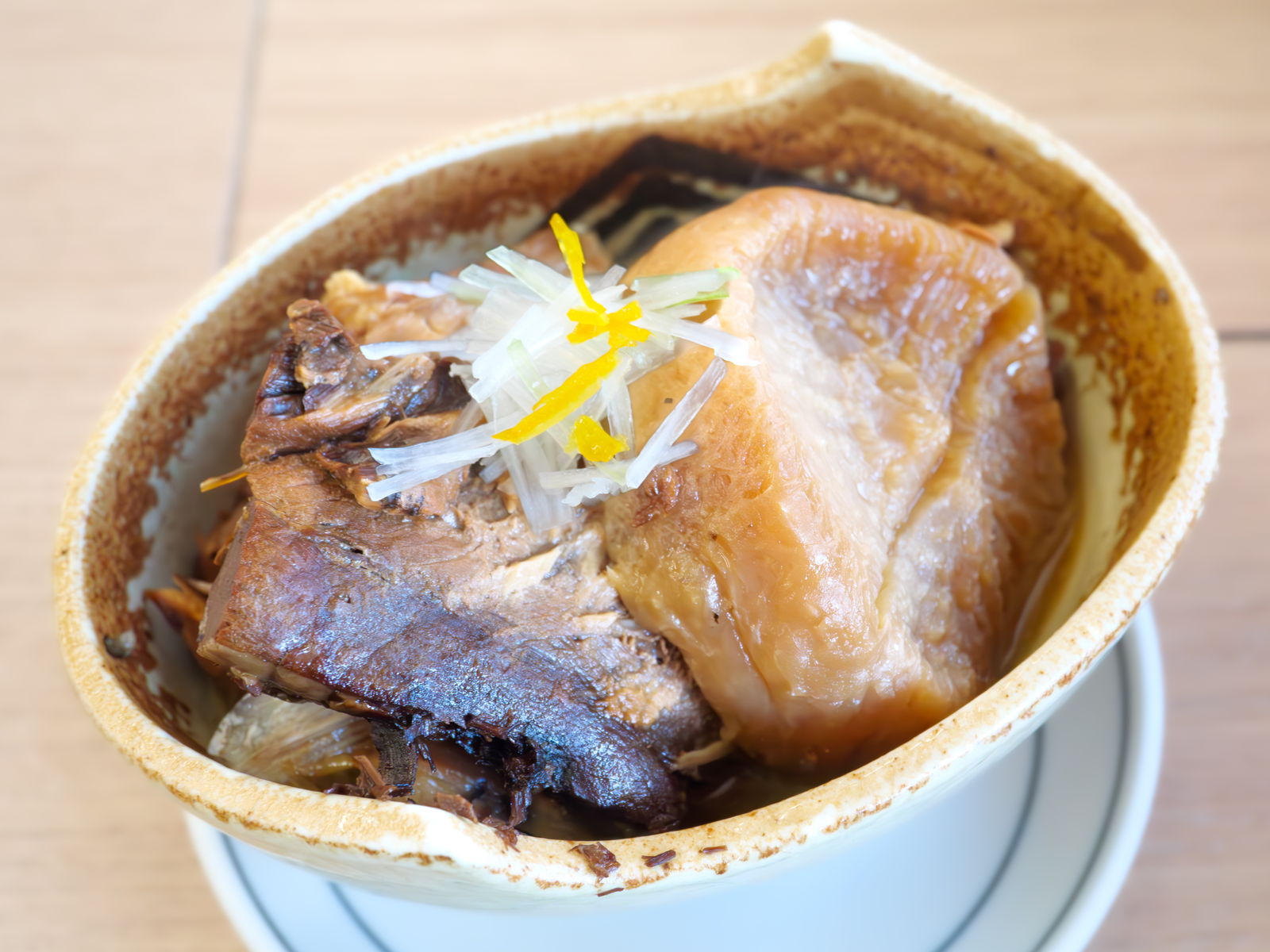
If you searched for kan-buri and the results pushed you toward Toyama, here is the shorter answer: you do not need to leave Tokyo. Kan-buri (寒ブリ, “cold-season yellowtail”) is the wild winter fish landed in the Sea of Japan and graded at ports like Himi — but it is auctioned, boxed, and on a refrigerated truck to Toyosu the same morning, where Tokyo counters buy it like everyone else. So the real question is not which famous restaurant to rank. It is two practical things: when in the December-to-February window you go, and whether you can read what the counter is actually offering. Get those right, and a buri piece in Tokyo is the same fish a Himi restaurant serves. Get them wrong, and you pay buri money for a leaner fish that is not kan-buri at all.
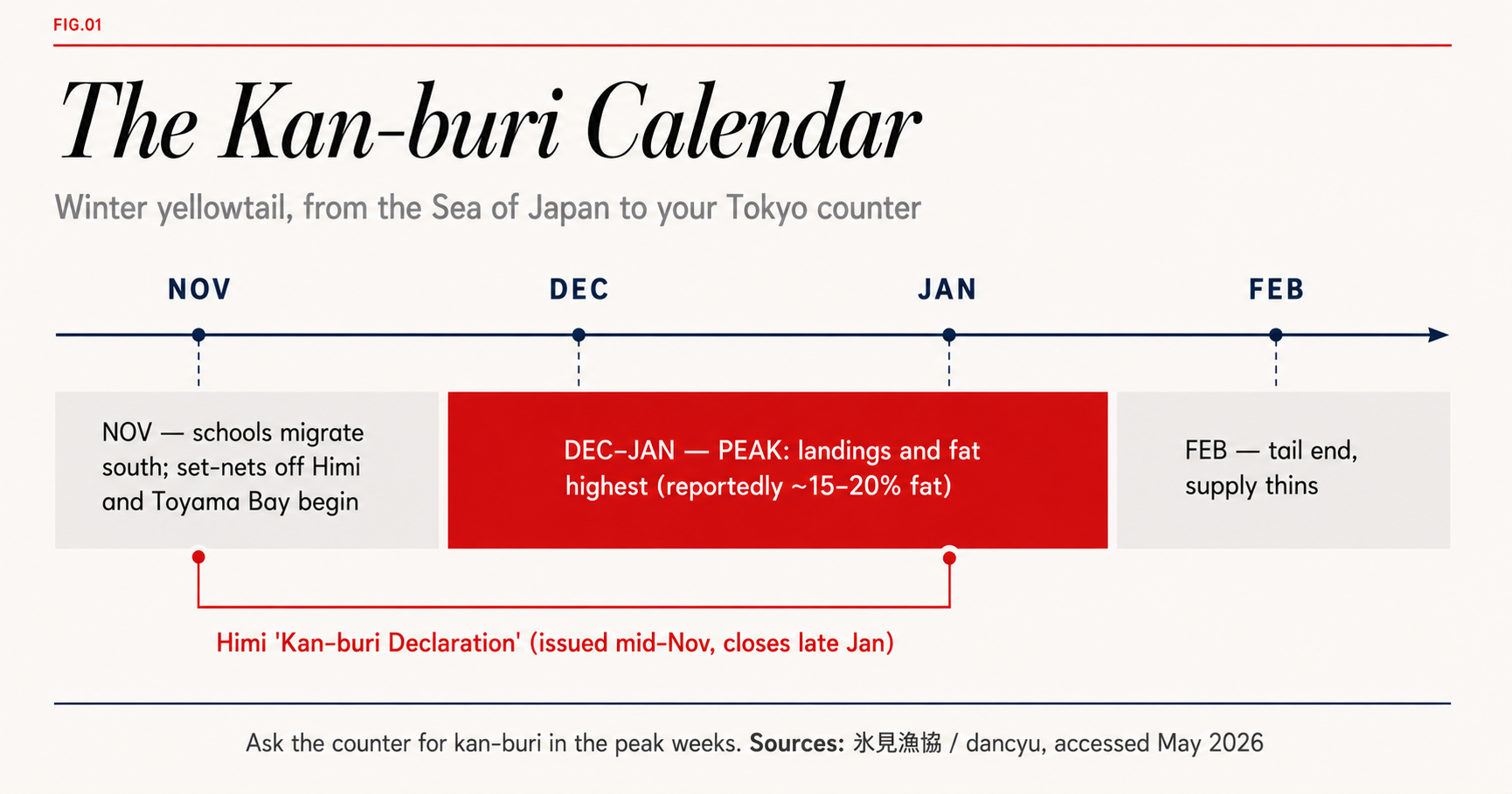
Kan-buri Reaches Tokyo Through Toyosu Every Morning
The buri that schools migrate south down the Sea of Japan from around November, fattening as the water cools, gets caught in the fixed set-nets off the Noto Peninsula and Toyama Bay. From Himi port, the graded fish moves through the wholesale chain — and a meaningful share of it lands in Tokyo at Toyosu, where buri trades daily. That is the part the regional explainer articles skip. They describe the fish at its source and quietly redirect you to the coast, as though a Tokyo eater were second in line. You are not. The supply chain ends at a wholesale floor a short train ride from where you are probably staying.
What that chain costs is worth knowing before you sit down. The Toyosu wholesale average for buri ran about ¥841 per kilogram in March 2026, up roughly 9 percent on the prior March — and that is the broad-market average, blending farmed and lesser wild fish. A whole wild, brand-graded Himi fish sells at a steep premium above that floor, which is precisely why a kan-buri nigiri (にぎり) is priced well above a piece of farmed hamachi. When a Toyosu-adjacent counter charges more for the winter cut, it is not theater. It is the fish costing more upstream.
Learn the Naming Chain Before You Order, or You’ll Pay Buri Money for Inada
Buri is a shusse-uo (出世魚, “promotion fish”) — a fish that changes name as it grows, like a clerk earning new titles. In the Kanto convention used in Tokyo, the same species is called wakashi (わかし) at around 35 cm and under, then inada (いなだ) from roughly 35 to 60 cm, then warasa (わらさ) from about 60 to 80 cm, and only at 80 cm and up does it become buri (ぶり). Kan-buri is that last stage, caught in winter, carrying the season’s fat. A menu listing inada or hamachi is offering a smaller, leaner, often farmed fish — closer in spirit, not the winter monarch.
The trap deepens in Kansai, where the chain runs differently — tsubasu to hamachi to mejiro to buri — and “hamachi,” the word most foreign diners already know, corresponds roughly to Kanto’s inada: a younger fish. So if you walk into a Tokyo counter in January, see hamachi on the board, and assume you’ve found the winter specialty, you’ve been misread by your own vocabulary. The phrase to use is kan-buri arimasu ka — “do you have kan-buri?” If the answer is yes and they can tell you where it came from, you’re in the right place. This is the same literacy we walk through in How to Behave at a Sushi Counter Without Embarrassing Yourself; the naming chain is just the seasonal layer on top.
“Himi Kan-buri” Is a Graded Brand, Not a Loose Label
The strongest provenance signal a counter can give you has a number behind it. Himi kan-buri (氷見寒ブリ) is a controlled brand, not a marketing adjective. Each season the Himi Fish Brand Council issues a formal “Himi Kan-buri Declaration,” and only buri auctioned at Himi port above a set weight qualify to carry the name — a bar the council keeps tightening to protect what the label means. It sat around 6 kilograms through the 2010s, was raised to 7 kg for the 2024 season, then to 8 kg for the 2025 season, after fishers argued that 7 kg fish were still coming in too lean. For a winter trip, the practical takeaway isn’t the exact kilogram. It’s that “Himi kan-buri” is a graded, certified brand with a grading mechanism underneath it — so if a chef says “Himi,” the honest version of that claim has a port auction behind it, not just a hometown.
That mechanism is also why a fixed January date can land you in feast or scarcity. The 2024–25 season was declared on November 20, 2024 and closed on January 20, 2025, landing 69,351 fish — reportedly one of the stronger totals in recent seasons. But seasons swing hard: a recent poor season saw under 80 tonnes landed, no declaration issued at all, and wholesale prices reportedly three to four times normal. The winter fish reportedly carries 15 to 20 percent fat against a low single-digit percentage in summer, which is the whole point of eating it now — but no one can promise a given counter will have it on a given night. The wild supply decides. What you can do is tilt the odds: ask, and ask in December or January, when the schools and the landings peak.
Eat It Where the Morning Fish Lands — and Skip the Conveyor Belt
The closest you can physically sit to the supply chain is inside the Toyosu market building itself, at Sushi Dai Toyosu (Toyosu). It runs an omakase (おまかせ, “I leave it to you”) format, so the chef serves what landed that morning — which, in December and January, makes a kan-buri piece more likely here than almost anywhere. The cost is timing: it’s open 5:30–14:00, closed Wednesdays and Sundays (accessed May 2026), takes no reservations, and the queue forms from around 5:30 a.m. with stock often gone by 10–11 a.m. This is the timing lesson made literal.
If a dawn queue isn’t your January, the accessible counterpoint is Sushi Zanmai Tsukiji Honten (Tsukiji), open 24 hours, 365 days, sourcing daily from Toyosu and running explicit seasonal campaigns — so it can put kan-buri on the board in winter at a walk-in price point, without a 5 a.m. start. West of the market, Midori Sushi Umegaoka (Shimokitazawa) is the residential, value-leaning end: big-cut, generous nigiri where a winter buri slice reads dramatically — ask what’s on the seasonal board rather than assuming. Three counters, three trade-offs: market-edge access, round-the-clock convenience, neighborhood value.
Knowing what good kan-buri looks like on the plate is what lets you judge the difference. A winter slice is paler and more marbled than a summer cut, with thin ribbons of fat running through pink flesh; left at room temperature for a minute, the surface goes faintly glossy as the fat softens. On the tongue it reads less like lean fish and more like something between tuna’s chu-toro and a slice of cured ham — rich up front, clean at the finish, with none of the metallic edge a poorly handled or farmed piece can carry. That richness is the 15-to-20-percent winter fat doing its work, and it is the single sensory tell that separates real kan-buri from a younger inada standing in for it.
One place not to chase kan-buri is a conveyor-belt or tuna-specialist counter like Maguro Bito Asakusa (Asakusa) — excellent at what it does, which is tuna on a belt, not a seasonal wild fish that may or may not have landed that morning. Kan-buri rewards the counter where you can ask a person a question. And it doesn’t stop at raw: Edomae technique cures it with kelp (kobu-jime) or soy (zuke), and the cooked winter classics are buri-daikon (ぶり大根, yellowtail simmered with radish) and buri-shabu (ぶりしゃぶ, slices swished briefly in hot broth). Raw, the fat reads as sweetness; in shabu, the heat firms the texture and seals the umami in. This is shun in its clearest form — the concept we unpack in What “Shun” Means. The fish is at its peak for a few weeks. Tokyo is where you can reach it.
Sources & Further Reading
- Kitokito Himi — 令和6年度 ひみ寒ぶり情報 (2024 declaration dates Nov 20, 2024 – Jan 20, 2025 and 69,351-fish total; accessed May 2026)
- Chunichi Shimbun — ひみ寒ぶり8キロ以上に 基準厳しく (qualifying weight raised to 8kg for the 2025 season, up from 7kg, to exclude leaner fish; accessed May 2026)
- Yoitabi — ひみ寒ぶり宣言 発表 (declaration mechanism and Himi Fish Brand Council; accessed May 2026)
- Chunichi Shimbun — 寒ブリ不漁「宣言」いつ (poor-season volatility: under 80 tonnes, no declaration, prices 3–4x; accessed May 2026)
- GD Freak — 豊洲市場 ブリ・ワラサ 月別平均卸売価格 (Toyosu buri wholesale avg ~¥841/kg, March 2026; accessed May 2026)
- 魚相場ナビ — 豊洲市場の相場 (daily Toyosu buri price tracking; accessed May 2026)
- MAFF — Buri Shabu, Our Regional Cuisines (buri-shabu and regional winter preparation; accessed May 2026)