
Why Vegetarian Is Harder Than Vegan in Tokyo
In Tokyo, “no meat” rarely means no fish — because dashi, the stock under almost everything, is made of it. Why “vegan” is the safer word than “vegetarian,” what to actually say, and the kitchens where it is already solved.
The plan sounds safe. You do not eat meat, Japanese food has a lot of vegetables and tofu and rice, so you will simply order the vegetable dishes and be fine. Then you order a bowl of simmered vegetables, a miso soup, a plate of spinach with sesame, and every single one of them contains fish — not as a visible ingredient you could pick out, but dissolved into the base, invisibly, by design.
This is the part no one warns you about clearly enough. The difficulty of eating vegetarian in Tokyo is not a shortage of plants. It is that the savoury foundation of almost the entire cuisine is made of fish, and the word “vegetarian” does not reliably communicate that you need it removed. Counterintuitively, declaring yourself vegan often gets you safer food than declaring yourself vegetarian. This piece explains why, and what to say and where to go instead.
What “Vegetarian” Translates To Here
Say bejitarian (ベジタリアン, “vegetarian”) to a Tokyo server and you have not given them the instruction you think you have given them. The loanword exists, but its meaning travelled loosely. In practice it is commonly understood as “does not eat large pieces of meat” — a category that, to many people, still leaves fish, shellfish, and fish-based stock comfortably inside the line. The Japan National Tourism Organization, the government body whose entire job is helping visitors, says this directly in its own vegetarian guidance: the concept is not widely understood, and fish or fish stock is frequently offered to self-identified vegetarians as though it were obviously fine.
The failure is rarely indifference. A server looks at a bowl of simmered pumpkin, sees no meat and no fish, and tells you honestly that it is vegetable food — because to them it is. The dried bonito that built the broth was strained out hours ago in a back kitchen they never see. They are not lying. They are answering the question they think you asked, which was about what is visible on the plate, not about what is dissolved into it. “Vegan” travelled into Japanese more recently and more precisely, often arriving already attached to the idea of “no animal products at all, including the stock.” That precision is why the stricter word frequently produces the more reliable meal.
The Stock Under Everything
The single ingredient that defeats most vegetarian visitors is dashi (出汁, the basic Japanese stock). It is not a sauce you can decline. It is the umami spine of the cuisine — the thing that makes miso soup taste like miso soup, that seasons the simmering liquid for vegetables, that goes into the egg, the noodle broth, the dipping sauce, the rolled omelette, the tofu hot pot. Most everyday dashi is built from katsuobushi (鰹節, dried fermented skipjack tuna shaved into flakes) or niboshi (煮干し, dried baby sardines), often with kombu (昆布, kelp) alongside. The kelp is a plant. The bonito and sardines are emphatically not.
This is why subtraction does not work. You cannot order a vegetable dish “without the fish,” because there was never a piece of fish to leave out — the fish was the seasoning, present the way salt is present, undetectable and structural. A clear bowl of broth with three pieces of vegetable in it is, in flavour terms, a fish dish that happens to contain vegetables. The same logic catches soy sauce for a different reason: standard shoyu is brewed with wheat, which is the trap for gluten-free travellers rather than vegetarians, but it is the same underlying point — the thing that makes the food taste right is rarely the thing you can see. If you want the wider version of this, our piece on how to read a Japanese menu covers the characters that flag what is actually in a dish.
Why the Exception Proves the Rule
Japan does have a complete, centuries-deep vegetarian tradition: shojin ryori (精進料理, Buddhist temple cuisine, literally “devotion cooking”). It was carried from China by the monk Dogen, founder of the Soto school of Zen, refined in temple kitchens for more than seven hundred years, and built on the Buddhist principle of ahimsa — non-harm. It excludes meat, fish, and even the pungent alliums grouped as gokun (五葷, the “five forbidden” — garlic, onion and their relatives). Its umami comes entirely from kombu and dried shiitake, never from anything that swam. GO TOKYO, the city government’s official travel guide, treats it as a recognised cuisine in its own right.
The instructive part is what shojin ryori’s existence implies. A separate, named, monastic discipline had to be constructed and maintained precisely because ordinary Japanese cooking is not vegetarian and never pretended to be. The default cuisine is fish-founded; the plant-based version is the deliberate exception, protected inside temples. For a visitor the lesson is strategic, not historical: do not try to extract a vegetarian meal out of a fish-based kitchen by negotiation. Go to the kitchens that were built plant-based from the start — temple shojin restaurants, dedicated vegan shops, or the small but real number of mainstream places that now run a genuinely separate vegan line.
The Sentence That Actually Works
Stop leading with the identity word. “I am a vegetarian” invites the loose interpretation. Lead with the specific exclusions, and name the stock explicitly, because the stock is the part that gets missed. A workable spoken request is niku to sakana to dashi nashi de onegai dekimasu ka (肉と魚と出汁なしでお願いできますか, “could I have it without meat, without fish, and without dashi?”). The phrase does the one thing the word “vegetarian” fails to do: it puts the invisible fish stock on the table as an explicit item to be removed.
Two tools make this dramatically easier. HappyCow, the global vegetarian and vegan restaurant database, has deep, current coverage of Tokyo and is the single most useful app a plant-based visitor can carry here; it filters for fully vegan kitchens, which sidesteps the comprehension problem entirely by removing the need to negotiate at all. And the Japan National Tourism Organization publishes a free official vegetarian-and-vegan guide with vetted listings and the exact wording to use. The strategic summary is short: in a kitchen built around fish stock, “vegan” is the safer word and a dedicated vegan or shojin restaurant is the safer room. Reserve the negotiation for places that have already done the work for you.
Where This Is Already Solved
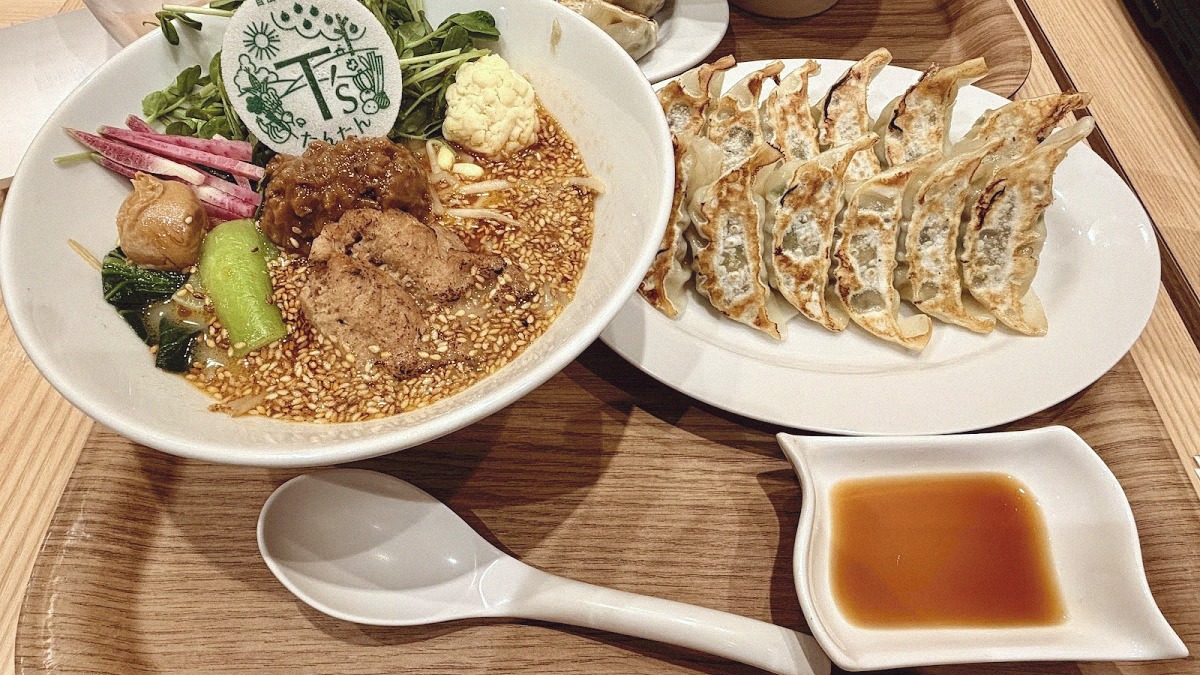
Tokyo’s plant-based scene is real and growing, concentrated in the central wards, and the most reliable options are the shops that committed fully rather than the ones that improvise. T’s Tantan, inside the ticket gates at Tokyo Station, is the cleanest demonstration of the principle: a fully vegan ramen kitchen — no meat, no fish, no dashi anywhere in the building — which means the comprehension gap simply does not exist there. You do not have to explain anything, because there is nothing on the menu to exclude. For a constrained-diet traveller moving between Shinkansen connections, a guaranteed plant-based meal at the country’s central transit point removes one of the genuine stresses of the trip.
AFURI in Ebisu makes the same point from the opposite direction. It is a mainstream, internationally known ramen shop famous for a yuzu-salt bowl built on chicken and bonito — and it has run a genuinely separate vegan ramen, on a vegetable-and-kombu base, since 2017. It is not an afterthought salad; it is a designed bowl with its own following. AFURI is the proof that the safe version of eating plant-based in Tokyo is not asking a fish kitchen to subtract, but finding the kitchens — temple, dedicated, or mainstream-with-a-real-vegan-line — that already added. Build the trip around those, carry HappyCow, and say “vegan, no dashi” rather than “vegetarian.” The food is here. It just has to be sought rather than negotiated.
Sources & Further Reading
- Japan National Tourism Organization — A Vegetarian and Vegan Guide to Japan (official guidance on the comprehension gap and recommended wording)
- GO TOKYO, the Tokyo Metropolitan Government official travel guide — Shojin Ryori (Buddhist Vegetarian Cuisine)
- HappyCow — global vegetarian and vegan restaurant database, with deep Tokyo coverage and a fully-vegan filter
- On dashi composition (katsuobushi, niboshi, kombu, dried shiitake) and why standard miso soup is not vegetarian: cross-referenced cooking references and the JNTO guide above.