
How to Eat Shibuya
The crossing everyone has seen and almost nobody eats well. In Shibuya the good food is never at eye level on the scramble — it's either up in the new towers or down a two-metre alley. The four layers, above and below the street.
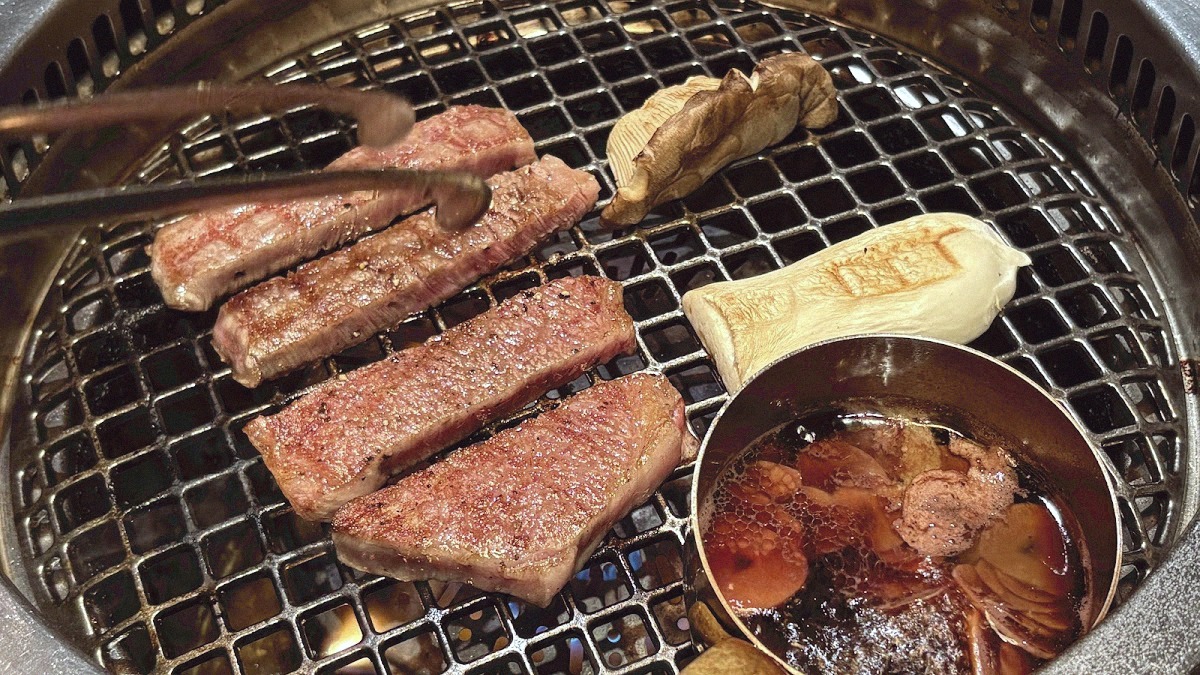
Shibuya is the crossing everyone has seen and the district almost nobody eats well. The reflex is to stand at street level near the scramble, pick the brightest sign in view, and eat exactly where the entire crowd is funnelled. That is the one place in Shibuya you should not eat. The good food here is never at eye level on the main crossing — it is either up, in the new towers, or down, in an alley two metres wide that the rebuild somehow missed.
This piece is that vertical structure: why Shibuya eats the way it does, the layers it splits into above and below the street, the order to use them, and what to walk past.
Why Shibuya Eats the Way It Does
Shibuya is the district being rebuilt fastest and the one fighting hardest to keep what it had. A decade of redevelopment stacked glass towers — Scramble Square, Stream, Miyashita Park — onto a youth-crowd street culture, while a few unrenovated postwar alleys held their ground in the gaps between the cranes. So Shibuya’s food is organised by elevation and by speed, not by cuisine: the designed, view-driven floors of the towers; the fast, solo, no-conversation feeders built to move a relentless young crowd; the tiny holdout alley where old Tokyo never left; and the cafe layer the district’s creative crowd runs on. The crossing is just the turnstile. The eating is what is layered above and below it.
The Four Layers of Shibuya
The speed layer (street level, done right). Shibuya is engineered to feed a crowd fast and alone, and it is excellent at it: Ichiran turns tonkotsu into a private booth transaction, Uobei on Dogenzaka is touch-panel conveyor sushi at maximum velocity, Gyukatsu Motomura is the grill-it-yourself beef cutlet, and Kushikatsu Tanaka is the cheap fried-skewer crowd-pleaser. The holdout layer (down a two-metre alley). The reason to stay after dark: Toritake is the old-school yakitori the redevelopment did not touch, the kind of counter Nonbei-Yokocho-era Shibuya was built on. The long-table layer. Group eating has its own format here — Han no Daidokoro for the serious yakiniku occasion, Kurand Sake Market for the self-serve all-you-can-pour sake room that only works in a district this young. The cafe layer. Shibuya’s creative crowd runs on third-wave coffee: Fuglen Tokyo is the Oslo coffee-by-day, cocktails-by-night hybrid, and Streamer Coffee is the latte-art benchmark — the layer that resets you between the others.
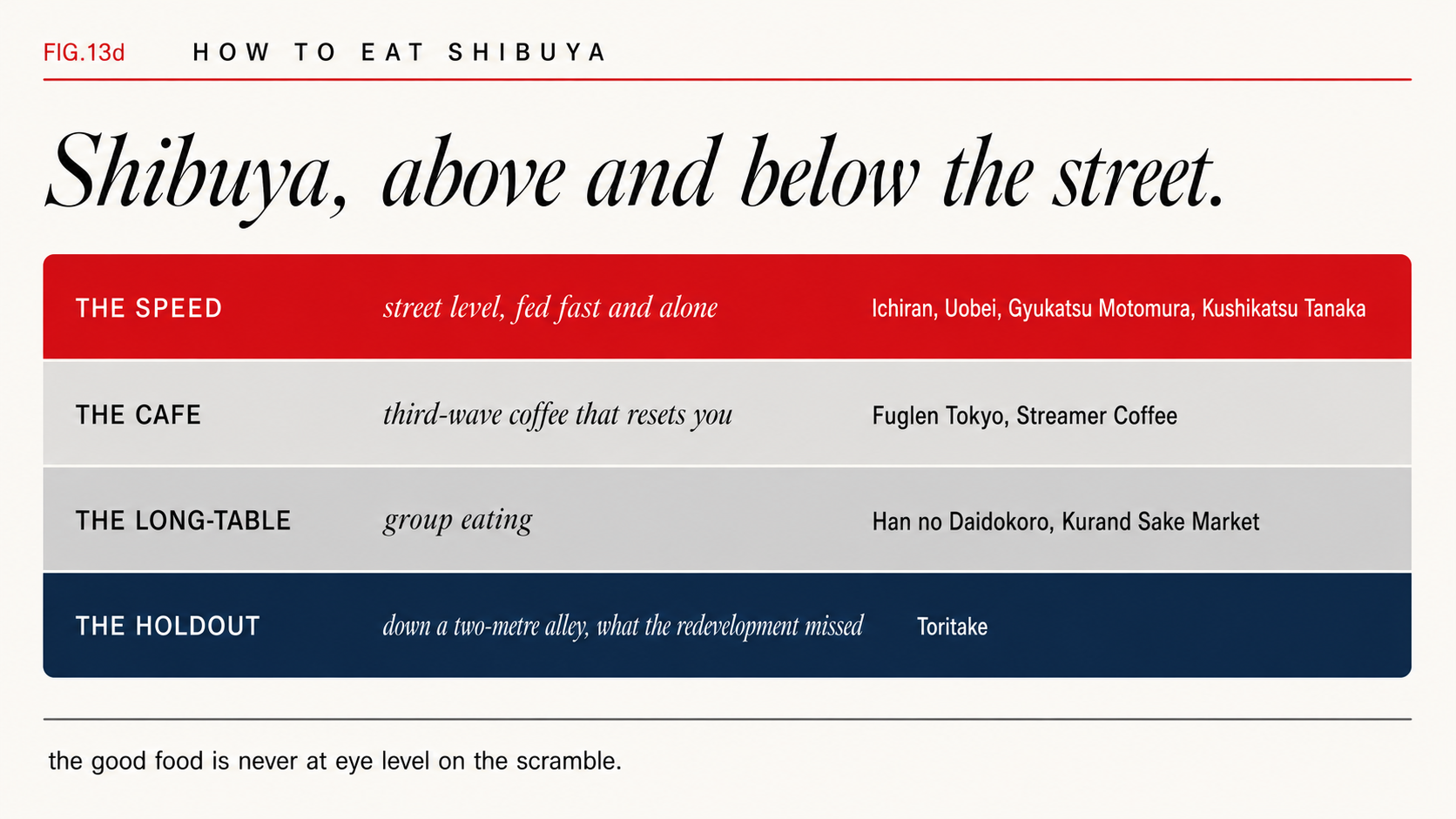
How to Actually Eat Shibuya
Work it as a vertical, not a map. Use the speed layer in daylight, when the crowd is the enemy and a fifteen-minute solo bowl is the win — Ichiran or Uobei, walked into off-peak, then out. Use the cafe layer as the deliberate pause: a Fuglen or Streamer stop is not a detour in Shibuya, it is the thing that makes the density survivable. Save the night for the holdout layer — a yakitori counter down a narrow lane is the Shibuya worth staying for, and the one the towers cannot reproduce. Keep the long-table layer for when you are a group with an actual evening to spend, not a gap to fill. The sequence that works: fast and low by day, slow and narrow by night, coffee in between — and the towers only when you specifically want the view with the meal, never as the default.
What to Skip, and the One Rule
Skip eating at street level on the scramble itself, which is priced and placed for people who will never come back; skip the tower restaurant floors unless the view is the point you are paying for; and skip judging Shibuya by its daytime crush, because the district only resolves after dark in the alleys. For the connective logic, the yokocho guide covers the holdout-alley etiquette, the Tokyo coffee belts piece places the cafe layer, and the sibling pillars how to eat Shinjuku and how to eat Asakusa run the same layer-reading method on districts that resolve completely differently. The one rule for Shibuya: never eat at eye level on the crossing — in this district the food is always either above the street or below it.
Sources & Further Reading
- Tokyo Cheapo — Shibuya area guide (Center-gai / Dogenzaka structure; the redevelopment context)
- Magical Trip — Shibuya Nonbei Yokocho, a 70-year tradition (the unrenovated two-metre holdout alley; 4-8 seat counters)
- Magical Trip — Shibuya nightlife guide (Miyashita Park / Shibuya Yokocho; the night structure)
- BESPES — Shibuya: Tokyo’s dynamic entertainment district (the tower redevelopment; Scramble Square / Stream)
- Time Out Tokyo — the best yokocho alleys for eating and drinking (Nonbei Yokocho’s place among Tokyo’s holdout alleys)