
Chain vs Independent: When the Chain Is the Right Answer in Tokyo
“Avoid chains, eat independent” is an imported rule that costs you good meals in Tokyo. The oldest fast-food chain on earth is Japanese (1899) for a reason — why the binary breaks here, and the exact hours the chain is the correct choice.
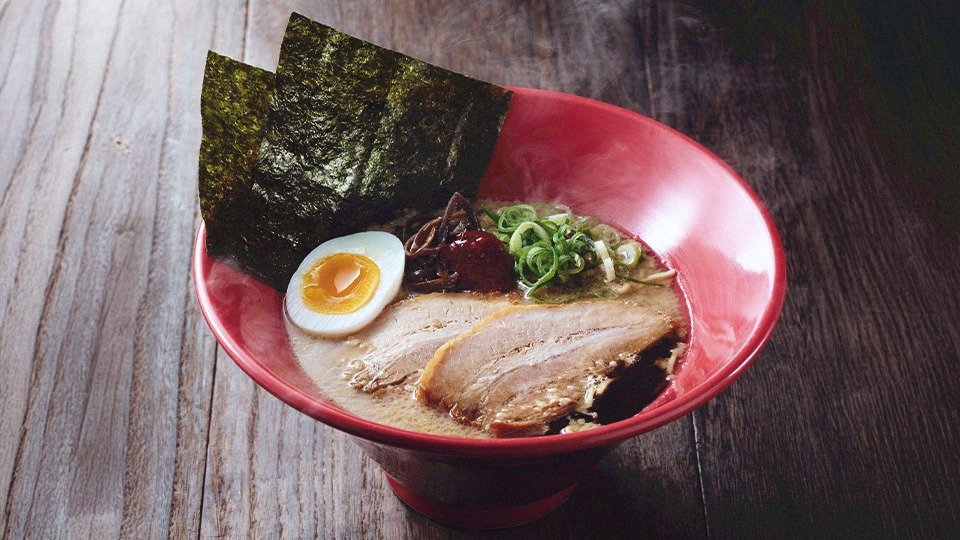
Travellers arrive carrying a rule imported from home: avoid chains, eat independent, the chain is where flavour goes to die. In most of the world that rule is sound. In Japan it quietly costs you good meals, because the premise underneath it — that scale and care are enemies — is not how eating here is built. The reflex is not wrong so much as miscalibrated for the country it landed in.
This piece resets it: why the chain-versus-independent binary breaks specifically in Tokyo, why the two are better understood as parallel disciplines than as a quality ladder, and the precise situations in which the chain is not the compromise but the correct choice.
Why the Binary Breaks Here
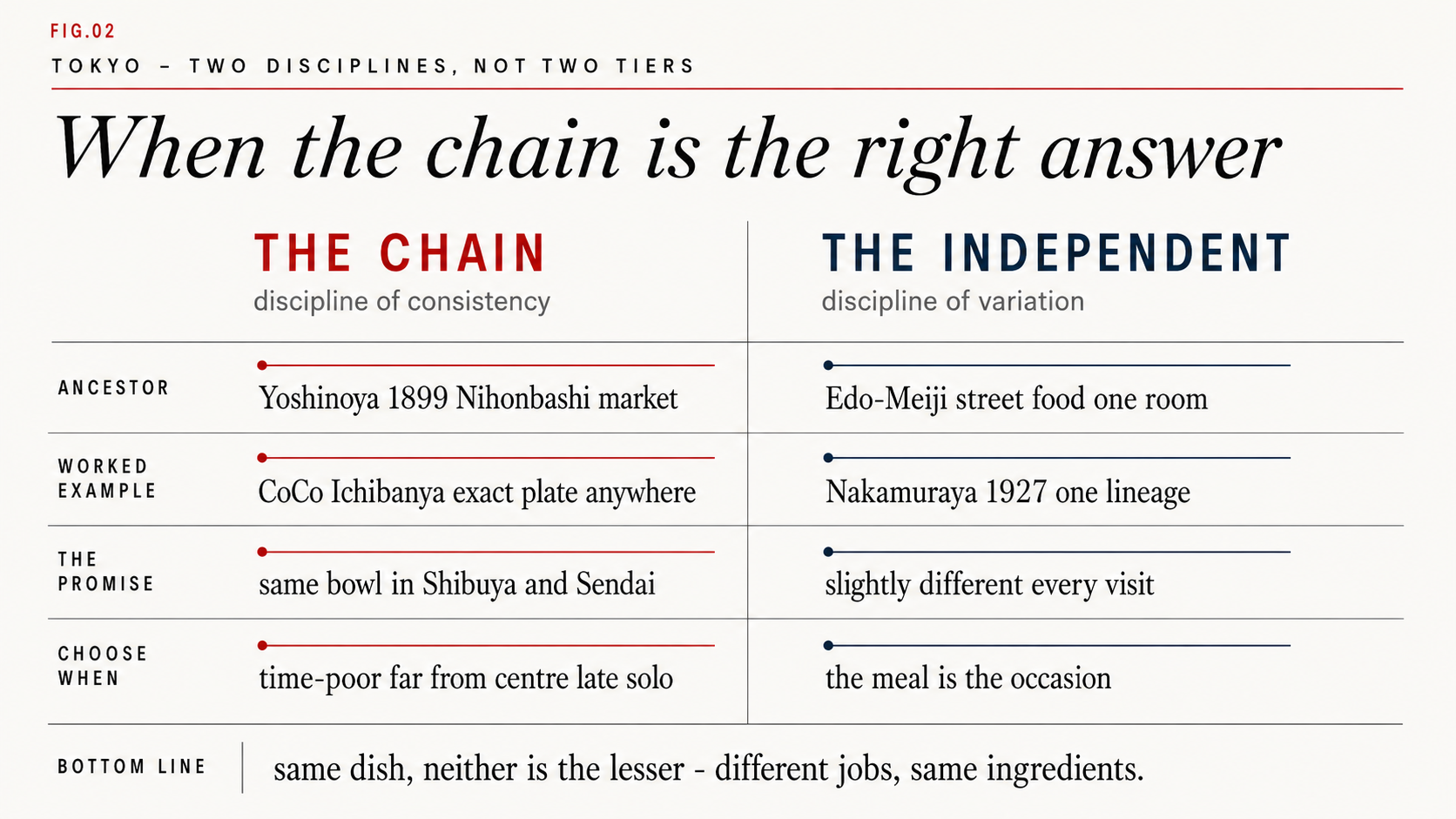
Start with a fact that reframes everything: the oldest fast-food chain in the world is Japanese. Yoshinoya opened in 1899 at the Nihonbashi fish market, feeding market workers a single dish — gyudon (牛丼, beef bowl) — fast and cheap, on the motto “tasty, low-priced, quick.” It did not descend from some soulless industrial line opposed to the craftsman. It came from exactly the same place the great independents did: Edo and Meiji street food, one dish made for working people who needed it hot and now. The chain and the artisan share an ancestor here. That shared origin is why the floor is so high: a Japanese chain typically perfects one thing, buys for that one thing at national scale, and — in a no-tipping economy that cannot hide labour cost in a gratuity — survives only by being genuinely good at it. Single-dish specialisation is not the opposite of craft. In Japan it is a form of it.
Two Disciplines, Not Two Tiers
Read the chain and the independent as two answers to one question — how do you make this dish reliably excellent? — and the hierarchy dissolves into a pair of disciplines. The chain practises the discipline of consistency: the same bowl, engineered so it is the same in Shibuya at noon and in Sendai at midnight, the variable removed on purpose. The independent practises the discipline of variation: the cook’s hand, the day’s fish, a thing that is slightly different every visit because a person is deciding it each time. Curry is the cleanest worked example. CoCo Ichibanya is the consistency discipline taken to its limit — you build the exact plate, to the spice number, identical anywhere in the country. Nakamuraya, serving its own curry in Shinjuku since 1927, is the variation discipline: one room, one lineage, not reproducible by design. Same dish. Neither is the lesser. They are doing different jobs with the same ingredients.
When the Chain Is the Right Answer
Because the floor is high, the chain stops being a fallback and becomes a tool you should reach for deliberately in specific conditions. When you are jet-lagged and decision-fatigued and one more illegible menu will end you, the chain removes the decision and still feeds you well. When it is late or you are alone and the independent rooms are closed or daunting, the chain is open, lit, and unbothered by a solo diner. When a dietary line actually matters — a controllable allergen, a hard no — a standardised national menu is more predictable than a one-off kitchen improvising. When the budget has a real ceiling, a sub-five-hundred-yen plate that is genuinely good is not a defeat. When you want a regional or canonical dish executed to a known standard so you have a baseline before you go chase the artisan version, the chain is the calibration instrument. And with children or a picky eater, the predictable room beats the brilliant gamble. In all of these the chain is not what you settle for. It is the right instrument for that hour.
How to Use Both
The move is not to pick a side but to deploy each where it wins. Use the chain as baseline and safety net: Ichiran is the solo-booth tonkotsu that turns a daunting dish into a private, no-Japanese transaction; Uobei is the chain conveyor done fast and cheap; AFURI is the rare case of a craft style that scaled without falling. Then spend your scarce, high-attention meals on the variation discipline — Tonki, the tonkatsu theatre running since 1939, Tsunahachi, counter tempura since 1924, and Nakamuraya for the curry the chain is a reliable echo of. The supporting reads: the cost-of-eating guide for why the chain floor protects a budget, solo dining in Tokyo for why the chain is the easiest table when you are one, and the restaurants you can walk into for the no-queue logic the chain shares. The rule that survives: in Tokyo the question is never “chain or independent.” It is “which discipline does this hour of my trip need.”
Sources & Further Reading
- Wikipedia — Yoshinoya (founded 1899, Nihonbashi fish market; the single-dish, low-price model)
- Wikipedia — Gyudon (the dish; Sukiya / Yoshinoya / Matsuya specialisation)
- Encyclopedia.com — Yoshinoya D & C Company Ltd. (the procurement-network quality argument; fast-food pivot)
- MATCHA — gyudon: Japan’s four major chains compared (consistency-at-scale; price and speed benchmarks)
- Japan Dev — guide to Japanese chain restaurants (Saizeriya price floor; Marugame in-store fresh-noodle making)