
Tokyo’s Two Coffee Cultures — Specialty Roasters and the Kissaten Underground
Tokyo has more coffee shops per capita than any other major Asian city, distributed across two parallel cultures that barely overlap. Knowing which one you are walking into changes what you order, what you pay, and what the staff expects of you.
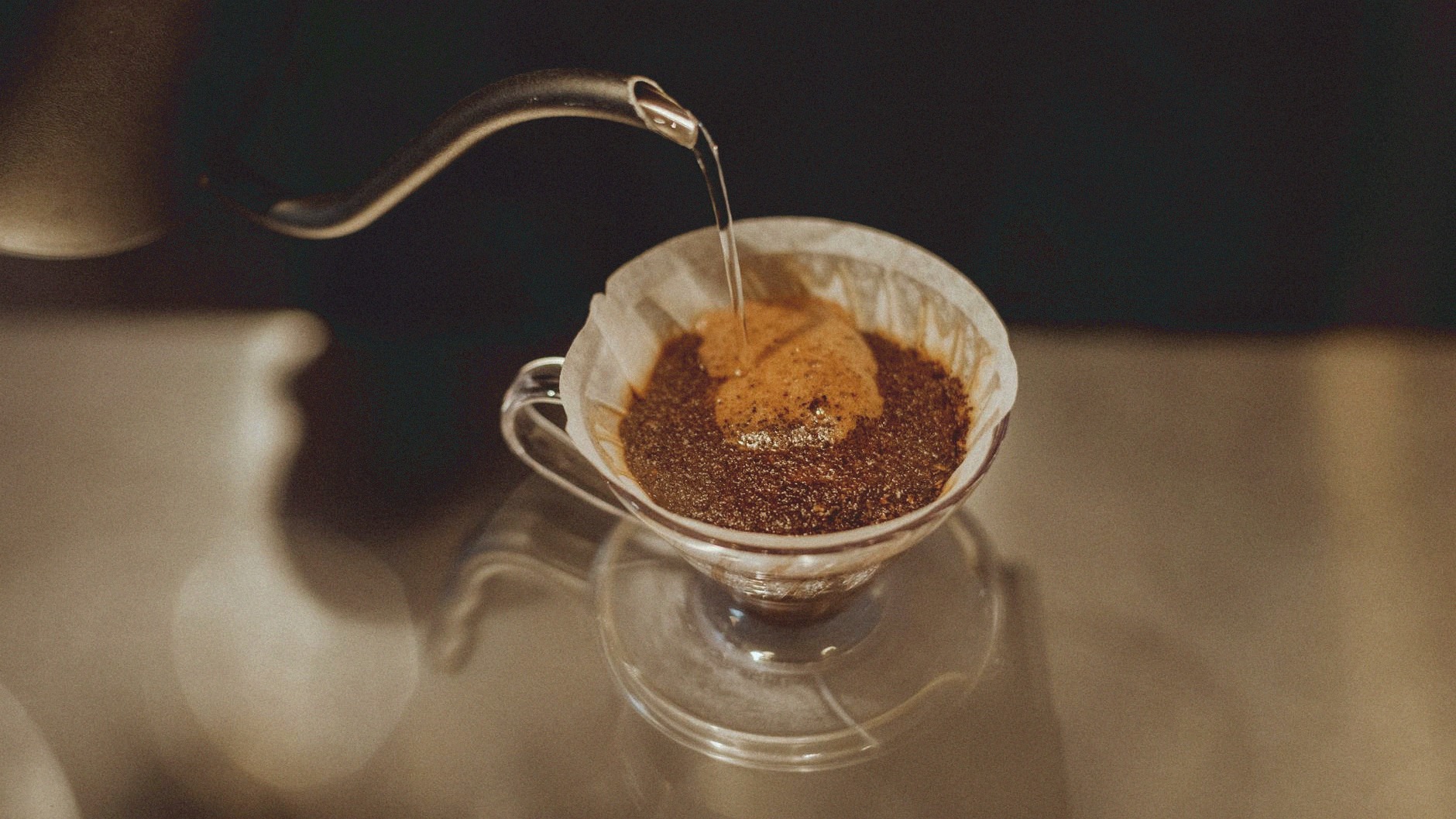
If you order coffee in Tokyo, you are entering one of two cultures. The first is the global third-wave specialty scene — single-origin pour-overs, Scandinavian aesthetics, Instagram-grade interiors, baristas who weigh beans to the gram. The second is the postwar Japanese kissaten (喫茶店) tradition — dark wood, deep leather booths, an older proprietor working alone behind a copper-tinted counter, brewing siphon coffee at a pace the modern cafe industry would not tolerate.
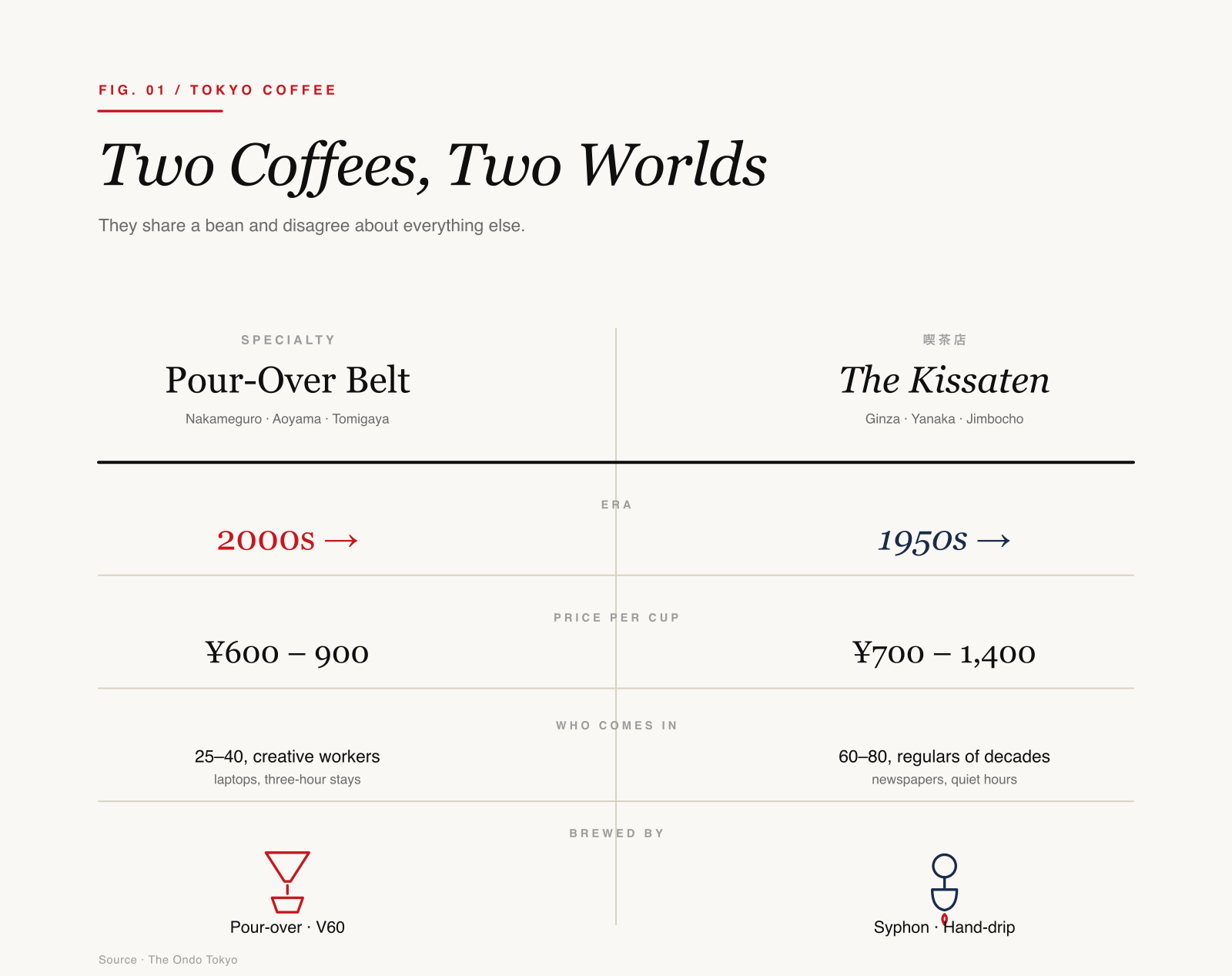
These two scenes share a beverage and almost nothing else. They cluster in different neighborhoods, attract different customers, charge different prices, and use the word “coffee” to describe what is functionally a different ritual. Knowing which one you are walking into is the difference between a satisfying ¥600 stop and a confusing ¥1,400 one, or vice versa.
The Specialty Belt: 1990s to Now
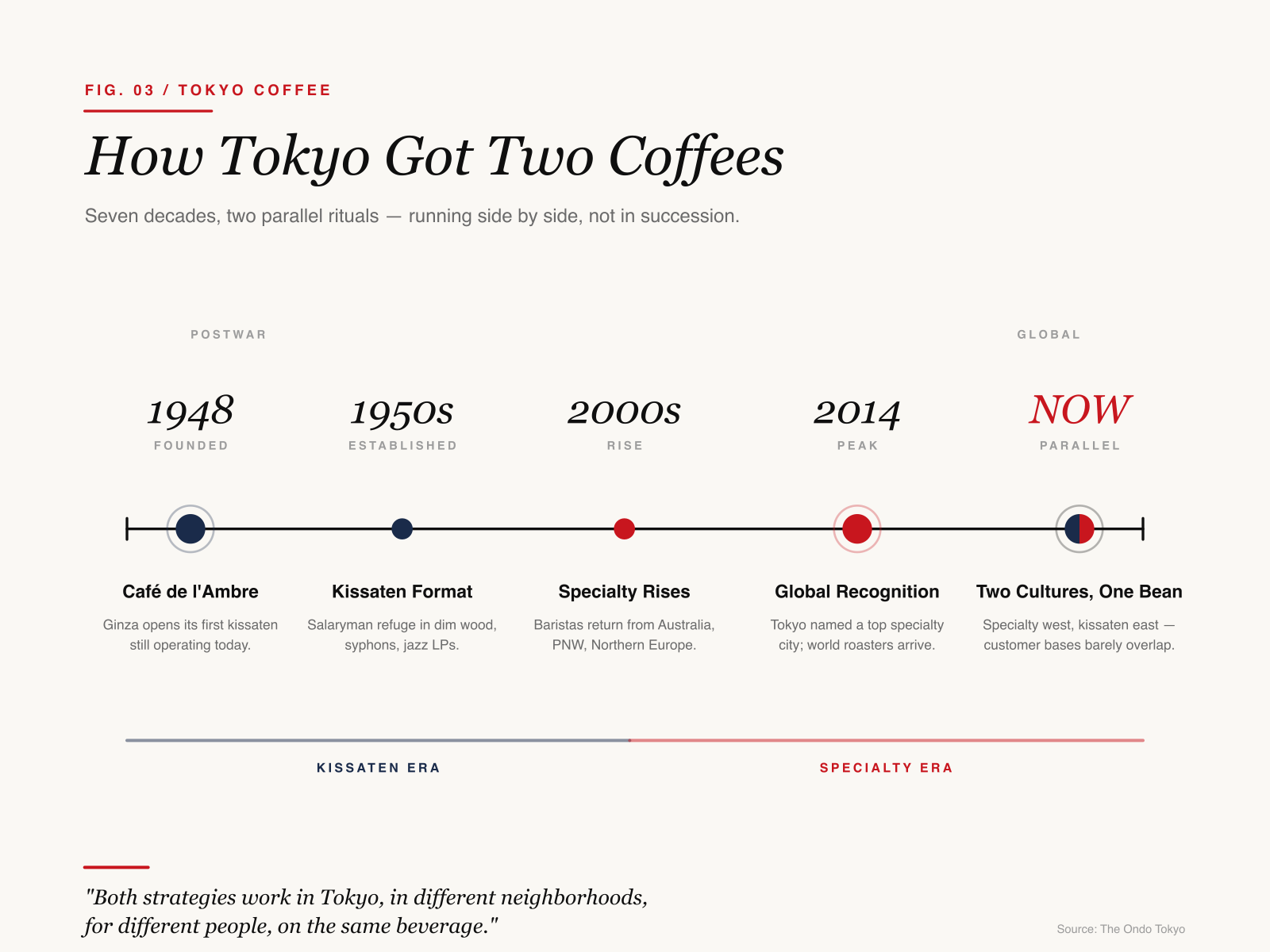
Tokyo’s specialty coffee scene began in earnest in the early 2000s, accelerated by Japanese baristas returning from training in Australia, the Pacific Northwest, and Northern Europe. By 2014, Tokyo had become a globally recognized specialty city, and several of the world’s leading roasters had either opened branches here or licensed their beans through Japanese operators.
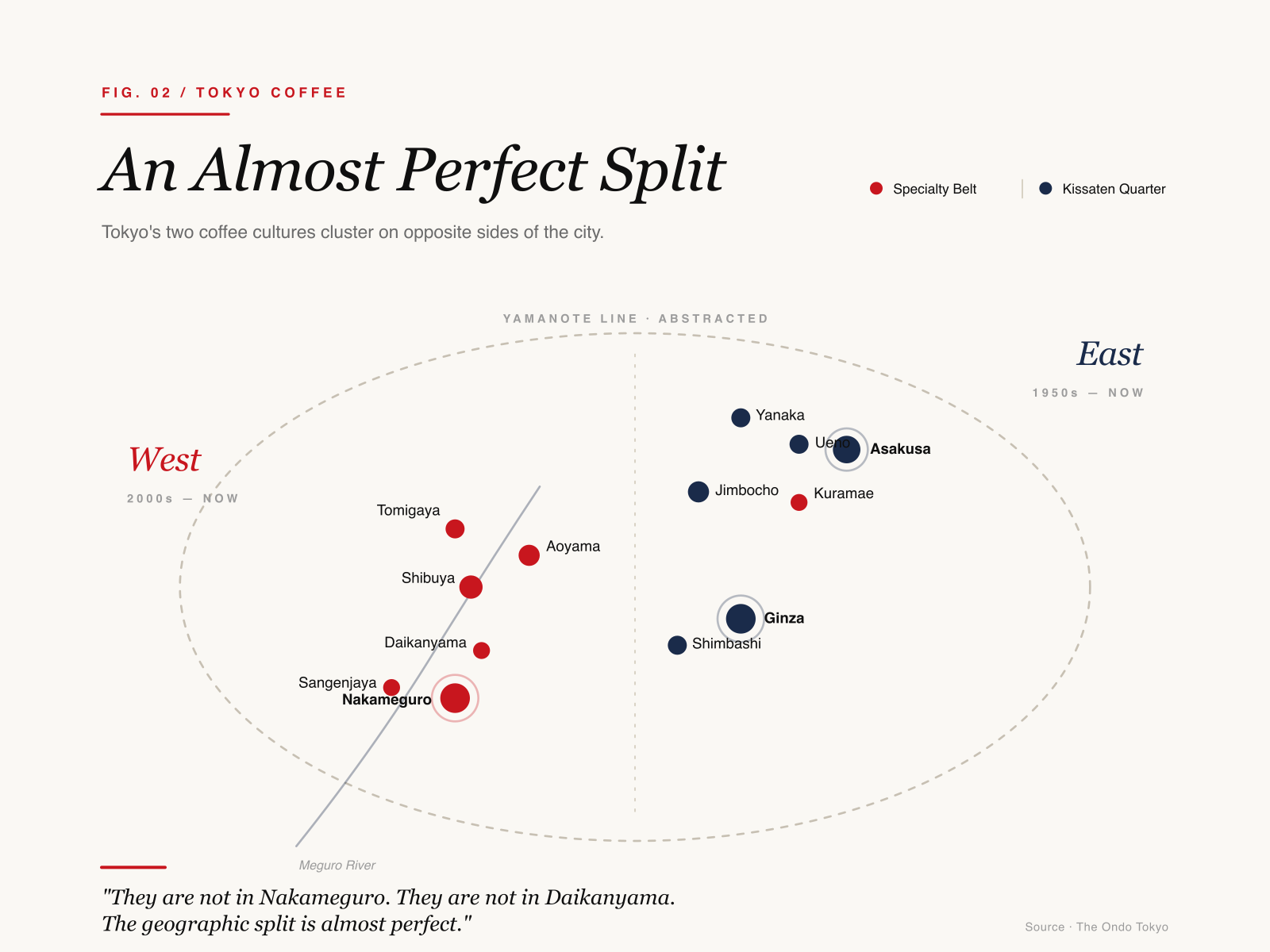
Geographically, the specialty scene has settled into a clear belt running through Tokyo’s western and central wards. The densest clusters are in Nakameguro (around the Meguro River), Aoyama and Shibuya (in the design and fashion zones), Daikanyama, Sangenjaya, Kuramae, and pockets of Asakusabashi. These neighborhoods share a customer base: 25-to-40-year-old creative-industry workers, students, and tourists, with high disposable income and low time pressure.
The specialty format is consistent across these shops. A pour-over bar with five to seven brewing stations, a roaster either in the same building or visible through a glass wall, a menu of three to six single-origin beans listed by farm and altitude, prices of ¥600 to ¥900 per cup. The interior is bright, the music is folk or low-fi electronic, and the staff are usually in their late twenties. The expected customer behavior is to order, pay, sit, work or read for one to three hours, and order one more drink at the halfway point. Most specialty cafes have free Wi-Fi and outlet access at every seat.
Three shops define the genre and are worth knowing as references: Fuglen Tokyo in Tomigaya (the Norwegian-owned shop that ran the third-wave wave), Onibus Coffee in Nakameguro (Japanese-owned, single-origin focused, multiple branches), and Sarutahiko Coffee in Ebisu and across central Tokyo (one of the larger Japanese specialty operations).
The Kissaten: 1950s, Largely Unchanged
The kissaten is older, weirder, and increasingly endangered. The format was established in the late 1940s and 1950s, when coffee — a Western import — became affordable to the rebuilding Japanese middle class. The kissaten was the place a salaryman could go after work to read the newspaper, smoke (kissatens were the last interior smoking holdouts in Tokyo for decades), drink one cup of coffee for an hour, and not be expected to leave.
The visual signature is consistent across surviving kissatens: dark wood interior, low ceilings, deep red or green leather seating, a wall of coffee filters and copper kettles behind a counter, brass-and-glass syphon brewers heated by alcohol burners. The lighting is dim by design — kissatens were intended as refuges from fluorescent offices. The music, when there is music, is jazz from the 1950s to 1970s.
The proprietor is almost always a single person, usually 60 to 80 years old, who has been operating the same shop for 30 to 50 years. They make every cup themselves, by syphon or sometimes by hand-drip. A single coffee takes four to six minutes to prepare. The price is typically ¥700 to ¥1,400 — higher than specialty for what is, in raw coffee terms, often older beans and less-controlled extraction. The price is not for the coffee. The price is for the chair, the time, the silence, and the proprietor’s continued operation of a business that does not scale.
Kissatens cluster in Tokyo’s older eastern and central neighborhoods: Ginza, Asakusa, Jimbocho (the bookshop district), Shimbashi (the salaryman district), Yanaka, Ueno. They are not in Nakameguro. They are not in Daikanyama. The geographic split between the two coffee cultures is almost perfect.
How They Differ in Practice
The mechanics of using each are different in ways that matter.
Order styles. At a specialty cafe, you order at the counter, pay in advance, and either wait or take a numbered receipt that the staff will call out. At a kissaten, you sit first, the proprietor brings water and a hot towel (oshibori), you order from the menu, and you pay at the end. Walking up to a kissaten counter to order is a minor faux pas at most older shops. Walking into a specialty cafe and sitting first will produce confused looks.
Pace. A specialty cafe expects you to stay one to three hours. A kissaten expects you to stay one to two hours, but the relationship to time is different. At specialty, time is yours; at kissaten, time is the proprietor’s, and you are renting a chair in their space. Looking at your phone the entire visit at a kissaten reads as rude in a way it does not at specialty.
What to order. At specialty, the right move is a pour-over of whatever the staff recommends that day. At a kissaten, the right move is what the establishment specializes in — usually a house blend coffee (often labeled buren-do, ブレンド) or a syphon-brewed single bean. Many kissatens also have a small food menu — a thick toast set in the morning, an old-fashioned napolitan spaghetti at lunch, a hand-cut sandwich. These are not after-thoughts; they are part of the ritual.
Behavior. Specialty cafes are working spaces — laptops, conversations, occasional phone calls. Kissatens are quiet by convention, and many have explicit signs banning laptop use, phone calls, or both. Reading a book or a newspaper is the dominant activity. Conversations exist but are quiet.
Why Both Survive
The simple economic explanation is that the two formats serve different needs. The specialty cafe is for the digital-economy worker who needs three hours of working space, decent coffee, and Wi-Fi. The kissaten is for the older Japanese customer (and an increasing minority of younger ones) who wants to be unreachable for an hour in a space that has not been redesigned in their lifetime. The customer bases barely overlap, and the two markets do not compete for the same euros.
The deeper reason is that the kissaten’s value proposition is not coffee — it is continuity. A 70-year-old proprietor who has run the same shop since 1972, in a building that has not been renovated, is offering something the specialty system structurally cannot offer: a fixed point in a city that rebuilds itself every decade. The kissatens that have survived have done so because they have committed to not changing. The specialty cafes that thrive have done so because they have committed to constant evolution. Both strategies work in Tokyo, in different neighborhoods, for different people, on the same beverage.
How to Choose Which
If you have one coffee stop in a Tokyo day, choose by what kind of break you need.
Choose specialty if you want to work for two hours, photograph your drink, taste a coffee that compares with the best of Melbourne or Oslo, and spend ¥600 to ¥900. Walk to Nakameguro, Aoyama, Tomigaya, or Kuramae.
Choose kissaten if you want to sit silently for an hour in a space that feels like the early 1970s, drink syphon coffee made by an 80-year-old, eat a thick slice of buttered toast, and not be on your phone. Walk to Ginza (Café de l’Ambre, founded 1948), Yanaka (Kayaba Coffee, in a 1916 wooden building), or Jimbocho (any of the dozen kissatens still operating around the bookshop district).
Choose both, on different days, if you want to understand what Tokyo coffee actually is — which is not one culture, but two cultures sharing a bean and disagreeing about everything else.