
Where to Try Shirako (Fugu Milt) in Tokyo, Winter 2026-2027
The famous fugu version is real but reservation-only and four figures. The shirako you'll actually meet in a Tokyo winter is cod milt — a ¥800-1,300 izakaya special with a peak window that closes by mid-February. Here's how to decode it, time it, and order it.
Here is the thing nobody tells you before you go looking for shirako (白子, “white children,” the milt of a male fish) in Tokyo: the version you will actually eat this winter is almost certainly not the famous pufferfish one. It is cod. Specifically Pacific cod, madara (真鱈, “true cod”), poached and served cold under citrus-soy as shirako ponzu (白子ポン酢) for roughly ¥800-1,300 at an ordinary izakaya you can walk into tonight. The fugu version — the one every restaurant listicle steers you toward — is real, but it lives inside reservation-only fugu courses that run ¥20,000 and up. Most travelers conflate the two and then either overpay or skip the dish entirely. You do not have to.
This is a guide to ordering shirako in Tokyo in the winter of 2026-2027: what it is, plainly; which fish you are eating at which price; the surprisingly narrow window when cod milt is at its best; and the three forms you will see on a menu. We are not going to dress it up as a dare. It is a winter delicacy with a season, a price ladder, and a clear best way to meet it.
Shirako Is Milt, and the Cod Version Is the One You Want
Let’s decode it once, cleanly. Shirako is the sperm sac — the milt — of a male fish, eaten for its texture: soft, custard-like, somewhere between sea urchin and a warm panna cotta when it’s good. The English-language internet tends to lead with the word “semen” for shock value. That framing tells you nothing useful. What matters is which fish, because the fish decides the price, the season, and where you’ll find it.
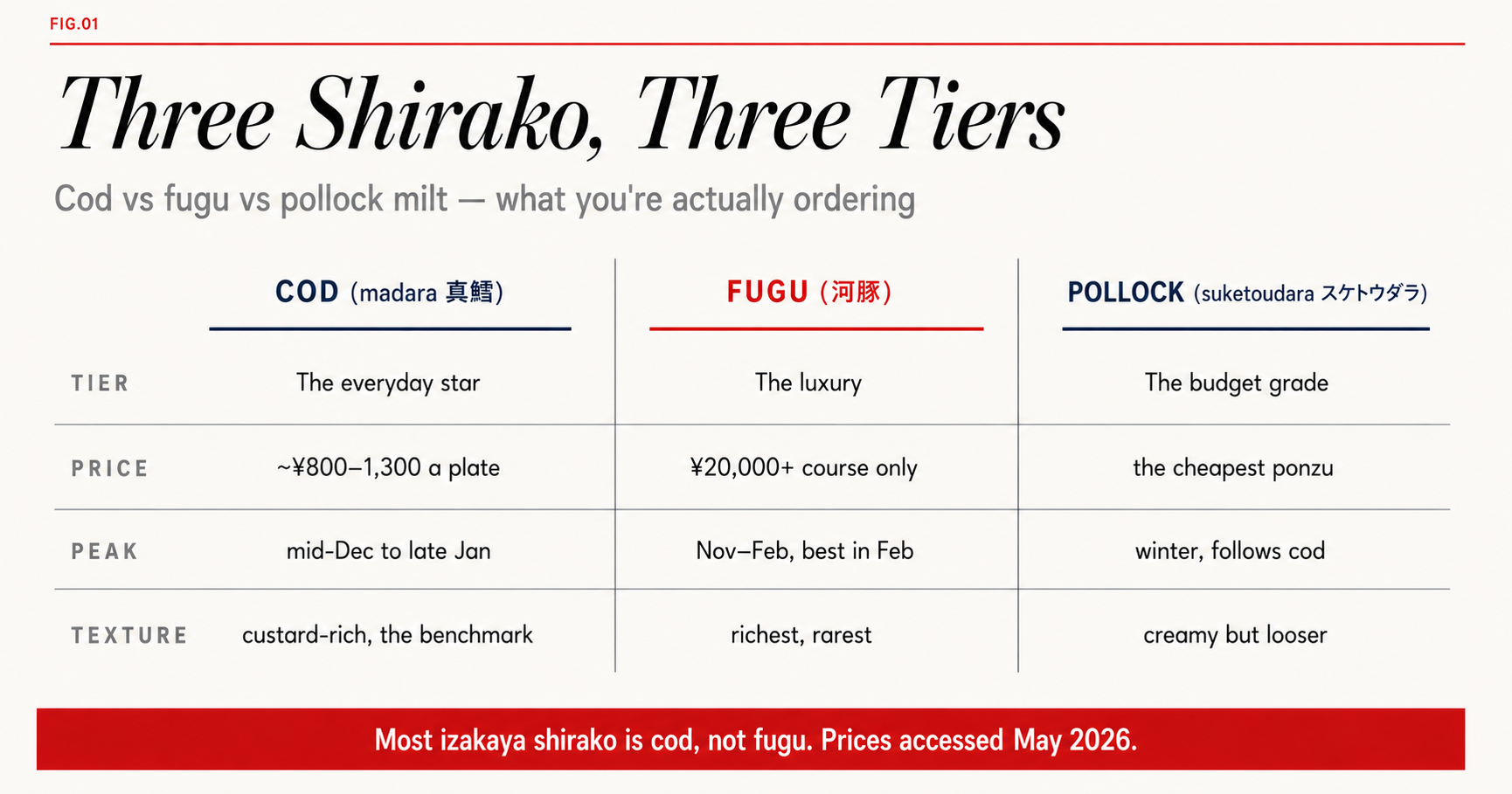
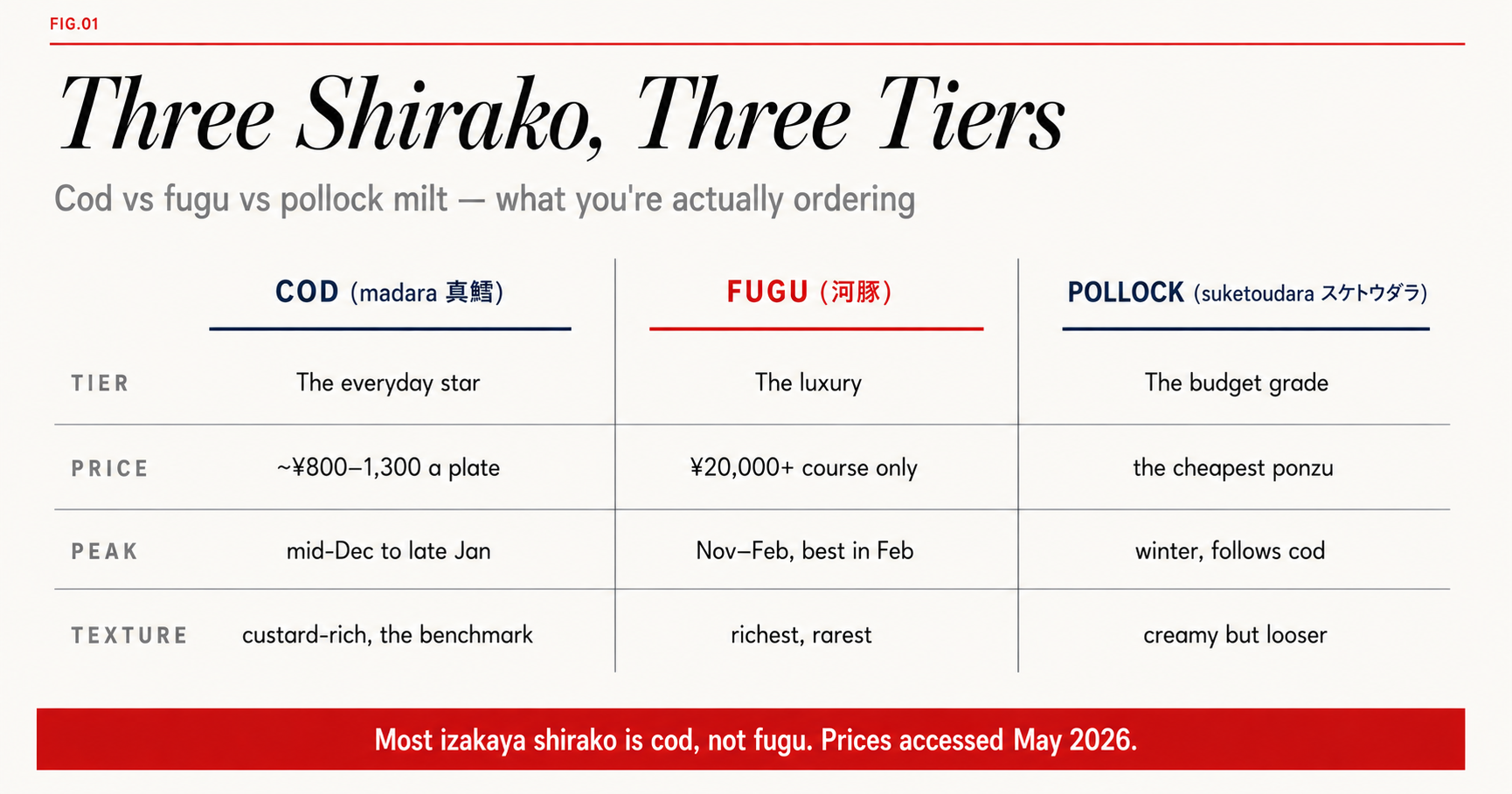
Three fish supply most of Tokyo’s shirako. Pacific cod (madara) is the everyday star — its milt, called madachi in the trade, is prized enough that fishmongers describe it as rivaling fugu milt in flavor. Pufferfish (fugu, 河豚) is the luxury tier, the rare four-figure-course version. And walleye pollock (suketoudara, スケトウダラ) supplies the budget grade, called sukedachi — smaller, looser, creamy but rated a notch below cod, which is part of why izakaya prices for “shirako ponzu” vary so much. When a chalkboard just says 白子 with no fish named, assume cod. That is the default, and it is the one worth knowing.
There’s a quiet oddity here worth carrying with you. For cod, the male is the prize. Across most fish the egg-bearing female commands the premium — think of roe. With madara it flips: the female’s roe (mako, 真子) comes wrapped in a dark membrane and sells cheap in supermarket trays, while the male’s white milt is the delicacy people line up for. If you want to understand why a single winter fish shows up on every izakaya board in January, that inversion is the reason.
The Window Is Narrower Than the Guides Admit
Most English explainers give a lazy “January to March” for shirako season. The Japanese sources are sharper, and the difference matters if you’re timing a trip. Madara is landed roughly December through March, but the best cod milt sits in a short stretch from mid-December to late January. After mid-February it turns abruptly watery — the texture thins, the richness drops, and what was custard becomes something closer to broth. The fish is still on menus into March; the magic is not.
Fugu milt runs on a slightly later clock. Wild tiger pufferfish and their milt peak from around November through February, with February cited as the milt’s single best moment — by then a male’s sac can reach toward a kilogram, where in November it was the size of a thumbnail. So if you are in Tokyo across the holidays and into January, you are squarely in cod-milt prime time. If you come in February and want the very top of the season, that’s the fugu-course window — at fugu-course prices.
This is exactly the kind of timing logic the Japanese seasonal framework is built for. The concept of shun — peak, rising, fading — explains why a regular at a Shinjuku counter will order shirako ponzu in early January without a second thought and quietly stop asking for it by March. It is the same instinct that governs how Tokyo eats in summer, just pointed at the cold half of the calendar. Eat shirako when the city is eating it, and you’ll never get the watery late-season version.
One more thing the trip-timer should know: this is wild seafood on a seasonal menu, not a fixed dish. Any given izakaya carries shirako in winter when supply is good, not as a year-round guarantee. If it’s on the board, order it. If it’s not, it’s the season or the day, not the shop.
Cod, Fugu, Pollock — How to Read the Price Ladder
The single most useful map for a traveler is the one no SERP result draws: which shirako you meet at which tier, and which one you can simply walk into. The diagram below lays out the three fish side by side, but the short version is this. Cod milt is the everyday izakaya item — a winter seasonal special at roughly ¥800-1,300 a plate, no reservation, no ceremony. Pollock milt is the cheaper cousin, often what you’re getting when a low-priced shirako ponzu turns up at a budget chain; perfectly good, slightly looser. Fugu milt is the rare one, almost always bundled inside a multi-course fugu meal at a licensed specialist, which is where the ¥20,000-plus figure comes from. There is no walk-in fugu-shirako-by-the-plate tier in the way there is for cod.
Regional names add a small layer of confusion you can now decode. The same cod milt is called tachi in Hokkaido, tazu in Aomori, kiku in Iwate and Miyagi, dadami in parts of Akita, Yamagata and Fukui, and kumoko in Kyoto. In Tokyo you’ll mostly just see 白子, but if a Hokkaido-themed izakaya writes tachi on the board, that’s the premium cod grade announcing its origin, not a different animal.
The fish travels from the Japan Sea side — madara concentrates from Aomori down through the San’in coast around Tottori and Shimane, hauled from roughly 200 to 400 meters deep — into Tokyo’s wholesale system and onto izakaya menus within a day or two. The ¥800-1,300 you pay for a plate of ponzu is the everyday end of a luxury ingredient, which is the whole appeal: a delicacy at the price of a side dish.
Three Forms, and How to Spot 白子 on the Board
You’ll meet shirako in three preparations, and knowing them lets you order by texture rather than by luck. Shirako ponzu (白子ポン酢) is the default: the milt blanched until just set, chilled, and dressed with citrus-soy and usually grated daikon and scallion. Cold, clean, the truest read of the ingredient — start here. Yaki-shirako (焼き白子, grilled), sometimes done with butter, is the warm, richer version, the inside going molten while the surface catches a little color. And shirako tempura (白子天ぷら) battered and fried turns the whole thing into a hot custard bomb inside a crisp shell — the most forgiving introduction if the cold version feels like a leap.
Reading the menu is the last barrier, and it’s a low one. The character pair to recognize is 白子 — literally “white” plus “child.” Spot those two characters on a winter chalkboard and you’ve found it; the suffix tells you the form (ポン酢 ponzu, 焼き grilled, 天ぷら tempura). If you want the broader toolkit for decoding a Japanese board on the fly, our guide to the 30 characters that cover most Tokyo menus turns these moments from guesswork into reading.
Where to actually do this: aim for a seafood-forward izakaya in winter and check the seasonal specials. A grill-your-own seafood spot like Isomaru Suisan in Shinjuku is the everyday tier in its purest form — the kind of casual, walk-in counter where cod shirako shows up as a winter special and you can have it grilled or in ponzu without booking anything. For atmosphere, the retro stalls of Ebisu Yokocho are exactly where you’ll catch 白子 chalked up as a winter-only line on a tiny stall’s board, one shop to the next. And shirako isn’t a central-Tokyo-only luxury: a long-running late-night izakaya like Shirubee in Shimokitazawa shows the dish surfacing on winter menus right across the city. None of these will have it every night — it’s seasonal — but in deep winter, with supply running, this is the tier where you meet it. The book-ahead fugu course is the other path; it’s the splurge, not the starting point.
Sources & Further Reading
- Yamauchi Sengyoten — madara & shirako season FAQ (cod milt peak mid-Dec to late-Jan, watery after mid-Feb; backs the timing window; accessed May 2026)
- NORTH DISH — madachi vs sukedachi (cod vs pollock milt) (backs the two-grade price ladder and the male-prized inversion; accessed May 2026)
- Gurume-tei — true cod milt timing & regional names (backs the Dec-Mar range and tachi/tazu/kiku/dadami/kumoko naming; accessed May 2026)
- Furunavi — fugu season by region (backs fugu milt peak Nov-Feb, February best; accessed May 2026)
- Sekitora Honten — tiger fugu milt (backs the fugu-milt growth curve, thumbnail to ~1kg by February; accessed May 2026)
- Hot Pepper Gourmet — shirako ponzu feature (backs winter-only izakaya pricing roughly ¥800-1,300; accessed May 2026)
- Tabelog — Tokyo izakaya shirako ponzu listings (backs price points seen across Tokyo izakaya; accessed May 2026)
- Food in Japan — Shirako explainer (backs the milt decode and cod/fugu/pollock breakdown; accessed May 2026)