
The Ramen Ticket Machine: the Scariest Object in Tokyo Is the Friendliest
The wall of kanji buttons by the ramen-shop door is the part visitors fear most. It was built to remove exactly that fear: what the shokkenki is, why a tiny shop needs one, and the five-second rule to read any of them — money first, top-left.
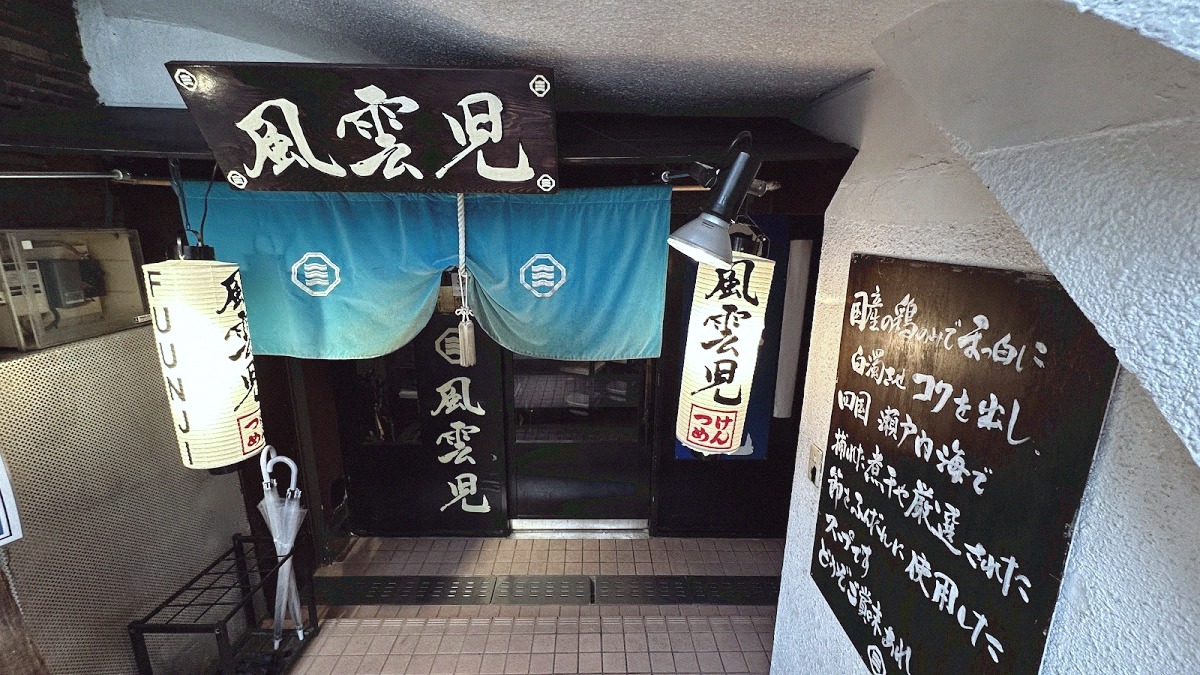
It is usually by the door: a steel box with a grid of identical buttons, each one a block of kanji, no English, no pictures on the older ones, and a short line of people behind you who clearly know exactly what they are doing. For a lot of visitors this machine is the single most stressful object in Tokyo eating. The irony is total. The ticket machine is not the hardest part of the ramen shop; it is the part that was specifically engineered so that you would never have to speak, negotiate, or be understood. It is the friendliest thing in the building, wearing the scariest costume.
This piece decodes it completely: what the machine actually is, why a ramen shop wants one badly enough to put it before the door, how to read a wall of kanji in five seconds, and the tiny sequence of etiquette that turns you from tourist to regular.
What the Machine Actually Is
The object is a shokkenki (食券機, meal-ticket machine); the printed slip it spits out is a shokken (食券, meal ticket) — a prepaid voucher for one specific dish. You are not using a strange terminal. You are buying a ticket, exactly as you would for a train, and then exchanging that ticket for food. Nothing about it is improvised at the table: the transaction is finished before you sit down, the kitchen receives an unambiguous physical token, and money never changes hands again. Once you see it as “ticket, then food” rather than “menu I cannot read,” the entire interaction collapses into something simpler than ordering at home.
Why a Ramen Shop Wants One
The machine is not decoration or novelty; it is the economic spine of a small ramen shop. With no tipping in Japan, labour cost cannot be quietly offloaded onto the customer, so a tiny shop survives by removing every job it can. The shokkenki deletes the entire role of taking and ringing up orders: one person can cook while the room essentially serves itself. It also handles cash once, cleanly, at a single point — no till at the counter, no change fumbled with broth-covered hands, faster table turnover for a shop whose whole model is a short, fierce lunch rush. And, almost as a side effect, it turns the language barrier into a non-event: a system built for Japanese efficiency happens to be the most foreigner-proof ordering method in the city, because it asks you to press, not to speak. The thing that intimidates you exists precisely so that nobody — including you — has to talk.
How to Read the Wall in Five Seconds
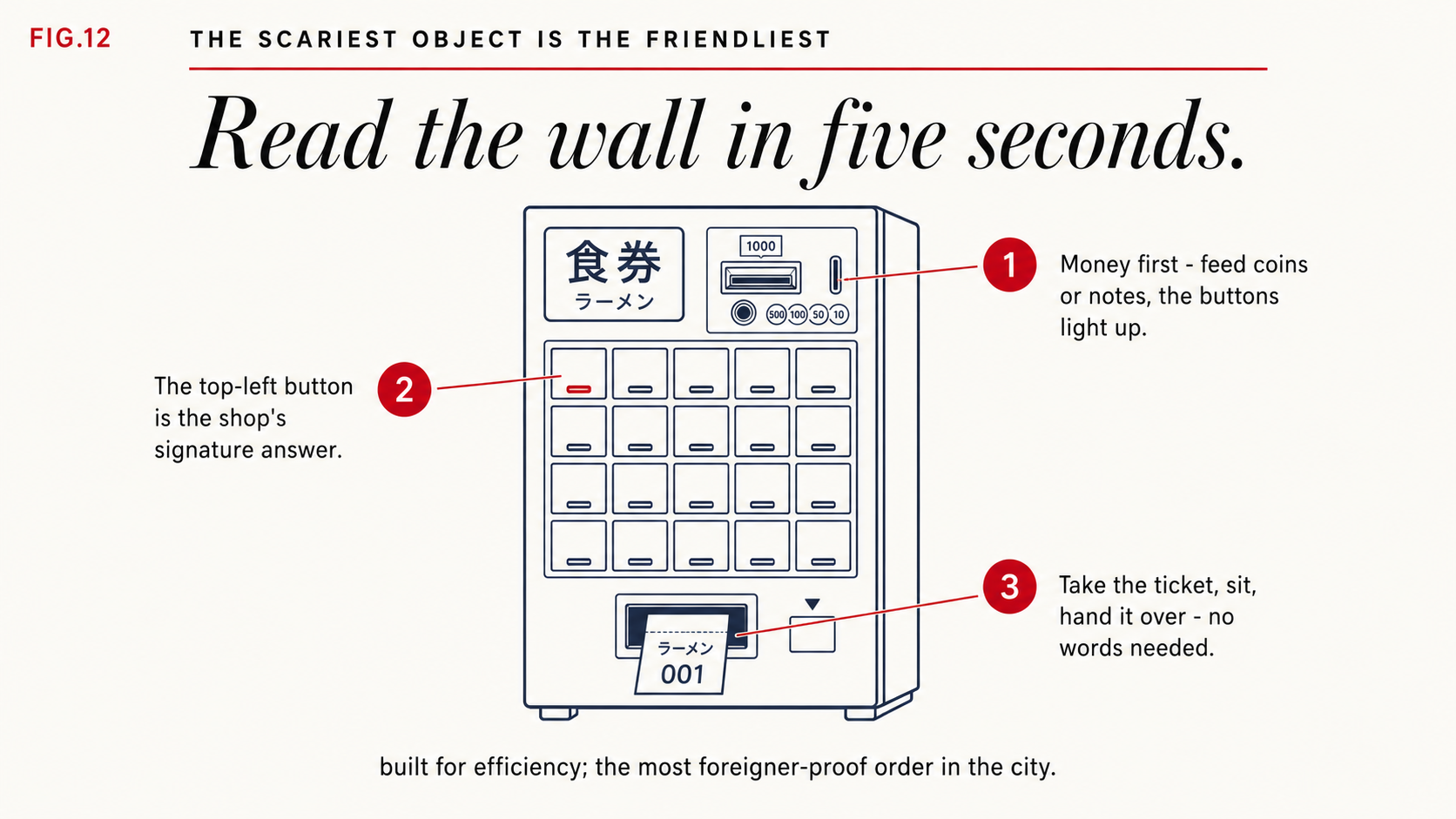
Three rules handle almost every machine. First: money goes in before anything will work — feed coins or notes (most now take notes, many take IC cards) and the buttons light up. Second: the top-left button is the answer. By near-universal convention the shop puts its signature bowl — the thing most people come for — in the top-left position. If you do nothing else, press top-left; you will have ordered the right thing on purpose. Third: a handful of kanji unlock the rest. 並 is regular size, 大盛 (oomori) is a large portion, 替玉 (kaedama) is a second helping of noodles bought as its own ticket at a tonkotsu shop, 味玉 (ajitama) is a seasoned egg, 海苔 is nori, and a button reading チャーシュー adds extra pork. Modern shops increasingly run a colour touch-panel with English, Chinese and Korean and photographs, which removes even this — but the top-left rule still holds, and change is always dispensed automatically, so you never need to ask for it.
The Five Seconds of Etiquette That Matter
The social part is shorter than the ordering part. If the machine is by the entrance, buy your ticket before you take a seat, not after — the seat is for eating, the door is for deciding. Hand the slip to the staff face-up with a small “onegaishimasu” and you have done the entire ritual correctly. Two things are deliberately not on the machine: noodle firmness and broth richness, where they are offered, are told to the cook out loud in one word or simply skipped for the default, and water or tea is self-service from a station, not something you request. And do not agonise over the wall while the line waits — pressing top-left immediately is not a failure, it is literally what the regulars are doing. Slurping, once the bowl lands, is welcomed, not rude.
Where to Practice
Pick the version that matches your nerve. For the modern, English, touch-panel kind, AFURI in Ebisu is the gentle introduction — a photo panel and a yuzu-salt bowl that started a whole style. For the real thing — a classic button machine, a serious queue, and the top-left rule doing exactly its job — Fuunji in Shinjuku and Gonokami Seisakusho are the tsukemen proving grounds, and Nakiryu in Otsuka pairs the machine with a Bib Gourmand tantanmen worth the detour. Read these alongside the unspoken rules of eating ramen for what happens after the ticket, whether the famous ramen queues are worth it for which lines to even join, and the restaurants you can walk into for the timing that shortens them. The decode in one line: money first, press top-left, hand it over with one word — the box you feared was the welcome mat the whole time.
Sources & Further Reading
- Wikipedia — Shokken (meal ticket) (definition; the prepaid-voucher system and where it is used)
- GaijinPot Study — kanji cheat sheet: the ramen ticket machine (the kanji that unlock size, egg, kaedama and toppings)
- Coto Academy — how to order with a Japanese ramen vending machine (button vs touch-panel; money-first; the handover phrase)
- LIVE JAPAN — 4 easy steps to order ramen by ticket machine (the top-left house-special convention; step sequence)
- Japlanease — how to use a food ticket machine in Japan (why shops use it; etiquette and self-service water)