
Why Gluten-Free Is a Soy-Sauce Problem in Tokyo
Sushi and sashimi look safe — until the soy sauce arrives. In Tokyo gluten-free is a fight with one wheat-brewed seasoning that hides in almost everything, plus a few decoys. The real culprit, the traps, and the bottle that fixes it.
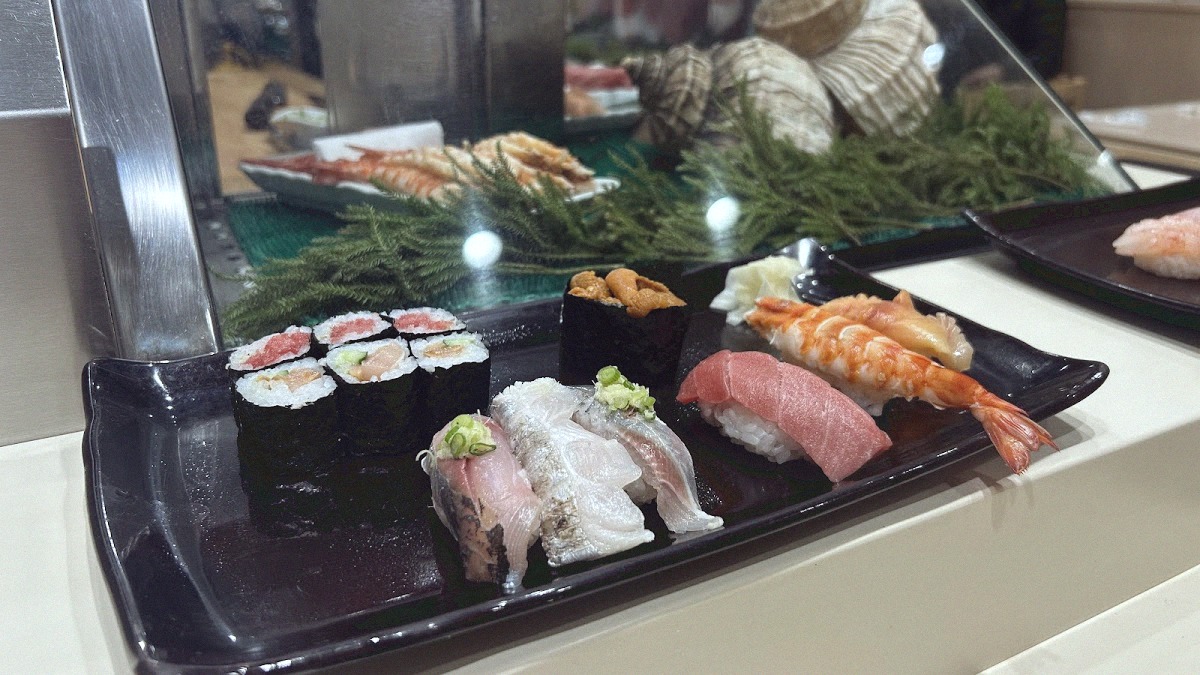
The reasoning looks airtight. Sushi is raw fish and rice. Sashimi is just fish. Grilled meat is meat. None of that is bread, so a gluten-free traveller in Tokyo should be able to eat widely by simply avoiding the obvious wheat. Then the soy sauce arrives — poured, brushed, or already mixed into the dish — and the supposedly safe meal is no longer safe, because the single most universal seasoning in the cuisine is, by recipe, a wheat product.
Gluten-free in Tokyo is not really a search for gluten-free dishes. It is a fight with one ingredient that hides inside almost everything savoury, plus a short list of decoys that look like wheat problems and are not. This piece names the real culprit, the traps that follow from it, and the specific moves that work. It pairs with our companion piece on why vegetarian is harder than vegan here — the structure of the problem is identical: the thing that defeats you is dissolved into the base, not sitting on the plate.
The Culprit Is Brewed, Not Added
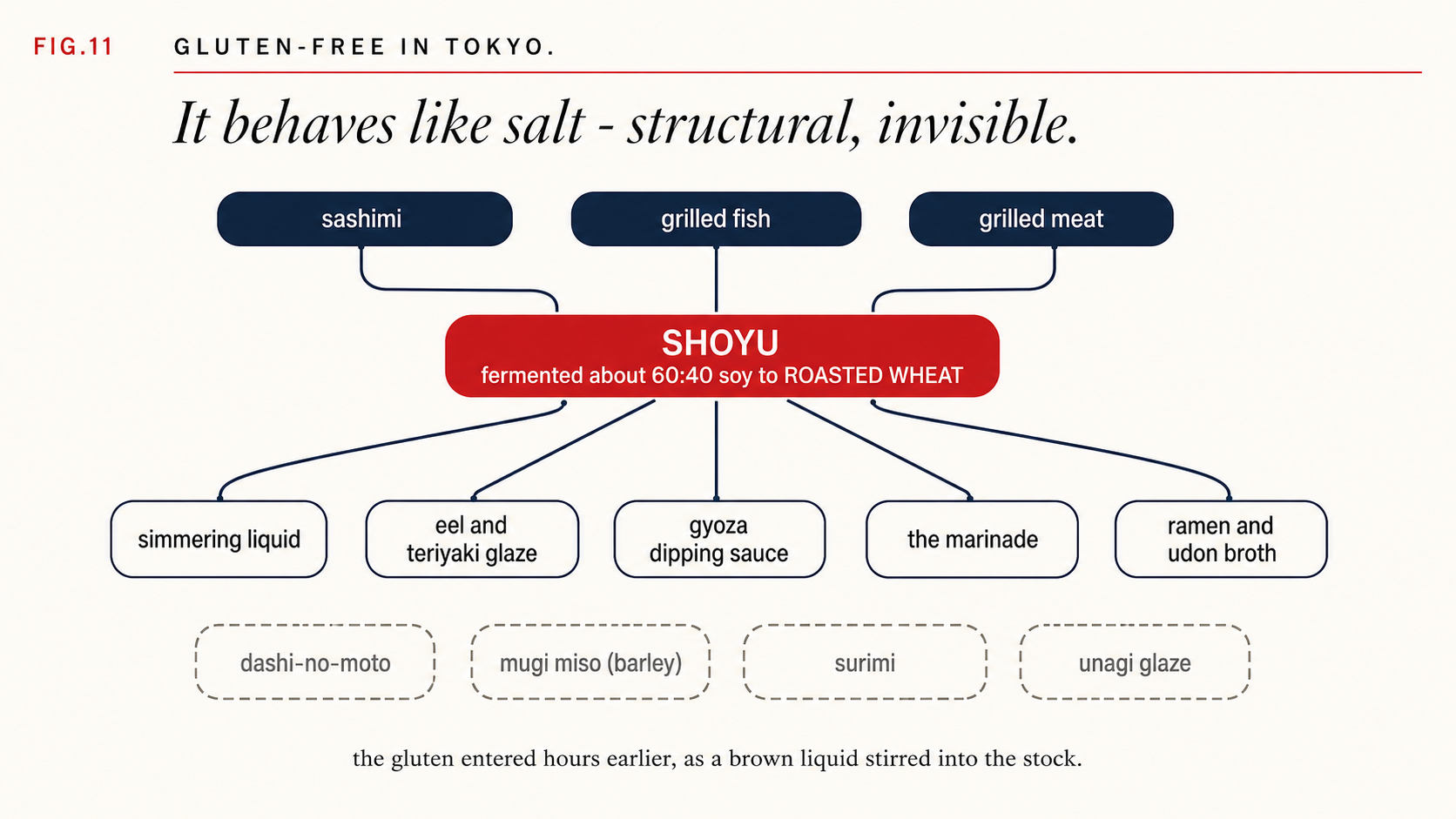
Standard Japanese soy sauce, shoyu (醤油), is fermented from a roughly 60:40 blend of soybeans and roasted wheat, cultured with koji (麹, Aspergillus oryzae). The wheat is not a thickener someone could leave out; it is half the raw material and a driver of the flavour and aroma. United States labelling rules make the consequence explicit: a wheat-brewed soy sauce, or anything using it as an ingredient, cannot legally be called gluten-free. Shoyu then travels into nearly every savoury preparation — the simmering liquid for vegetables, the glaze on grilled eel, teriyaki, gyoza dipping sauce, the marinade under the fish, the broth adjustment in a ramen or udon pot. The cuisine is seasoned, at its base, with a wheat ferment.
This is why “no wheat, please” does not protect you. There is no slice of bread to decline. The gluten entered hours earlier, in a back kitchen, as a brown liquid stirred into the stock. A plate of sashimi is genuinely gluten-free until the soy sauce touches it, at which point it is a gluten dish with fish in it. The mistake is treating gluten as a visible solid. Here it behaves like salt: structural, invisible, everywhere.
The Decoys That Follow
Once soy sauce is understood as the spine, the secondary traps follow logically. Dashi (出汁, the basic stock) built from kombu (昆布, kelp) and katsuobushi (鰹節, dried bonito) is naturally gluten-free — but most restaurants adjust the pot with soy sauce, and the instant version, dashi no moto (だしの素), routinely contains wheat-based soy. Miso (味噌) is usually safe, except mugi miso (麦味噌) is made with barley; an unlabelled “miso” is a coin flip. Imitation crab (surimi) and unagi glaze commonly carry wheat. Tempura is wheat batter and is simply out. Even fried items share oil with battered ones. The pattern is consistent: the danger is in the seasoning system and the shared equipment, not in anything that announces itself as bread.
One famous decoy works the other way. Tamari (溜まり, from tamaru, “to accumulate”) is the liquid that historically pooled beneath fermenting miso, and it is traditionally brewed with little or no wheat. It is the closest thing to a gluten-free Japanese soy sauce — but “tamari” on a label is not a guarantee, because some producers still add wheat. The safe version is a bottle that specifically says certified gluten-free, not merely “tamari.” Carrying your own small bottle of certified gluten-free tamari is, in practice, the single highest-leverage thing a coeliac traveller can do in Tokyo: it converts every naturally gluten-free format — sashimi, plain rice, grilled unsauced fish — back into something you can actually season and eat.
Why the Cuisine Is Built This Way
Wheat-brewed soy sauce became the universal seasoning for an industrial-era reason, not a culinary accident. Roasted wheat speeds and deepens the koji fermentation and lengthens the flavour, which made shoyu cheap, stable, and reproducible at national scale from the Edo period onward. A condiment that consistent inevitably becomes the base of everything, the way a reliable stock or a standard salt does. The gluten is not contamination from the visitor’s point of view; from the kitchen’s point of view it is simply how the food is made to taste correct.
That reframes the strategy. You are not asking a kitchen to remove a mistake; you are asking it to rebuild a flavour base it has never had a reason to rebuild. Most kitchens cannot do that on request, and a well-meaning server who sees no bread will tell you a dish is fine in complete sincerity. The workable approach is the same as for plant-based eating: do not negotiate subtraction inside a soy-sauce kitchen. Seek the formats and rooms where the wheat seasoning was never the base — and bring your own tamari for the rest.
The Sentence, and the Format
Lead with the medical frame and name soy sauce explicitly, because the word “gluten” alone does not map cleanly onto everyday Japanese kitchen categories. A workable line is komugi arerugii ga arimasu; shoyu mo dame desu (小麦アレルギーがあります、醤油もだめです, “I have a wheat allergy; soy sauce is also not okay”). Framing it as an allergy, and putting soy sauce on the table by name, communicates the actual risk far better than the abstract “gluten-free.” For complex situations, a printed Japanese coeliac restaurant card is more reliable than spoken requests, and the long-running guides from Legal Nomads and Gluten Free Japan provide vetted wording and venue lists.
Then choose forgiving formats. A conveyor sushi shop with a touchscreen, such as Uobei in Shibuya, lets you order plain nigiri and control your own soy entirely — you apply your own tamari, the kitchen applies nothing. A 24-hour counter like Sushi Zanmai in Tsukiji, with full English menus and staff used to international dietary questions, is the kind of room where the allergy framing actually lands and the chef can keep the soy off the fish. The principle is the same one that runs through all of constrained-diet eating in Tokyo: the safe meal is found by choosing the right format and carrying the right bottle, not by asking a wheat-seasoned kitchen to season differently.
Sources & Further Reading
- Celiac.com — Is Soy Sauce Gluten-Free? (shoyu wheat content; US gluten-free labelling rule)
- Gluten Free Watchdog — wheat-based soy sauce in gluten-free meals
- Kikkoman — Tamari and Soy Sauce: what’s the difference (tamari brewing; not all tamari is wheat-free)
- Legal Nomads — Gluten-Free Guide to Japan (hidden wheat in dashi-no-moto, mugi miso, surimi, eel glaze; restaurant cards)