
Is Michelin Ramen Worth the Queue in Tokyo in 2026?
“Tokyo's three Michelin-starred ramen shops” describes a moment that has largely passed — Michelin restructured, and the stars are gone. The real question: does the queue still buy a better bowl than the no-line one around the corner?
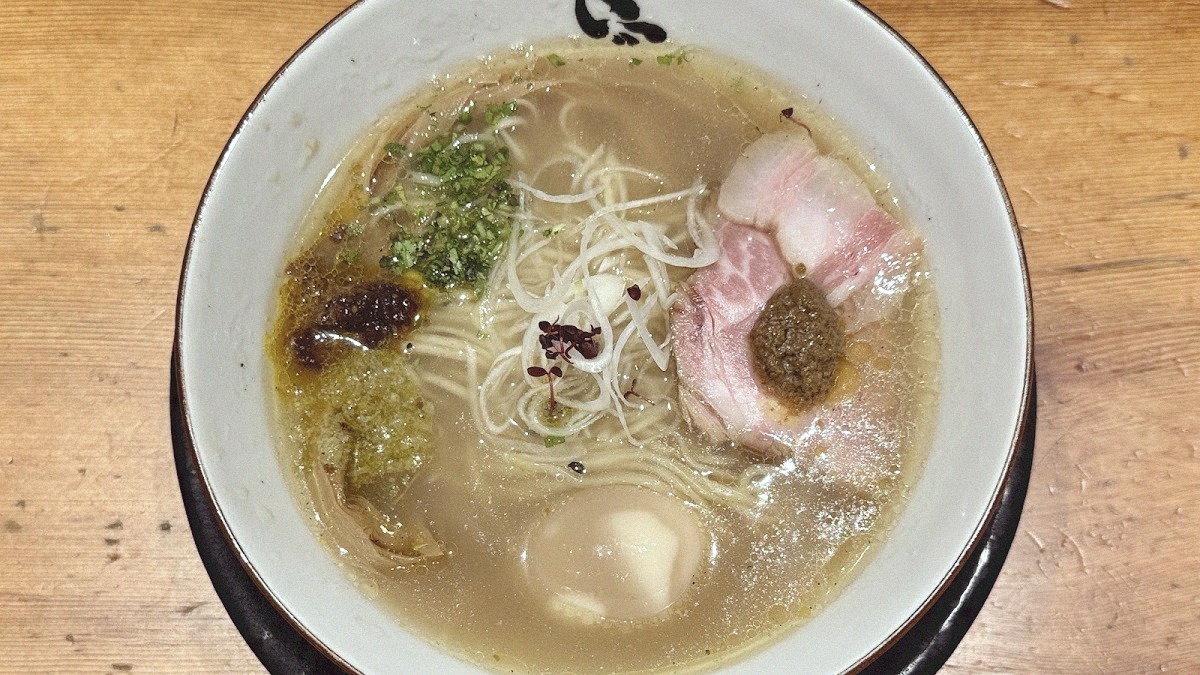
The phrase “Michelin-starred ramen” is doing a lot of work in Tokyo travel writing, and most of it is out of date. The familiar story — that Tokyo has three Michelin-starred ramen shops you must queue for — describes a moment that has largely passed. Michelin restructured its categories, and the shops that carried the original stars no longer hold them in the current guide. The interesting question is not “which ramen has a star” — increasingly, none in the headline sense. It is whether the queue these places still command buys you a meaningfully better bowl than the excellent non-starred one around the corner.
This piece separates the label from the food: what the star actually was, what it is now, and the honest cost-benefit of standing in a Tokyo ramen line for two hours in 2026. (For where a bowl of ramen sits in a full day of eating, see our Tokyo food budget guide.)
What the Star Actually Was
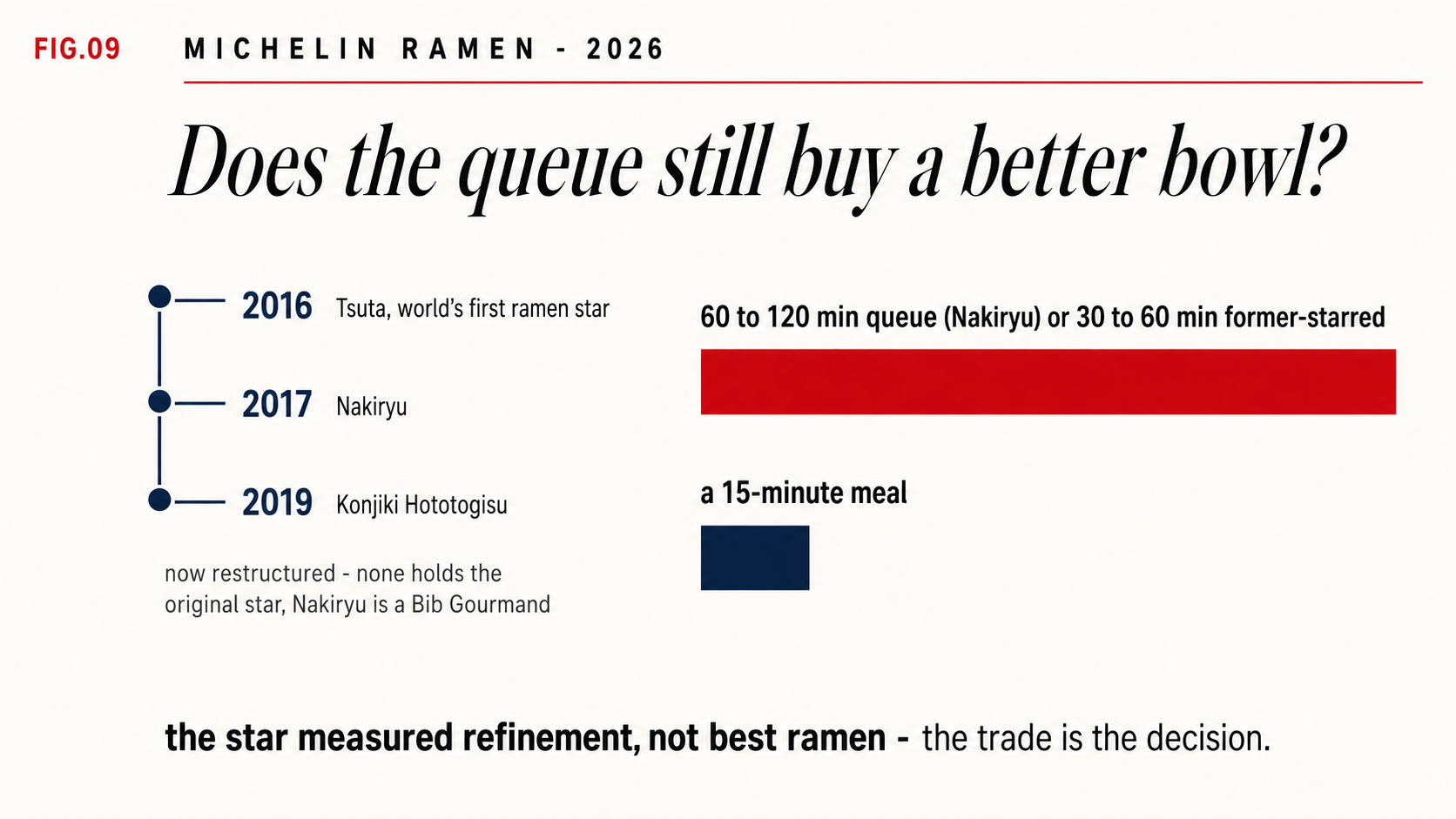
When Japanese Soba Noodles Tsuta became the first ramen shop in the world to receive a Michelin star in 2016, it was a genuine cultural event — a working-class dish admitted to fine dining’s most famous list. Nakiryu (鳴龍) followed in 2017, and Soba House Konjiki Hototogisu (金色不如帰) in 2019. For a few years, “three-Michelin-starred ramen city” was true and worth chasing. Then Michelin reorganised how it classifies these shops. In the current Tokyo guide none of the three holds the original star; Nakiryu now appears as a Bib Gourmand — the guide’s “good quality, good value” designation, which is arguably a more honest label for what a great ramen shop actually is.
A Michelin star never measured “the best ramen.” It measured a kitchen’s consistency, technique, and refinement against fine-dining criteria — which is why the starred bowls were the constructed, layered ones: Tsuta’s shoyu finished with truffle oil and porcini soy, Konjiki Hototogisu’s shio built on clam, chicken, and pork. That is a specific, excellent style of ramen. It is not a verdict that a ¥1,000 neighbourhood tonkotsu is worse food. The star answered a different question than the one most queuers think they are asking.
What the Queue Actually Costs
The lines are real and they are long. Nakiryu typically runs a sixty- to one-hundred-and-twenty-minute queue and effectively requires arriving before the 11:30 open; the former-starred shops generally run thirty to sixty minutes minimum. The standard reassurance — that the line moves faster than it looks because diners finish in fifteen to twenty minutes — is true and also the point: you are trading roughly one to two hours of a finite Tokyo day for a fifteen-minute meal. That math is the actual decision, and it is rarely stated plainly. The bowl is excellent. The question is whether it is two-hours-of-Tokyo excellent, when the city is full of fifteen-minute, no-queue bowls that are also excellent.
The honest answer is conditional. If refined, fine-dining-adjacent ramen is specifically the thing you came to eat, and the shop is on your route, and you arrive before opening so the queue is shortest — then yes, clearly. If you are queuing because a listicle said “Michelin,” for a star that the guide itself has since removed, while skipping a superb non-famous bowl two stations away with no line — then the trade is poor, and it is poor specifically because the premise is outdated.
How to Decide in the Moment
Reframe the choice around marginal gain versus time. A genuinely great Tokyo ramen — and there are hundreds — already delivers most of what makes ramen extraordinary. The starred-style bowls add a further layer of refinement and a constructed complexity that a serious eater can taste and value. Whether that increment is worth one to two hours depends entirely on how many hours you have and how much you specifically care about that increment. The shops worth the queue are the ones whose style you actually want, not the ones whose old accolade you recognise.
A concrete version of the alternative makes the trade legible. Ten minutes from Konjiki Hototogisu, Fuunji in Shinjuku is a tsukemen (つけ麺, tsukemen, dipping noodles) shop with a queue measured in tens of minutes, not hours, for a bowl that ranks among the city’s best. Further out, Mutekiya (無敵家) in Ikebukuro — one minute from the station, ~20 seats, cash only — serves a tonkotsu-shoyu bowl for roughly ¥1,000–1,500 with a reported 20-to-60-minute wait rather than two hours. Neither was ever starred. Both are the answer to “is the line worth it” when the honest answer is “not this line.”
Two practical levers remove most of the bad version of this trade. First, timing: arriving fifteen to thirty minutes before opening collapses the worst queues, the same mechanic covered in which Tokyo restaurants you can actually walk into. Second, the prestige tier is increasingly shifting to reservation or ticket systems to manage exactly this problem. The clearest example is Ginza Hachigo (銀座 八五, Ginza Hachigo) — itself a former one-star, now a Bib Gourmand — which takes online bookings through TableCheck: reservations for the following week open at 9:00 a.m. each Saturday, seatings run in 30-minute slots from 12:30 p.m., and there is a ¥500-per-person service fee, with walk-up seats still held from 11:00 a.m. to 12:30 p.m. (reportedly ~30 bowls a day). Use systems like this when they exist; they convert a two-hour gamble into a fixed appointment.
The Bowls Worth Knowing
On The Ondo Tokyo, the two former-starred shops in our catalogue are exactly the constructed-style bowls the original stars rewarded. Konjiki Hototogisu near Shinjuku Gyoen is the clam-and-shellfish shio — the most legible argument for why this style earned recognition, and a one-bowl meal you reach by ticket machine and a line, not a reservation. Nakiryu in Otsuka — now a 2026 Bib Gourmand — is the tantanmen: a sesame-and-Sichuan bowl whose balance is the entire reason it was ever recognised, and a deliberate detour to a neighbourhood no tourist itinerary includes.
Both are worth the queue under one condition: that this refined style is the ramen you actually came for, and you arrive before opening so the line is shortest. If you simply want a superb bowl with no wait, Tokyo grants that on almost any block — the starred reputation is a reason to seek these two out specifically, not a reason to believe the rest of the city is a step down. The label has changed. The bowls have not. Decide on the bowl.
The Two Bowls, by the Numbers
The decision is easier with the specifics in front of you. Both shops serve a roughly ten-seat counter, both run on a ticket machine rather than a reservation, and both reward arriving before the doors open. Prices and hours below are the shops’ own listings as carried by the MICHELIN Guide, Tabelog (食べログ, tabelogu, Japan’s largest restaurant-review site), and Time Out Tokyo; figures are accurate as of June 2026 and ramen shops adjust them without notice.
| Konjiki Hototogisu (金色不如帰) | Nakiryu (鳴龍) | |
|---|---|---|
| Area / access | Shinjuku-Gyoenmae — ~4 min walk from Shinjuku-Gyoenmae Stn (Marunouchi Line) | Otsuka — ~5 min walk from Otsuka Stn (JR Yamanote Line) |
| Signature bowl | Sea-bream & clam shio soba — ¥900 (¥1,000 with ajitama egg) | Tantanmen — from ¥900 (spicier mala / sour sanramen ¥950) |
| Seats | ~10 (a few counter seats plus limited tables) | ~10 counter seats |
| Opens / arrive by | Reportedly 11:00 (closed Mon / some Tue) — arrive ~10:30 | Lunch from 11:30 (closed Tue; Mon lunch only) — numbered tickets issued outside from the morning |
| Typical line | ~45–60 min | ~60–120 min |
| 2026 status | Bib Gourmand (former one-star) | Bib Gourmand (former one-star) |
| Payment | Ticket machine | Ticket machine |
FAQ
Do Tokyo’s former Michelin ramen shops still have stars?
No. In the 2024 Tokyo guide, MICHELIN removed the stars from the last three starred ramen shops — Ginza Hachigo, Konjiki Hototogisu, and Nakiryu — leaving the world with no starred ramen. Tsuta, the first ramen shop ever starred (2016), had already lost its star earlier. All now appear as Bib Gourmand, the guide’s good-quality, good-value tier. (MICHELIN Guide / Time Out Tokyo, accessed June 2026.)
How long is the wait at Nakiryu?
Reportedly 60–120 minutes at peak. Lunch starts at 11:30, the shop is closed Tuesdays (Monday is lunch only), and numbered tickets are issued outside from the morning — so the practical move is to take a ticket early rather than stand the full two hours. The counter seats about ten.
How much is a bowl, and is it cash only?
Both shops run on a ticket machine. Konjiki Hototogisu’s sea-bream-and-clam shio soba is ¥900 (¥1,000 with a marinated egg); Nakiryu’s tantanmen starts at ¥900. Carry cash — ticket-machine ramen shops are frequently cash-only, a habit explained in our piece on why cash-only Tokyo survived.
Can you reserve instead of queuing?
At the two shops above, no — both are ticket-machine-and-line only. But Ginza Hachigo, the other former-starred ramen shop, takes online reservations via TableCheck (slots open 9:00 a.m. each Saturday for the following week, ¥500-per-person fee). If a fixed appointment matters more to you than these two specific bowls, that is the route.
So — is Michelin ramen worth the queue?
Conditionally. If refined, constructed-style ramen is specifically what you came to eat, the shop is on your route, and you arrive before opening so the line is shortest, then yes. If you are queuing only because a listicle said “Michelin” — for a star the guide itself removed in 2024 — while skipping a superb no-line bowl two stations away, the trade is poor. Decide on the bowl, not the old label.
Sources & Further Reading
- MICHELIN Guide — Tokyo region, ramen (current Tokyo ramen listings and designations)
- MICHELIN Guide — Sosakumenkobo Nakiryu (Nakiryu’s current Bib Gourmand designation)
- Tokyo Ramen Tours — Michelin-star ramen Tokyo guide (post-restructure status; queue lengths; the three shops’ styles)
- Japan Today — Tokyo Michelin ramen starts a reservation system
- byFood — Michelin Guide Tokyo 2026
- 食べログ (Tabelog) — Nakiryu (鳴龍) listing (Japanese-language shop listing: current tantanmen price, hours, closed days; accessed June 2026)
- Nippon.com — Four Tokyo Ramen Eateries with Michelin Stars (Japanese publisher on the de-starring and Bib Gourmand shift; accessed June 2026)
- Time Out Tokyo — Ginza Hachigo now accepts online reservations (TableCheck booking mechanics; accessed June 2026)