
Is It Safe for a Woman to Eat Alone at Night in Tokyo? An Honest Map
The honest answer is yes — but not because "Japan is safe." It's because Tokyo's small late-night risk concentrates somewhere specific, and the ramen counter isn't it. Here's the seat-and-station map.
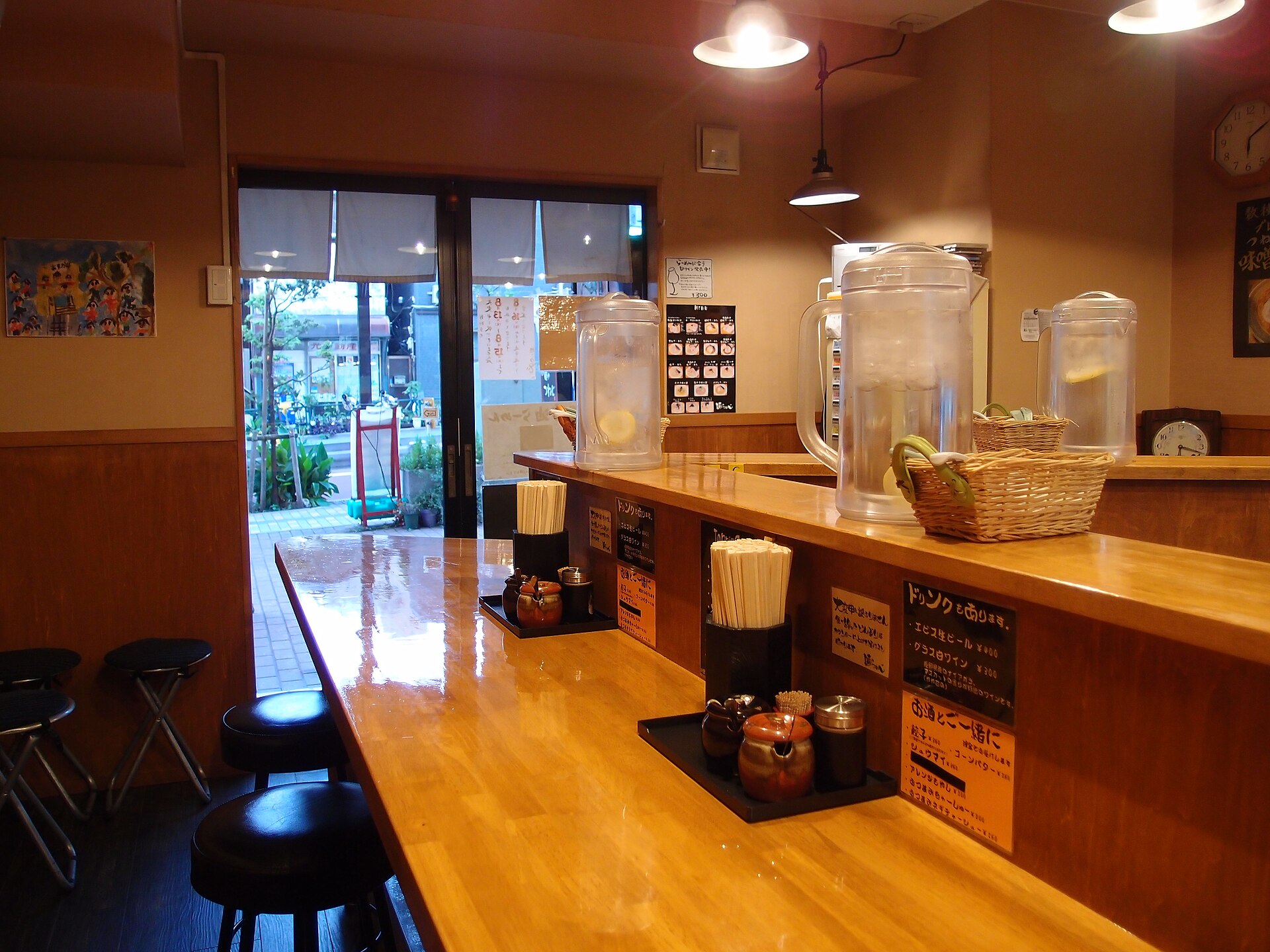
Yes — and the reason is structural, not a vibe. A woman eating alone at a Tokyo counter at 22:00 is, for the category that actually matters to a visitor (stranger street crime), about as safe as she would be almost anywhere on earth. But “Tokyo is safe” is a lazy answer, and you can feel that it’s lazy, which is why you’re still reading. The useful answer separates two very different risks a woman is quietly weighing — the walk to dinner and the dinner itself, versus the contexts where harassment genuinely clusters — and then hands you a map: which seats, which hours, which trains, which back-alleys to skip. That map is the rest of this article.
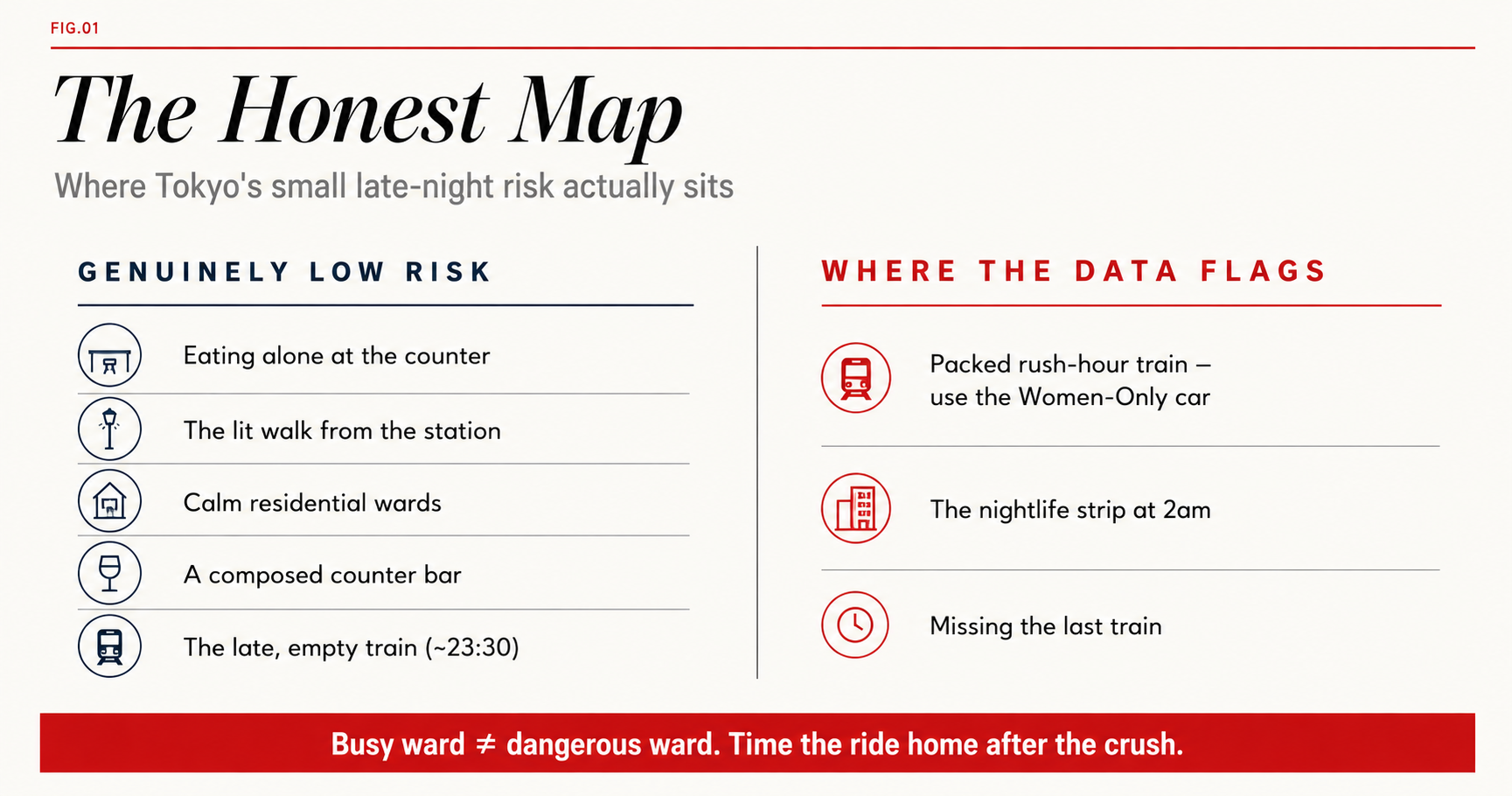
The misconception worth dismantling first is that eating alone at night is the dangerous part. It almost never is. What the data flags — and what we’ll be honest about — sits somewhere else entirely: a packed train, a district built around drinking until 3am. Neither of those is a ramen counter, and neither is the lit ten-minute walk from a station to one.
What you fear and what the numbers actually describe are two different things
The fear in the search box is stranger danger: someone follows you, something happens on the walk back. The numbers describe a city where that category is genuinely rare. Tokyo’s 23 special wards reportedly recorded on the order of 70,000 criminal offenses in 2024, and the large majority of that total was theft — overwhelmingly bicycle theft and shoplifting, per the Tokyo Metropolitan Police (Keishicho) annual “Crime in Tokyo” report. Robbery was a tiny fraction of the total. Put plainly: the dominant Tokyo “crime” is your unlocked bike vanishing outside a convenience store, not an assault. Japan’s intentional homicide rate, per UNODC and World Bank figures, sits near 0.25 per 100,000 — below one per 100,000, among the lowest recorded anywhere.
Here is the honest caveat that keeps this from being empty reassurance. Where violence against women in Japan does concentrate, it is overwhelmingly domestic — intimate partners and family, not strangers on a street. UNODC’s work on gender-related killing finds that the majority of female homicide victims in the region are killed by family or partners, a pattern that simply doesn’t reach a traveler at a counter. One honest qualifier on the numbers themselves: harassment like chikan (痴漢, “train groping”) is widely under-reported, so a woman’s lived experience can run ahead of the official count — which is exactly why the next section treats it as the one real exception rather than waving it away. We’re not telling you danger doesn’t exist; we’re telling you that the specific danger the scary headlines evoke — the stranger in the dark — is the rarest version of it here. The risk profile is, in a sense, the opposite of the one you’re bracing for.
The wards bear this out in a way that’s useful for planning. Suginami and Setagaya — residential, low-rise, unglamorous — reportedly post the lowest crime counts. Shibuya and Shinjuku rank higher, but largely because of commercial and nightlife density, not because the air gets dangerous after dark. That distinction matters: a busy ward isn’t a risky ward. It’s a ward with more bars, more drunk people at 2am, and more reported incidents inside that specific late-drinking ecosystem.
The one late-night risk Tokyo really flags is a train, not a table
If you want the single honest exception to “you’re fine,” it’s this: chikan on crowded trains. This is the one context the city has built physical infrastructure to address. Josei senyo sharyo (女性専用車両, “women-only cars”) exist precisely because packed rush-hour and late-evening carriages are where harassment clusters — they run mainly in the morning peak (roughly 6–9am) and evening (roughly 5–9pm), and on some lines later. After women-only cars were introduced in Osaka, complaints reportedly fell by about a third within a year. Look for the pink “Women Only” signage on the platform and the car door.
Notice what this tells you. The risk is tied to crush density, not to being out late. A near-empty 23:30 train home from dinner is a different animal from a sardine-packed 18:30 commuter car. If you can time your solo dinner so the ride home is after the worst of the evening crush — say, eating at 21:00 and riding back close to midnight on a half-empty line — you’ve routed around the actual flagged risk rather than the imagined one. That’s the whole move: late and empty beats early and packed.
The other genuine context is the drink-heavy nightlife pocket at its rowdiest hour — the strip of a district that’s all clubs and touts at 2am. You don’t have to avoid going out at night; you avoid that specific texture of night. A composed counter bar is the opposite of it. We’ll name one below.
Why a woman eating alone draws no attention here at all
Most of the anxiety around eating alone at night isn’t really about crime. It’s social: the feeling of being watched, of being the only person at a table for one, of being read as vulnerable or odd. In Tokyo that feeling has almost nothing to feed on, because solo dining isn’t an exception here — it’s a default the whole food culture is engineered around. The word is ohitorisama (おひとりさま, “table for one”), and it carries no apology. JNTO has written about solo dining as an ordinary Japanese custom, not a brave act.
The physical proof is the counter. Ramen counters built for walk-ins, sushi counters, teishoku (定食, “set-meal”) stools — these rooms assume one person, facing forward, eating and leaving. Nobody is arranged to look at you, because everyone is arranged to look at their bowl. At Ichiran Shibuya the design goes further: partitioned single booths and a bamboo curtain to the kitchen mean you order by slip and eat ramen without a single person, staff included, making eye contact. It is, not coincidentally, open 24 hours (with a reported late-night surcharge after 22:00) in one of the city’s busiest, brightest blocks — the exact ward that ranks “high” on crime stats for reasons that have nothing to do with a woman alone in a booth. If you’ve read our piece on solo dining in Tokyo, this is the same logic at night: the room is on your side.
This is why the “is this weird?” worry that drives so much of the “is this unsafe?” search simply doesn’t apply. You are not conspicuous. You are the median customer.
The actual plan: calm over rowdy, timed to the last train
Here’s the part you can use tomorrow night. The single best safety decision isn’t a gadget or a rule — it’s venue texture. Choose a calm counter over a rowdy room, and time the meal so the ride home avoids the crush. For a first solo night out, an easy, well-lit, transit-convenient area lowers the stakes before you’ve even ordered. Afuri in Ebisu is a clean starting point: bright yuzu-shio ramen, counter seating, about a 3-minute lit walk from Ebisu Station. You sit, you eat, you’re back on a train in forty minutes if you want to be.
If you want composed rather than casual, Kagari in Ginza is the case study. Ginza is among Tokyo’s calmest, best-lit, most surveilled districts after dark, and a refined ramen counter there makes “eating alone at night” feel like a polished choice instead of a defensive one — the solo diner is simply the format. For a genuinely relaxed night away from any crowd, Nakiryu in Otsuka sits on the quieter north side near the low-crime residential wards; it’s the honest illustration that quieter does not mean less safe in Tokyo. The calm neighborhoods are the safe ones.
Going out for a drink alone is also fine — you just choose the counter over the strip. Bar High Five in Ginza is the model: a serious, hushed basement bar where a woman can have a cocktail alone at the counter with none of the drink-til-3am dynamic the data actually flags. It reportedly runs until around 1:00, which is plenty for a measured night and a clear-headed ride home. That’s the difference between “going out at night” and “being in a nightlife district at its worst hour” — and it’s entirely within your control. For more on the rhythm of the late hours, our piece on the unspoken rules of eating late in Tokyo maps the territory.
Two practical anchors. Trains stop: most lines run their last service somewhere between roughly 24:00 and 01:00, so check your last train before you sit down, not after — a missed last train is the most common way a calm night turns into an expensive or stressful one. And the safety net is real and reachable: emergency police is 110, ambulance and fire is 119, koban (交番, “police boxes”) sit on corners across the city, Keishicho runs a 24-hour English helpline at 03-3501-0110, and JNTO’s Japan Visitor Hotline (050-3816-2787) operates around the clock in English, Chinese, Korean and Japanese. If something feels off, those are the numbers — but the honest truth is that on a normal solo dinner, the thing you’re most likely to need help with is reading a ticket machine.
Sources & Further Reading
- Tokyo Metropolitan Police (Keishicho) — “Crime in Tokyo” annual report (2024 ward and crime-category figures)
- UNODC / World Bank intentional homicide data, Japan (homicide rate near 0.25 per 100,000)
- UNODC Global Study on Homicide — gender-related killing of women and girls (risk is overwhelmingly domestic, not stranger street crime)
- Metropolis Japan — women-only train cars (secondary explainer — chikan, women-only car hours, the Osaka complaint figure)
- JNTO — Staying Safe in Japan / Japan Visitor Hotline (110/119, koban, 24-hour helpline numbers)
- JNTO — The Japanese custom of solo dining (ohitorisama as ordinary, not conspicuous)