
What Is Doyo no Ushi (Unagi Day) — and Should You Eat Eel in Tokyo?
Japan's eel day, decoded: the exact 2026 date, why unagi is an endangered species, why midsummer isn't even its season, what you'll pay, and how to eat it well in Tokyo.
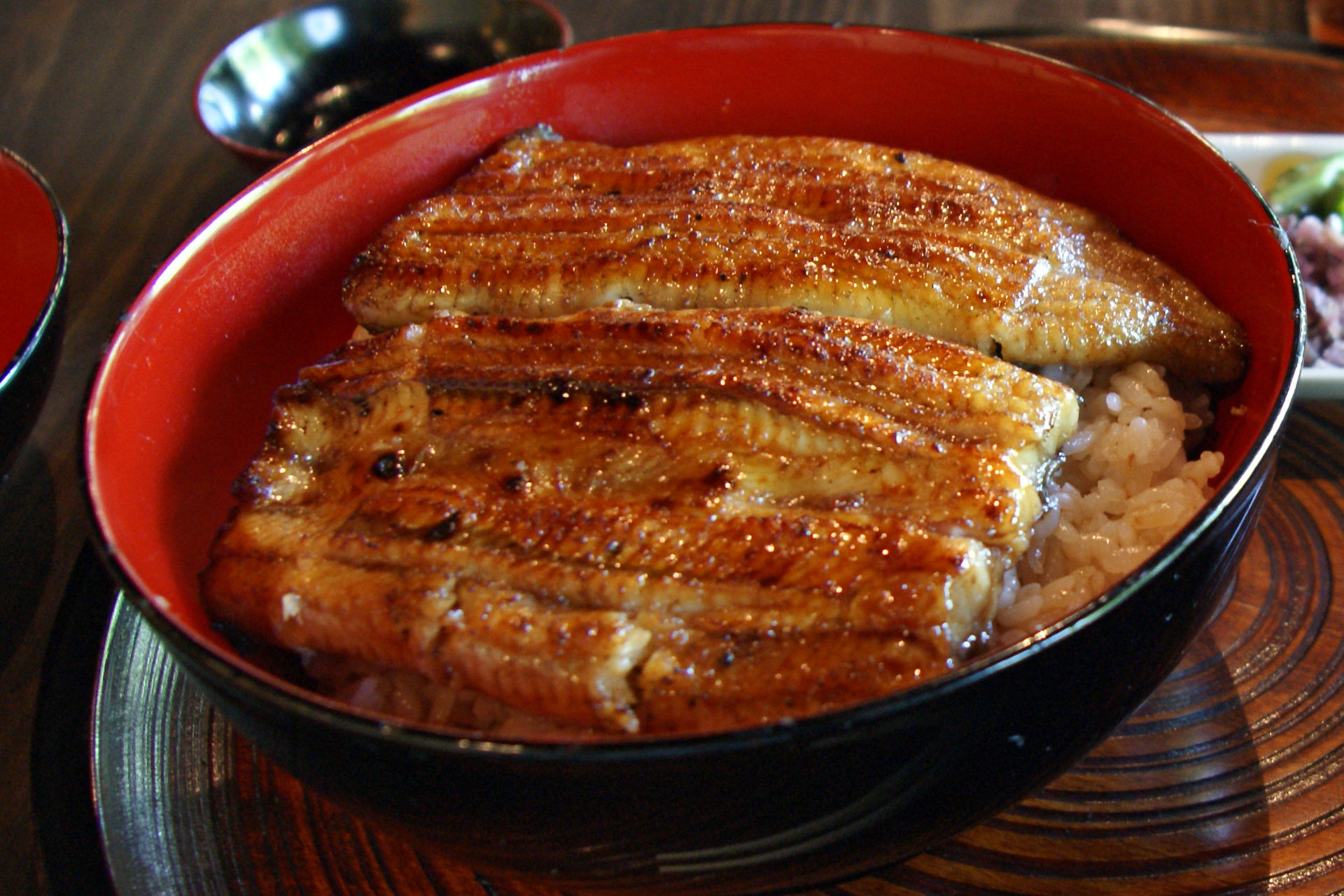
Doyo no Ushi no Hi (土用の丑の日, “the Midsummer Day of the Ox”) falls on July 26 in 2026 — a single day this year, with no second “ni-no-ushi” behind it. It is the day Japan eats grilled freshwater eel, unagi (鰻), by the millions of servings. The honest bottom line, before you join in: the eel is delicious, it is genuinely an endangered species, midsummer is not actually its season, and nearly every fillet you can order is farmed from wild-caught young. If you do eat it, eat it properly — a charcoal-grilled una-ju at a real specialist like the roughly three-century-old Izu-ei Honten in Ueno (from about ¥3,500) — and consider going a few days off the peak, when the queues thin and the kitchen is not slammed.

Most explainers stop at “eel is a stamina food for the summer heat” and leave it there: no date, no price, and no mention of the conservation problem sitting on the plate. All of those things are real, and they are more interesting than the cliche. This is what Doyo no Ushi actually is, why the eel is a harder choice than the menu lets on, what you will pay, and how to eat it well if you decide to.
First, the Date: One Ox Day in 2026, Not Two
Doyo (土用) is not a single day but a stretch — the roughly eighteen days before each change of season. The summer doyo, the one everyone means, is the stretch before risshu (立秋, the calendar start of autumn in early August); in 2026 it runs from July 20 to August 6. Inside that window you look for the ushi (丑), the Ox, one of the twelve animals of the old zodiac that cycle day by day. The Day of the Ox that lands inside the summer doyo is Doyo no Ushi no Hi.
Because the period is about eighteen days long and the Ox comes around every twelve, some years have two ox days inside it — an ichi-no-ushi (first ox) and a ni-no-ushi (second ox), and eel shops happily sell through both. 2026 is a one-ox year: July 26, and that is it. The reason the whole country fixes on eel for that date is, famously, an Edo-period marketing stroke usually credited to the polymath Hiraga Gennai — a story we tell in full in how Tokyo actually eats in summer. Here the only thing you need from it is the timing: one Sunday in late July, the busiest eel day of the year.
The Honest Problem: Unagi Is an Endangered Species
The Japanese eel, Anguilla japonica, has been listed as Endangered on the IUCN Red List since 2014, and the assessment has not improved since — the population is still classed as decreasing. The catch here is the part menus never print: even “farm-raised” (yoshoku, 養殖) eel is not bred in captivity. It begins as wild glass eels (shirasu-unagi, シラスウナギ) — transparent juveniles netted at river mouths in winter and grown to size in ponds. Farming the eel does not relieve the wild stock; it draws directly on it. Japan tightened the law accordingly: since December 2023, taking glass eels without a licence can bring up to three years in prison or a fine of up to ¥30 million.
The genuine breakthrough is brand new, and worth knowing as you order. In late May 2026 — weeks before this year’s Ox Day — Japan’s Fisheries Research and Education Agency and its partners put the first fully farmed (kanzen-yoshoku, 完全養殖) eel kabayaki on trial public sale, at Mitsukoshi Nihonbashi and on Aeon’s online store, at around ¥5,000 a fish. “Fully farmed” means bred in captivity across the entire life cycle, with no wild juvenile taken at all — a world first at commercial trial. It is still tiny in volume and a premium price, but it is the first eel you can eat that does not draw down the wild population.
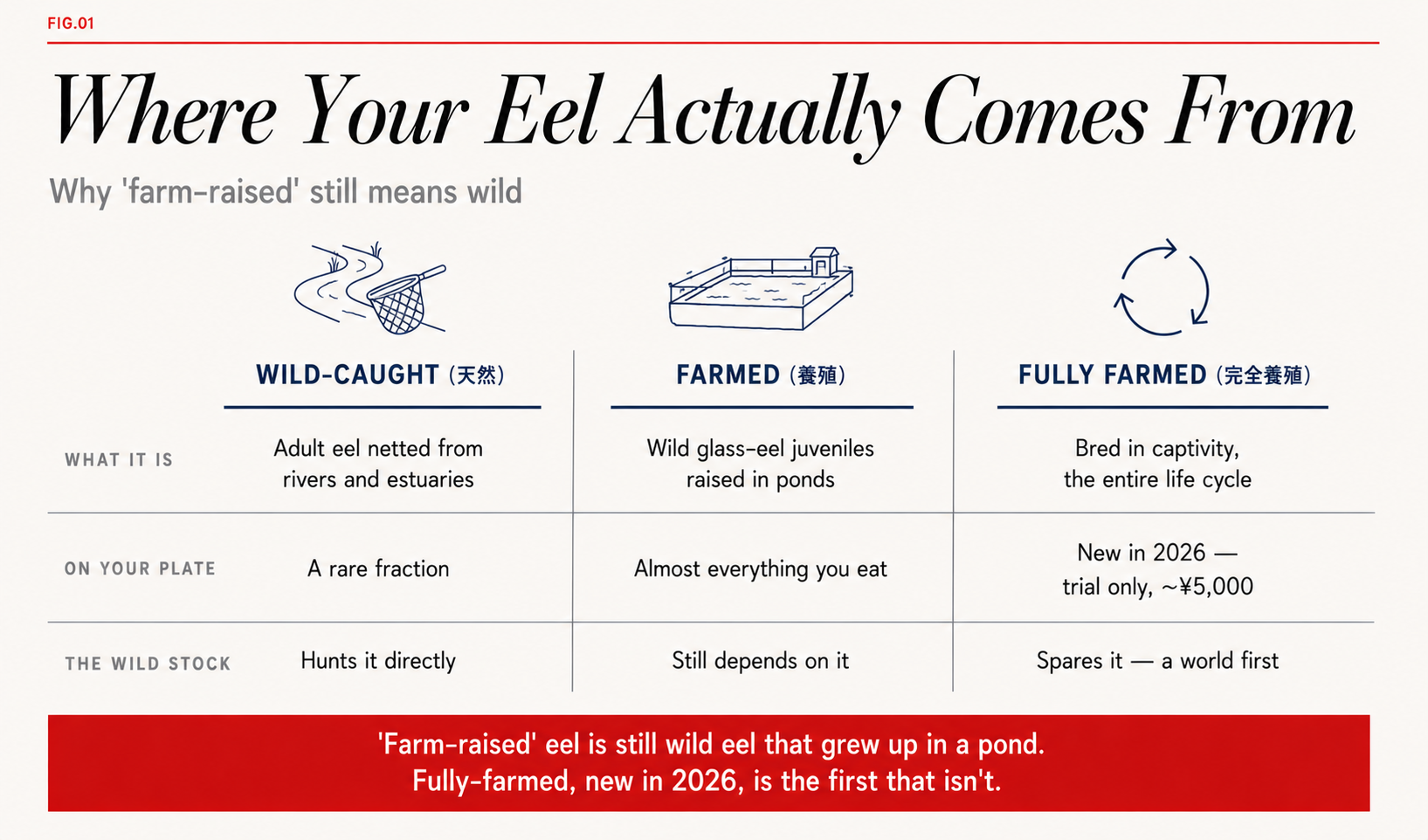
So, should you eat eel? The honest framing is this: the una-ju on a normal Tokyo menu is farmed-from-wild, which is exactly the thing the Red List is about. That does not make one meal a crime, and we are not here to wag a finger — but it is worth eating with your eyes open, ordering at a serious shop that treats the fish with respect rather than a discount slab, and watching the fully-farmed supply as it scales.
And Midsummer Is Not Even Its Season
Here is the deeper irony of an eel ritual pinned to late July: wild eel is at its best in autumn and early winter, not summer. As the water cools from around October, wild eel feeds hard and lays on fat for winter dormancy; the prized kan-no-unagi (寒の鰻, “cold-season eel”), roughly October through December, is the fattiest, richest natural eel of the year — the same cold-water logic that makes winter kan-buri yellowtail so prized. Gennai’s summer campaign worked because midsummer was the dead season for a fish that genuinely peaks in the cold.
If you want the broader idea of a true season — the difference between a marketing date and a natural peak — we lay it out in what shun actually means. For eel, the two are simply months apart. The honest caveat: this gap matters most for wild eel. Farmed eel, grown to a target weight in heated ponds, eats consistently year-round, which is precisely why the industry can stage a nationwide eel holiday in the heat of July at all.
What You Will Actually Pay
Eel is expensive and has been getting more so. At retail, grilled kabayaki ran about ¥1,452 per 100 grams in 2025, up roughly ¥200 on five years earlier. At wholesale, live eel at Tokyo’s Toyosu market averaged about ¥3,811 a kilogram in March 2026 — down about a quarter year-on-year, though 2025 had touched a multi-year high near ¥5,067. Prices ease and spike with each season’s glass-eel catch, but the long trend is up. (Figures as published by the market and trade trackers, accessed June 2026.)
In a restaurant the spread is wide. A wave of efficient, casual specialists now plates a respectable una-don for ¥1,000–2,000, roughly half what it used to cost; a long-established house runs ¥3,000–4,000 and up per person — Izu-ei in Ueno lists ¥3,500 to ¥12,000. One piece of menu literacy: on an old-school una-ju menu, the tiers matsu / take / ume (松・竹・梅, “pine / bamboo / plum”) usually mark portion size — how much eel sits over the rice — not three grades of quality. You are buying more eel, not better eel. And the fully-farmed fish above, near ¥5,000, is for now a curiosity premium rather than the cheaper future it eventually points to.
How to Eat It Well — and Where
If you eat it, eat the Tokyo (Kanto) version, which is its own craft. Edo-style eel is split down the back (se-biraki, 背開き) — belly-splitting carried an unlucky seppuku association in the samurai city — then skewered, steamed, and charcoal-grilled with a soy-and-mirin tare. That steaming step renders the fat and leaves the flesh custard-soft; Kansai eel, grilled straight through without steaming, comes out crisper. Most Tokyo specialists serve it as una-ju (鰻重), filleted eel lacquer-boxed over rice. The connoisseur’s order is shirayaki (白焼き) — grilled plain, no sauce, eaten with a little wasabi or salt — where there is nowhere for a mediocre eel to hide.
The reliable Tokyo address is a proper specialist, not a chain or a convenience-store pack. Izu-ei Honten, by Shinobazu Pond in Ueno, has grilled eel since the early eighteenth century (the ward dates the founding to 1720), building its tare daily from the grill drippings for close to three hundred years; expect ¥3,500–12,000 and lunch-to-evening hours. It is a sit-down, occasion meal — the right register for a fish this loaded, literally and culturally. If a full una-ju house is more than your day calls for, the casual specialists above deliver the real Kanto preparation at half the price.
The honest move on the holiday itself: Doyo no Ushi is the single most crowded eel day of the year, at supermarkets and specialists alike. If you want the meal rather than the ritual, go a few days to either side — the same eel, no two-hour queue, and a kitchen that can give your una-ju its full attention. Eat it well, eat it knowing what it is, and grilled eel over rice is still one of Tokyo’s great plates — just one worth ordering thoughtfully.
Sources & Further Reading
- IUCN Red List — Anguilla japonica (Japanese eel) (listed Endangered since 2014; population decreasing)
- 水産庁『うなぎをめぐる状況と対策について』 (Japan Fisheries Agency, eel resource management) (farmed eel begins as wild glass eels; Dec-2023 unlicensed glass-eel take up to 3 years / ¥30 million)
- 水産研究・教育機構 プレスリリース「完全養殖ウナギ蒲焼の試験販売」(2026-05-20) (first fully-farmed kabayaki trial sale from May 29, 2026; Mitsukoshi Nihonbashi / Aeon EC; ~¥5,000 per fish; a world first)
- 国立天文台 暦計算室(雑節・土用)/ Japanese almanac (summer doyo July 20–Aug 6, 2026; single Day of the Ox, July 26, no ni-no-ushi)
- 東京都中央卸売市場(豊洲)市況/うなぎ蒲焼 小売価格指数 (Toyosu wholesale ~¥3,811/kg Mar 2026, 2025 peak ~¥5,067; kabayaki retail ~¥1,452/100g in 2025; accessed June 2026)
- うなぎの旬・天然と養殖の違い(食通コラム) (wild eel fat peak Oct–Dec, kan-no-unagi; farmed eel year-round consistent)
- 鰻割烹 伊豆榮 公式/台東区「江戸創業事業所」 (Izu-ei Honten founding 1720, Ueno; price ¥3,500–12,000; Edo-style preparation)