
What the Plastic Food Display Outside a Tokyo Restaurant Is Really Telling You
Most visitors read the plastic food case as a 3D menu. Tokyo's sample trade reads it as a sales fixture with a deliberate grammar — a center-shelf hot spot, an engineered look of abundance, and a "becoming scenery" failure that turns a faded case into a quiet confession. Here's how to decode any Tokyo shopfront in five seconds, including what the absence of a case tells you.
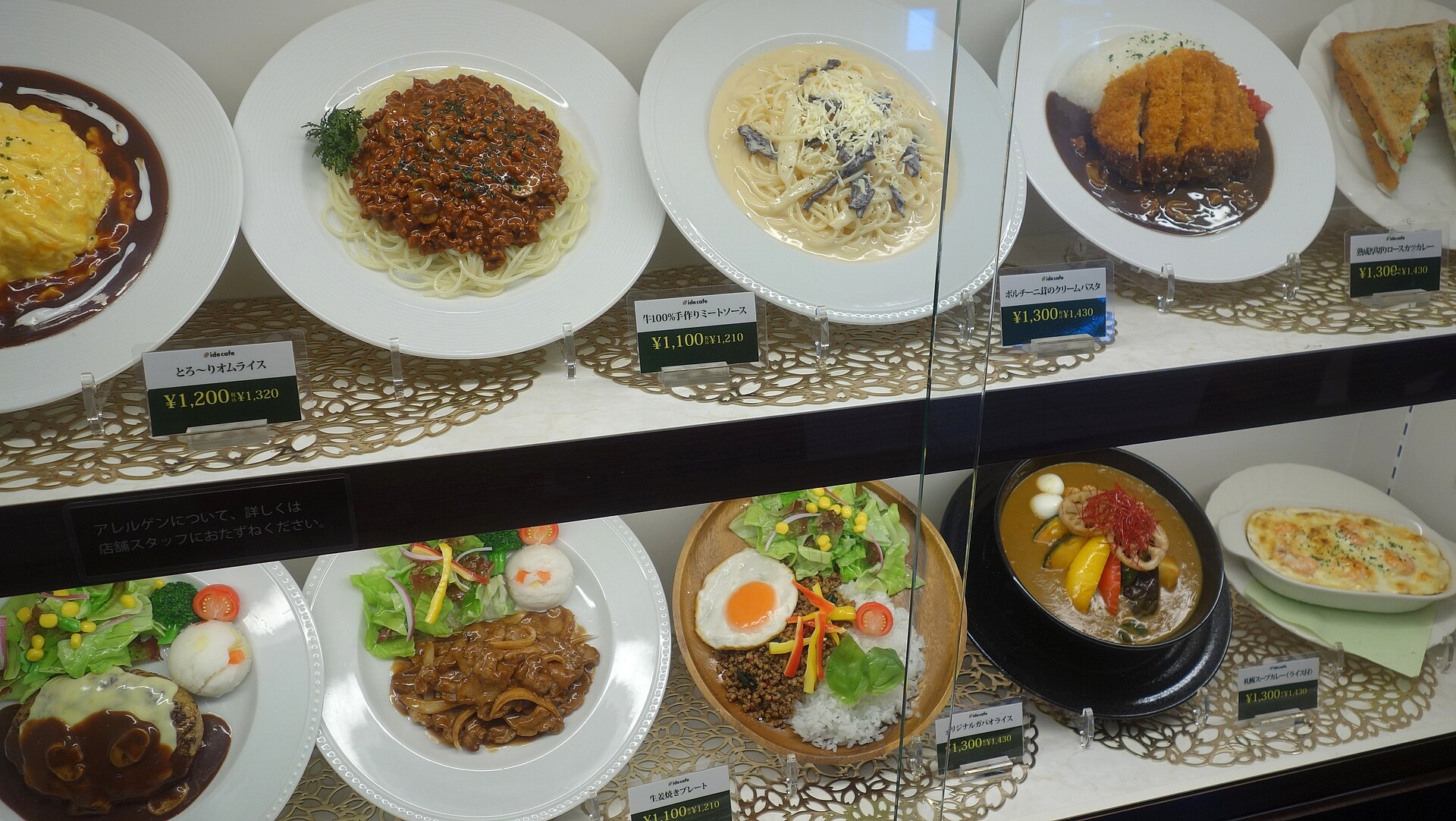
You have been reading the plastic food case wrong. Most visitors treat the glossy *shokuhin sampuru* (食品サンプル, “food samples”) in the window as a 3D menu — a friendly bridge over the language gap, a way to point instead of pronounce. It is that. But it is also something the kitchen is telling on itself without meaning to. In the Japanese sample-display trade there is an explicit grammar for how a case should be arranged — a “golden rule,” 黄金律 (*ougonritsu*) — that owners deliberately manipulate to push sales. Which means the manipulation is readable. Once you know where the owner hides the dish they most want you to order, what a packed case is engineered to signal, and what a faded one quietly confesses, you can decode a Tokyo shopfront in about five seconds — and use it tonight to choose between two restaurants on the same block.

What You Think It Means vs. What It Actually Means
What you think the case means: this is a tourist-friendly menu, and a place with one is probably casual, cheap, maybe a little touristy. Half right, half backwards. The case is not aimed at you, the visitor. It was built decades before mass inbound tourism, for Japanese passers-by who needed to decide — in the three seconds it takes to walk past a window — whether to stop. According to trade material from the sample industry, owners report sales climbing 20–50% after installing a case (an industry figure, not an audited one). The reason is mechanical: the case lets a customer decide what to order before they sit down, which compresses the time from seat to order and lifts table turnover. The sample maker iwasaki, the market-leading firm, frames the sample as doing the work of the menu itself — showing the dish’s detail while presenting its name and price in one glance.
So the case is not a sign of a lesser restaurant. It is a sign of a specific *kind* of restaurant: high-volume, walk-in, decide-at-the-door. And it is, in the trade’s own phrase, a display of the shop’s confidence — 店の自信の表れ (*mise no jishin no araware*). A kitchen that puts its food in the window is making a claim it has to keep. That is the first thing the case actually tells you: not “tourist trap,” but “we turn tables, walk in, here is exactly what you’ll get.”
The Golden Rule: Where the Owner Hides the Dish They Want to Sell
Here is the single most useful thing to know, and the thing every English explainer misses. The sample trade teaches a hot spot: the dish the owner most wants to sell goes in the dead center of the middle shelf. Not the top, not the prettiest corner — the center of the middle. Trade writing on the subject advises owners to physically move samples around and watch which slot lifts order counts, then settle the dish they want to push into that center spot. The eye lands there first, and the owner knows it.
So when you stand in front of a case, do not look at the most photogenic item. Look at the center of the middle shelf. That is the house’s pick — usually the dish with the best margin, the best execution, or both. The corollary is just as useful: the most beautiful sample in the case is often *not* the one the kitchen is best at; it is the one that photographs well in plastic. Read the hot spot, order the hot spot, and you are eating what the owner has decided, by trial and error, the shop does best.
The rest of the layout is engineered too. Plates are arranged with no gaps — edges slightly overlapping — to signal an abundant menu; a sparse case reads as a thin kitchen, so owners pack them. Lower shelves are tilted around 45 degrees, rising toward 60 degrees on the upper shelves, so every plate stays in your sightline as your eye climbs. And children’s dishes — the *okosama* plate with its little flag — sit on the bottom shelf, deliberately, because a short child standing at the glass can’t see the top tier. None of this is decoration. It is a sales fixture pretending to be a menu.
The Tell the Kitchen Doesn’t Know It’s Giving: 風景化
The trade has a word for the worst sin a case can commit: 風景化 (*fuukeika*), literally “becoming scenery.” It describes a case where the same dishes have sat in the same spots for years — so unchanging that locals stop seeing it, the way you stop seeing a vending machine you pass every day. A case that has become scenery has lost its entire job, which is to interrupt a passer-by. Owners are told to rotate the menu, swap samples, and add small seasonal cues — a cherry-blossom sprig in spring, a maple leaf in autumn — specifically to keep the case from going invisible.
This hands you a soft signal you can read in seconds. A case that is sun-bleached, dusty, with curling price tags and a menu that obviously hasn’t changed — and no seasonal cue anywhere — reads as a kitchen that has stopped tending its own front door. It does not *guarantee* the food is bad; plenty of beloved old shops keep a tired case and a sublime kitchen, and the read is a hint, not a verdict. But all else equal, between two unknown places on the same block, the one whose case looks maintained — clean glass, a current seasonal touch, samples that match what’s actually being served — is the kitchen that still cares about being seen. That is the case telling on itself, and it has no idea it’s doing it.
You can watch a maintained case do its work in a high-footfall district. Daikokuya Tempura (Asakusa), the tendon house founded in 1887 that helped make Tokyo’s dark-sauce tempura-over-rice a thing, sits in the river of foot traffic flowing off Senso-ji. A case there is not nostalgia — it is a working tool earning its keep on a street where most people decide in three seconds. Gyukatsu Motomura (Shibuya) and Maisen Aoyama Honten sit in the same tier: set-meal restaurants with long visitor queues, where a window display front-loads the decision before you sit and turnover is the business model. These are exactly the places the decoder is built for.
When There’s No Case at All — and the Four-Point Read
The most advanced read is the one the other guides never make: the *absence* of a case is information too. Counter sushi, *kaiseki* (会席, multi-course Japanese haute cuisine), and serious counter tempura don’t put plastic in the window — because their whole proposition is the opposite of decide-at-the-door. At Tsunahachi Sohonten, frying tempura over the counter in Shinjuku since 1924, the chef cooks to order in front of you and the “menu” is trust, not a plastic ebi-ten in a box. When a place near the station has no street case, no photos taped to the door, and just a *noren* (暖簾, the split entrance curtain) and a name, it is signaling a different contract: you sit, you defer, you pay more, and the value is in the hands behind the counter. You have, in effect, graduated out of the sample-case tier into counter-trust territory. Read that absence as a price-and-formality warning, not an oversight.
So here is the read you run on any Tokyo shopfront tonight. One: is there a case at all? A case means walk-in, casual-to-mid, decide-now; no case (and no photos) means counter-trust, higher price, sit-and-defer. Two: what’s in the center of the middle shelf? That’s the house’s pick — order it over the prettiest item. Three: is the case maintained or has it become scenery? Clean glass and a seasonal cue read as a kitchen still paying attention; dust, sun-bleach, and curling tags read as one that isn’t. Four: does the case match the kitchen? If the samples show dishes that aren’t on today’s menu, or the photos look a decade old, trust your eyes on the street less and the room inside more.
One last loop worth closing. The dish that started this entire industry was *omurice* (オムライス, omelette over ketchup rice) — in 1932, the sample maker Iwasaki Takizo (岩崎瀧三) made a plastic omelette realistic enough, the story goes, to fool his own wife, and the trade was born. You can still order the real plate behind a Ginza door at Kissaten You, the retro *kissaten* (喫茶店, old-style coffee house) by the Kabukiza. It’s a fitting place to end: the first food ever rendered in plastic, served as an actual plate, in a shop you found by reading — not the window — but everything the window was quietly telling you. For more on reading a Tokyo front door before you commit, see what a cash-only sign signals and which Tokyo restaurants you can actually walk into.
Sources & Further Reading
- gaisyoku.biz — “サンプルケースには黄金律がある” (the center-middle-shelf hot spot, overlapping-plate “abundance” arrangement, 45°→60° shelf tilt, children’s dishes low, and the 風景化 “becoming scenery” failure; trade/industry guidance, accessed May 2026)
- gaisyoku.biz — “食品サンプルの持つ力” (the reported 20–50% sales lift and “店の自信の表れ” framing; industry claims, not independently audited; accessed May 2026)
- 株式会社いわさき — corporate history (the sample doing the work of the menu; Iwasaki as the industry’s leading domestic firm — reported share varies widely by source and year, from “over 50%” to higher estimates; accessed May 2026)
- 岩崎瀧三 — Japanese Wikipedia (1932 founding, the omurice/omelette origin model; accessed May 2026)
- Ganso Shokuhin Sample-ya, Kappabashi (where to see restaurant-grade replicas and try making your own, near Asakusa; accessed May 2026)
- Daikokuya Tempura — GOOD LUCK TRIP (founded 1887, Asakusa tendon, hours drift — confirm before visiting; accessed May 2026)