
Tsukiji or Toyosu: Which Fish Market You Actually Want in 2026
“Tsukiji moved to Toyosu” is the most repeated wrong sentence in Tokyo travel writing. Only the wholesale auction moved; the Outer Market never did. What each place is in 2026 — and which morning you actually want.
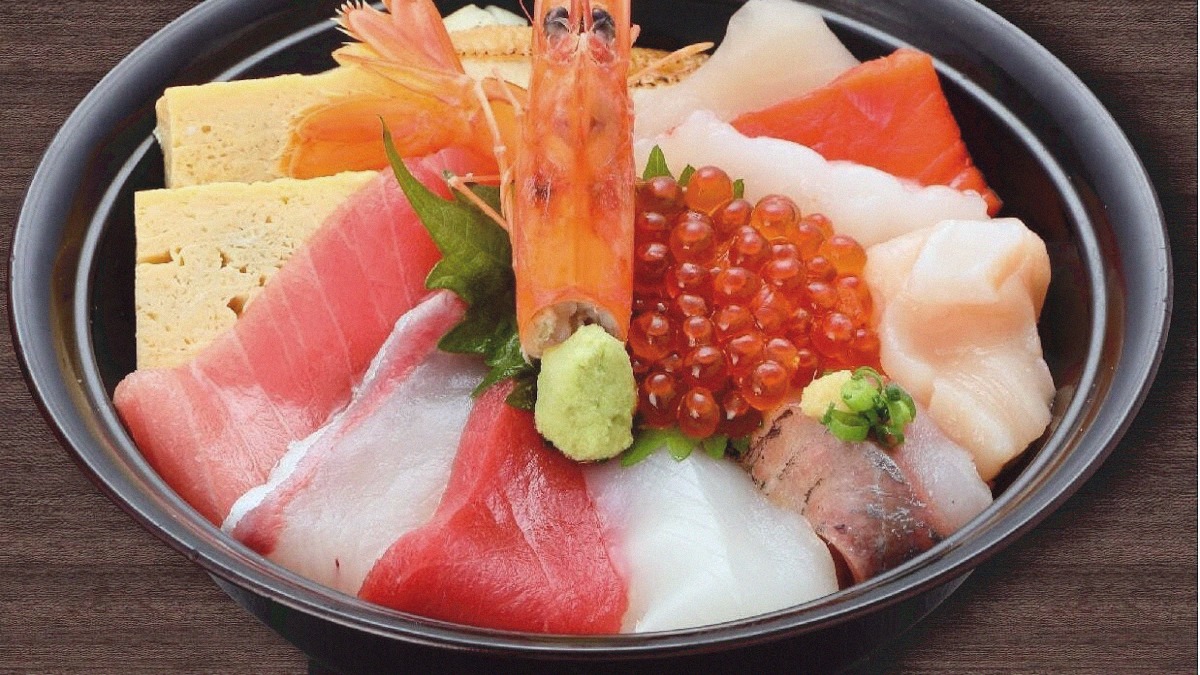
Tsukiji or Toyosu — which should you visit? Go to Tsukiji for eating and atmosphere (the Outer Market never moved; just show up hungry on a weekday morning), and to Toyosu for the tuna auction and a look at how the trade actually works. Only the wholesale auction relocated in 2018 — the line everyone repeats, “Tsukiji moved to Toyosu,” is half wrong. If you can, do both in one morning, and budget the meal with our Tokyo food budget guide. Here is each in 2026, and how to combine them.
A lot of what you will read about this is wrong, because it was written before 2018 and never updated. The sentence “the Tsukiji fish market has moved to Toyosu, so go to Toyosu now” is the single most repeated and most misleading line in Tokyo travel writing. What moved was the wholesale auction floor — the part most visitors were never really seeing anyway. What stayed at Tsukiji is the part they actually came for. These are now two different attractions, and choosing between them is a question of what you want to do at 6am, not which one is the “real” one.
This piece separates the two cleanly: what each place now is in 2026, why the split happened, and the honest answer to which one a given traveller should spend a morning on.
Tsukiji vs Toyosu at a Glance
The fast version, before the reasoning. Hours and figures below are accurate as of June 2026 and worth re-checking against the official sites before you go.
| Tsukiji Outer Market | Toyosu Market | |
|---|---|---|
| What it is | The original public food lanes (the wholesale floor left; this never did) | The modern wholesale facility plus the tuna auction and relocated counters |
| Hours | Roughly 5:00–14:00; individual stalls vary, many wind down by early afternoon | Auction roughly 5:30–6:30am; observation windows open around 5:00am; restaurants mostly close 13:00–14:00 |
| Nearest station | Tsukiji Shijo Stn (Toei Oedo line) or Tsukiji Stn (Tokyo Metro Hibiya line) — a few minutes’ walk | Shijo-mae Stn (Yurikamome line), connected to the market by covered passageway |
| Tuna auction | None — the auction moved in 2018 | Yes — the genuine predawn wholesale auction |
| Food experience | A dense walk-in food street: grazing, sushi, knives, tamagoyaki, dried goods | Counter sushi inside the facility, plus the constructed Senkyaku Banrai market street |
| Reservation / lottery? | No — walk in at any hour | Lower-deck auction viewing by online lottery (reportedly ~100 places a day); upper windows free, no lottery |
| Best for | Eating and browsing on a normal schedule | Seeing the auction spectacle and the pilgrimage counters |
What Actually Moved, and What Did Not
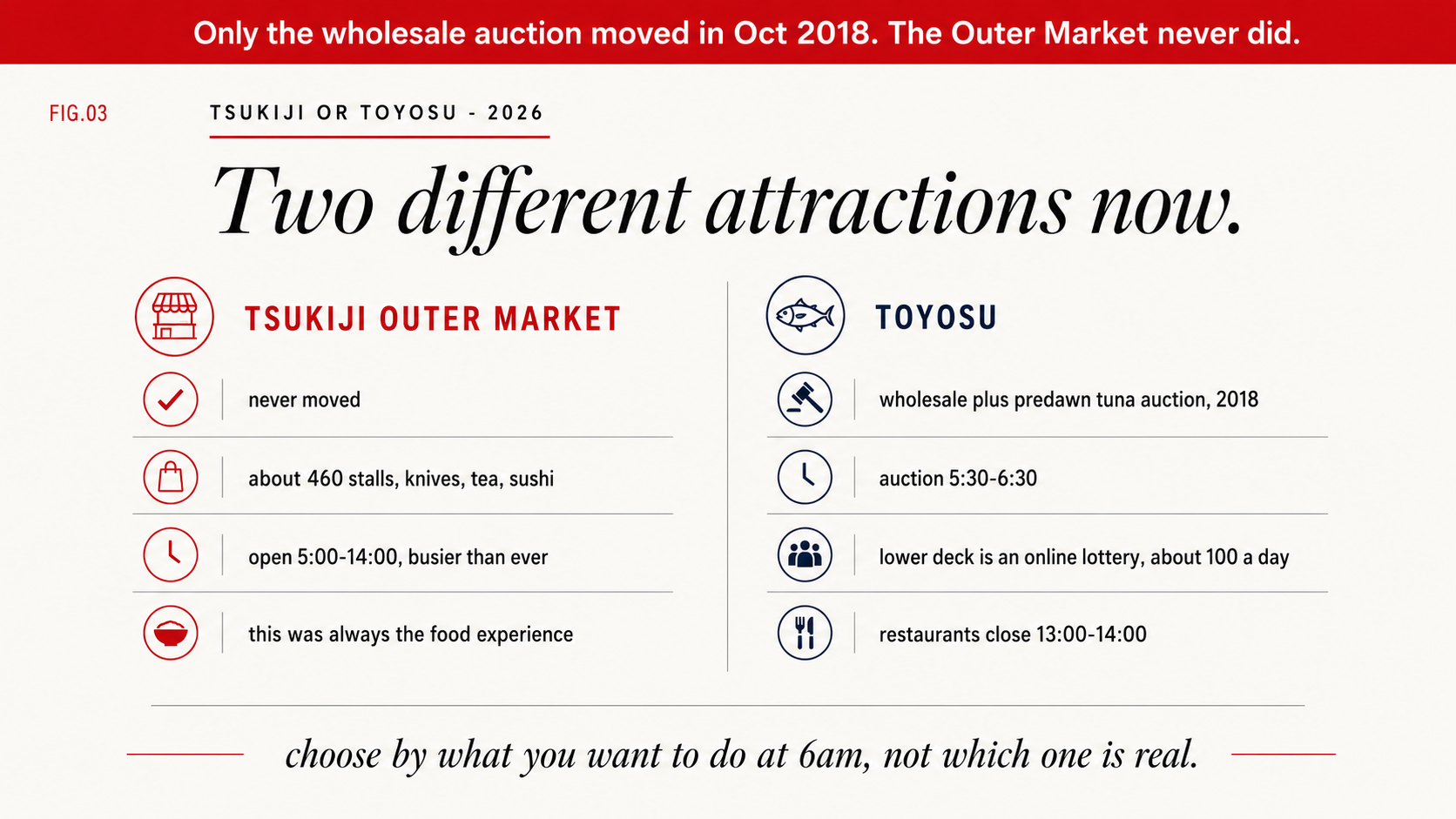
In October 2018 the wholesale operation — the licensed buyers, the intermediate wholesalers, and the famous predawn tuna auction — relocated from Tsukiji (築地) to a purpose-built facility at Toyosu (豊洲), about two kilometres east. That is the entirety of what moved. The Tsukiji Outer Market (Tsukiji Jogai Shijo, 築地場外市場) — the dense public lanes of around 460 tamagoyaki stalls, knife shops, dried-goods sellers, tea merchants, and sushi counters — never went anywhere. It is open in 2026, roughly 5:00 to 14:00, and it is busier than ever.
This matters because the Outer Market was always the food experience. The wholesale floor was a logistics operation that tourists watched from the edges; the eating, buying, and grazing happened in the Outer Market then exactly as it does now. Calling Tsukiji “gone” is like calling a stadium gone because the team changed training grounds. The stands are full. The thing the visitors came for is still there, on the same lanes, at the same hour.

What Toyosu Actually Is Now
Toyosu is the modern, glass-and-steel successor to the wholesale function, and it is a genuinely different product. The tuna auction runs roughly 5:30 to 6:30am and can be watched two ways. The upper observation windows are free, open from around 5:00am, double-glazed — which means quiet, climate-controlled, and slightly distant, with reflections that frustrate photos. The lower deck puts you behind a single pane of glass, inside the noise and cold of the actual auction, and it requires winning an online lottery: about 100 places a day, applied for roughly a month ahead during the first week of the previous month, drawn at random. Toyosu’s restaurants — including the relocated Sushi Dai and Daiwa Sushi — cluster on the intermediate wholesale building’s upper floor and mostly close by 13:00 or 14:00, earlier if the fish runs out. The spectacle is real money: the first auction of 2026, on January 5, saw a 243 kg bluefin from Oma sell for ¥510 million (about US$3.2 million) to Kiyomura, the Sushi Zanmai operator — a record the same buyer has now set repeatedly.

In February 2024 Toyosu also gained its own outer-market analogue: Senkyaku Banrai (千客万来), a three-storey facility built to recreate an Edo-era market street, with roughly sixty to seventy shops and restaurants and a rooftop hot spring. Its practical shape, for planning: the bathing wing (Tokyo Toyosu Manyo Club) runs 24 hours with hot-spring water trucked in from Hakone (箱根) and Yugawara (湯河原), and the 10th-floor rooftop bath is for paying spa guests, while the 8th-floor footbath garden is free. It is deliberately filling the role the Outer Market plays at Tsukiji — the eating-and-browsing layer around the wholesale spectacle. It is well made and worth knowing about, but it is a constructed experience that opened in 2024, not a century-old lane. That distinction is the whole decision.
Which One You Actually Want
The choice reduces to one question: do you want the spectacle, or the food walk? If the goal is the tuna auction — the genuine wholesale theatre, men with hooks and hand signals moving frozen two-hundred-kilo bluefin before sunrise — then Toyosu is the only option, and it demands commitment: a 4:30–5:00am arrival, ideally a lottery win for the lower deck, and the understanding that you are visiting a working facility, not a charming street. Pair it with a Sushi Dai breakfast if you can absorb the queue, which still runs hours even after the move.
If the goal is to eat and graze — fresh uni on the spot, a hot tamagoyaki skewer, a knife you will use for the next twenty years, sushi for breakfast without a lottery — then Tsukiji Outer Market is the answer, and it is a far easier morning. No reservation, no lottery, central location, and a tourist sweet spot around 9:00 to 11:00 when stalls are fully stocked but the 7–8am crush has thinned. For most travellers on a normal schedule, that is the better use of a Tokyo morning. The two are not ranked; they are different mornings. Toyosu is an event you apply for. Tsukiji is a place you walk into — which connects to the larger pattern in our piece on which Tokyo restaurants you can actually walk into.
How to Get There, and How to Do Both
The two markets sit about three kilometres apart in Tokyo’s eastern bayside, and the access is genuinely different, which is half of why people conflate them. Toyosu is reached by the Yurikamome line to Shijo-mae Station, which connects straight into the market building by a covered passageway — useful in rain and in the predawn cold. Tsukiji’s Outer Market is a few minutes’ walk from Tsukiji Shijo Station on the Toei Oedo line, or from Tsukiji Station on the Tokyo Metro Hibiya line; it sits in central Tokyo, not out on the bay.
If you want both in a single morning — and most planners do — run them in this order, because the auction is the time-locked half. Arrive at Toyosu by roughly 4:30–5:00am for the auction (lower deck only if you won the lottery; otherwise the free upper windows), then queue for a Sushi Dai breakfast if you can absorb the wait. From Shijo-mae, the quickest hop to Tsukiji is the Yurikamome line two stops, changing to the Yurakucho line and getting off at Shintomicho, then an eight-minute walk to the Outer Market — reportedly around 15 minutes of travel in total. On a clear day you can also walk it: about three kilometres over three bridges, roughly 30 minutes. Either way you arrive at the Outer Market around 9:00am, which lands you in the grazing sweet spot — stalls fully stocked, the 7–8am crush thinned.
Where to Eat at Each
At Toyosu, the relocated counters carry the legend. Sushi Dai remains the pilgrimage — an omakase of Edo-style nigiri that drew lines at Tsukiji and still draws them at Toyosu, with a multi-hour queue and a roughly one-hour seating; Daiwa Sushi next door is larger and faster (15–30 minutes at the counter, a shorter wait) if time matters more than the specific name. At Tsukiji, the move is breadth, not a single counter: graze the lanes, then sit down where it suits you — Sushi Zanmai’s Tsukiji flagship is the reliable anchor, open 24 hours with full English menus, the rare market-area sushi room you can enter at any hour without a queue or a lottery. Decide which morning you want first; the restaurant choice follows from that, not the other way around.
FAQ
Did Tsukiji move to Toyosu?
Only partly, and this is the line most articles get wrong. In October 2018 the wholesale operation — the licensed buyers, the intermediate wholesalers, and the predawn tuna auction — moved from Tsukiji to Toyosu, about two kilometres east. The Tsukiji Outer Market, the public food lanes where visitors actually eat and shop, never moved. It is open in 2026, roughly 5:00 to 14:00. So Tsukiji is not gone; only its wholesale floor relocated.
Which should I visit, Tsukiji or Toyosu?
It depends on what you want at dawn. Go to Toyosu for the spectacle: the genuine wholesale tuna auction (roughly 5:30–6:30am), which means a 4:30–5:00am arrival and, for the lower viewing deck, an online lottery applied for about a month ahead. Go to the Tsukiji Outer Market for the food walk: grazing, sushi, knives and tamagoyaki with no reservation and no lottery, easiest around 9:00–11:00am. For most travellers on a normal schedule, Tsukiji is the better single morning; the two are different experiences, not a ranking.
Can I see the tuna auction without winning the lottery?
Yes. The upper observation windows at Toyosu are free and open to anyone from around 5:00am, no application needed — they are double-glazed and a little distant, but you still see the auction. Only the lower deck, behind a single pane and inside the noise, requires winning the online lottery (reportedly about 100 places a day, applied for roughly a month in advance).
Sources & Further Reading
- japan-guide — Toyosu Fish Market (2018 relocation; tuna auction decks; restaurant hours)
- japan-guide — Tsukiji Outer Market (Outer Market remained; hours; what it is)
- GO TOKYO (Tokyo Metropolitan Government) — Toyosu Senkyaku Banrai
- The Tsukiji Outer Market — official site (open in 2026; ~460 shops; calendar and hours)
- Tokyo Cheapo — Toyosu Fish Market: full guide including the tuna auction (lower-deck lottery ~100/day; viewing windows; Tsukiji–Toyosu transit, accessed June 2026)
- CNN — Bluefin tuna fetches record $3.2 million at Toyosu auction (243kg Oma bluefin, ¥510M, Jan 5 2026, Kiyomura/Sushi Zanmai, accessed June 2026)
- GO TOKYO — Toyosu Senkyaku Banrai (opened Feb 2024; ~70 shops; 24h Manyo Club onsen, Hakone/Yugawara hot-spring water, accessed June 2026)
We keep Tokyo guides like this current as the city changes. One dispatch a week. Join the ONDO Tokyo newsletter.