
Why Tokyo’s Best Cheap Dinner Is a Department Store Basement
The best-value dinner in Tokyo hides in a luxury department store basement, in the last hour before closing — when a food-safety law forces premium bento down to convenience-store prices. The mechanism, the timing, and where to do it.
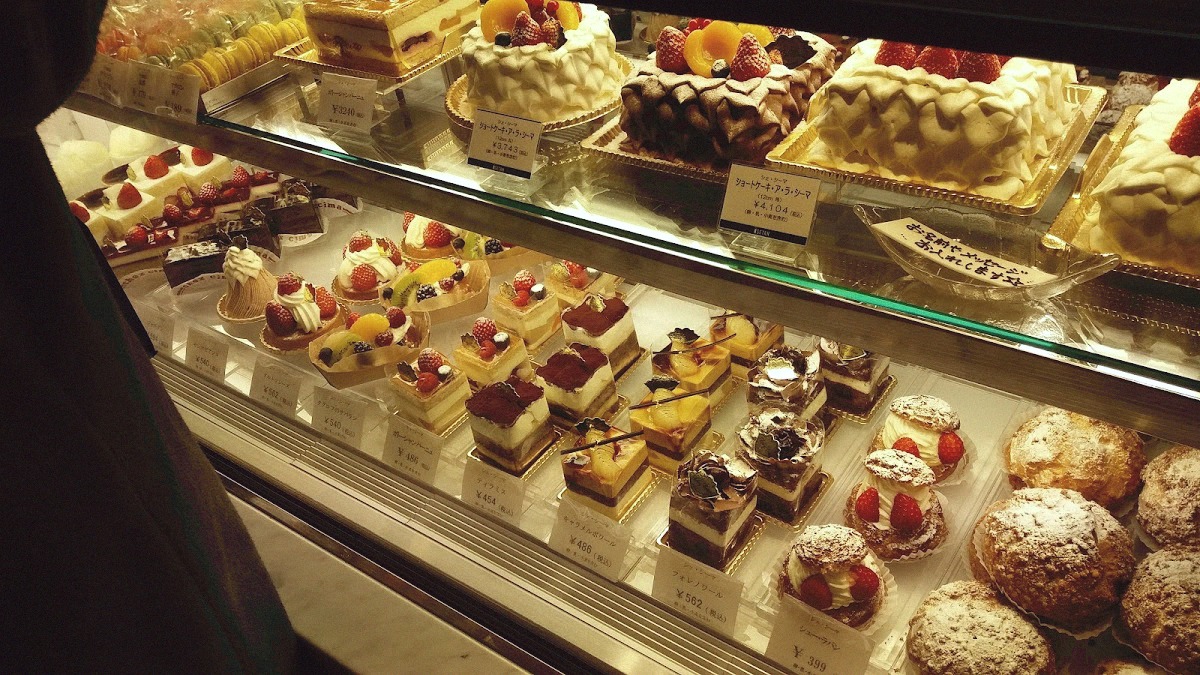
Ask where to eat cheaply in Tokyo and you will be sent to convenience stores, chain gyudon, or standing soba. All fine. But the best-value dinner in the city is hiding somewhere nobody thinks to look for a bargain: the basement of a luxury department store, in the last hour before it closes, when food that cost a small fortune at 5pm is being marked down to convenience-store money at 7:30. This is not a secret the stores are hiding. It is a legal obligation they would rather you helped them with.
The mechanism is specific, predictable, and almost never explained properly to visitors. This piece covers what a depachika actually is, the food-safety law that creates the discount, the exact timing, and how to walk out with a department-store dinner for the price of a fast-food one.
What a Depachika Is
The word is a contraction: depachika (デパ地下), from depato (department store) and chika (basement). It is the basement food hall under a major department store — typically one or two floors of confectioners, regional specialists, a wine and sake selection, and, critically, a vast sozai (惣菜, prepared-food) section of bento, sushi platters, tempura, grilled fish, croquettes, and salads sold by weight or by the box. The format dates to 1936, when Matsuzakaya opened the first basement market at its Nagoya flagship, and matured into its modern form after Tokyu’s renovated Shibuya food floor reset expectations around 2000. It is now a fixed feature of every serious department store in Tokyo.
Two things make it different from a supermarket. The quality is calibrated to a department-store clientele — these are vetted producers, not house brands — and the prepared food is made for same-day eating, not shelving. That second fact is the entire reason the bargain exists. A depachika is not a grocery; it is a high-end takeaway court that happens to be downstairs from the watches and the cosmetics.
The Law That Creates the Bargain
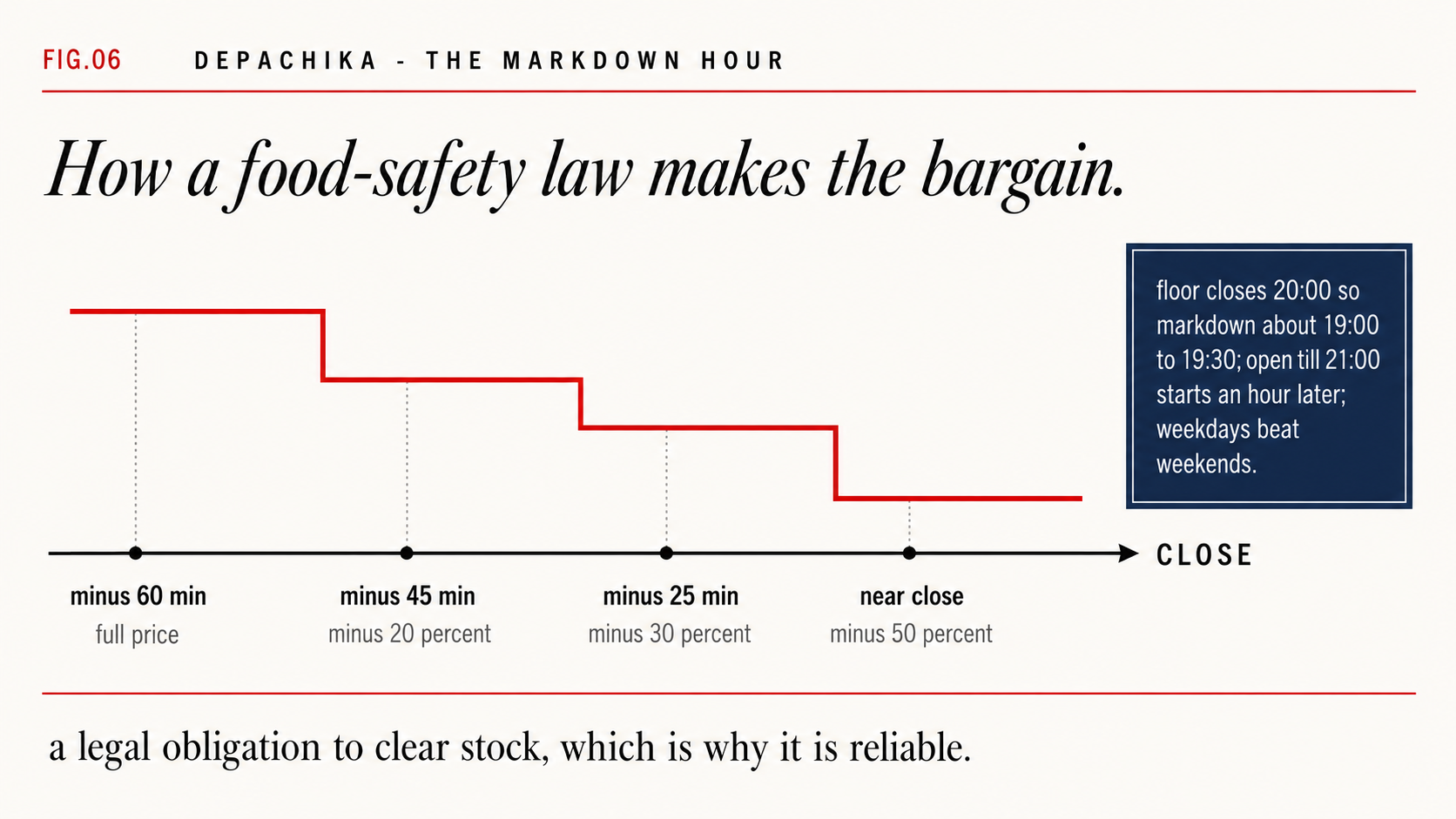
Japan’s food-safety standards do not let a counter carry a raw-fish bento or a fresh prepared dish over to the next day. Anything in the sozai cases that contains raw or perishable components has to be discarded at closing. A counter therefore faces a simple equation in its final hour: sell it at a discount, or destroy it at a total loss. Every depachika resolves this the same way. Roughly thirty to sixty minutes before the store closes, staff move through the sozai aisles applying stickers — first 20 percent, then 30, then, near the end, half price — onto bento, sushi trays, and grilled fish that were premium-priced an hour earlier.
The timing is mechanical enough to plan around. A floor that closes at 20:00 generally begins marking down around 19:00 to 19:30; a store open until 21:00 starts an hour later. Weekdays beat weekends, because fewer people are competing for the same stickered boxes. The discount is not a sale the store is excited about — it is loss mitigation forced by the discard rule — which is precisely why it is reliable. A promotion can be cancelled. A legal obligation to clear perishable stock cannot. In practice the stickers escalate on a clock: reportedly around 20 percent off at roughly sixty minutes out, 30 percent at about thirty minutes, and 50 percent — the hangaku (半額, half-price) sticker — in the final fifteen minutes.
The Markdown Hour by Store
Closing time sets the markdown window, so it pays to know which basements run late. The hours below were checked against each store’s official floor guide in June 2026; department-store hours shift seasonally and on holidays, so confirm before a special trip. As a rule, the markdown stickers begin roughly 45 to 60 minutes before the listed close.
| Depachika | Floor | Typical close | Markdown starts (approx.) |
|---|---|---|---|
| Isetan Shinjuku | B1, Main Building | 20:00 | ~19:00–19:15 |
| GINZA SIX | B2 | 20:30 | ~19:30–19:45 |
| Daimaru Tokyo (station-adjacent — best for Shinkansen travellers) | B1 “Hoppe Town” | 21:00 (Mon–Fri; 20:00 weekends/holidays) | ~20:00 weekdays |
| Tokyu Food Show, Shibuya | B1–B2, Shibuya Station east exit | 21:00 | ~20:00–20:15 |
| Mitsukoshi Ginza | B2–B3 | 20:00 (Sun 19:30) | ~19:00 |
The two later-closing basements are the practical edge. Daimaru Tokyo’s B1 “Hoppe Town” stays open until 21:00 on weekdays and sits a minute from Tokyo Station’s Yaesu side, which makes it the obvious grab for anyone catching an evening Shinkansen. Tokyu Food Show, wired directly into Shibuya Station’s east exit, runs to 21:00 as well, so its markdown window lands an hour later than the 20:00 stores.
How to Actually Use It
Arrive forty-five minutes before closing and go straight down to the sozai section — skip the confectionery and the gift counters, which do not discount the same way. Look for the sticker colour changing on the bento and platter cases. A composed dinner — a sushi selection, a piece of grilled fish, a vegetable side, something fried — that would total around ¥3,000 at full price routinely comes to ¥2,000 or less once the stickers are on, and often well under that in the final fifteen minutes. Individual sides run ¥300 to ¥900; a good bento, ¥1,000 to ¥2,500 before markdown.
Do not confuse the markdown hour with the rush hour. Between roughly 17:00 and 19:00 the basements jam with commuters buying dinner on the way home — the worst possible time to shop, and well before most counters start discounting anyway. The markdown window, in the last 45 minutes before close, is actually calmer, because the office crowd has already cleared. Aim for the gap after the rush but before the doors shut.
The hidden advantage for a visitor is that none of this requires language. You point, they weigh or ring it up, you pay. There is no menu to parse, no reservation, no cover charge, no tipping, no risk of ordering wrong. Carry it to a hotel room, a park bench, or a Shinkansen seat. For travellers managing a budget across a long trip, the depachika markdown hour is the single most efficient eating strategy in Tokyo, and it pairs directly with the wider maths in our cost of eating in Tokyo guide. It is also, by definition, a pure walk-in — the larger pattern covered in which Tokyo restaurants you can actually walk into.
What Affordable Depachika Food Actually Costs
Full-price, the sozai cases run ¥300–¥900 for individual sides and ¥1,000–¥2,500 for a composed bento — already reasonable for department-store quality. In the markdown hour, the stickers take 20 to 50 percent off the same boxes:
| Item | Full price | After the stickers (20–50% off) |
|---|---|---|
| Individual side (vegetable, fried, grilled) | ¥300–¥900 | ¥150–¥720 |
| Composed bento | ¥1,000–¥2,500 | ¥500–¥2,000 |
| A full composed dinner | ~¥3,000 | ¥2,000 or less, often far under |
Under ¥1,000, a realistic final-hour dinner is a half-price bento plus one discounted side — department-store cooking at convenience-store money.
Where to Do It
Two ONDO venues are the cleanest demonstrations. Isetan Shinjuku’s food hall, on B1 of the main building and directly connected to the station, is widely considered the most curated depachika in the country — which means the marked-down boxes here are unusually good, and the late hour is the only time its quality is also a bargain. GINZA SIX’s food floor runs the same mechanism on Ginza’s most polished basement; its broader 6th-floor dining can wait — the value play is the B2 sozai cases before close. The instruction is the same at either: arrive in the last hour, head straight for the prepared-food aisles, and let the discard rule do the work. The best cheap dinner in Tokyo is not cheap food. It is expensive food, an hour before it has to be thrown away.
FAQ
What time do depachika discount food?
In the last 30 to 60 minutes before the store closes — in practice usually from around 19:00 at a 20:00 store, or around 20:00 at a basement open until 21:00. Staff work through the prepared-food (sozai) aisles applying discount stickers, escalating toward closing.
How much do depachika discount?
The stickers typically run in a sequence: reportedly about 20 percent off first, then 30 percent, then 50 percent (hangaku, 半額 — half price) in the final stretch. The deepest cuts land in the last fifteen minutes, when the counter would otherwise have to discard the food under Japan’s same-day food-safety rules.
Which Tokyo depachika is best for discounts?
Isetan Shinjuku (B1) for sheer quality, GINZA SIX (B2) for a polished Ginza basement, and Daimaru Tokyo’s B1 “Hoppe Town” for travellers, since it closes at 21:00 on weekdays and sits beside Tokyo Station. Weekdays beat weekends — fewer people compete for the same stickered boxes.
Do you need to speak Japanese?
No. You point at what you want and pay; the price is on the box, the discount sticker is on top, and there is no menu, reservation, cover charge, or tipping. It is one of the few good dinners in Tokyo that needs no words at all.
Sources & Further Reading
- Nippon.com — “Depachika”: Japan’s Basement-Level Food Markets (1936 Matsuzakaya origin; the post-2000 modern boom)
- Japan National Tourism Organization — Guide to Japanese Department Store Food Floors
- Tokyo Cheapo — Depachika underground food halls of Tokyo (closing-time markdown timing)
- SoraNews24 — visit the shop just before closing time to save money in Japan (the discard-rule discount mechanism)
- Time Out Tokyo — best depachika food markets in Tokyo
- Store closing hours (Isetan Shinjuku 20:00; GINZA SIX 20:30; Daimaru Tokyo B1 21:00 weekdays; Tokyu Food Show Shibuya 21:00; Mitsukoshi Ginza B2–B3 20:00) verified against each store’s official Mitsukoshi-Isetan / Tokyu / Daimaru floor guide (accessed June 2026). Department-store hours and the 20–50% markdown timing are drift-prone — confirm before travelling.