
How Tokyo Actually Eats in Summer
A Tokyo summer isn't “eat whatever's cold.” It's a system built around natsubate — with a stamina axis and a cooling axis, an eel ritual that's actually an 18th-century ad campaign, and shaved ice that's a craft, not a snow cone.
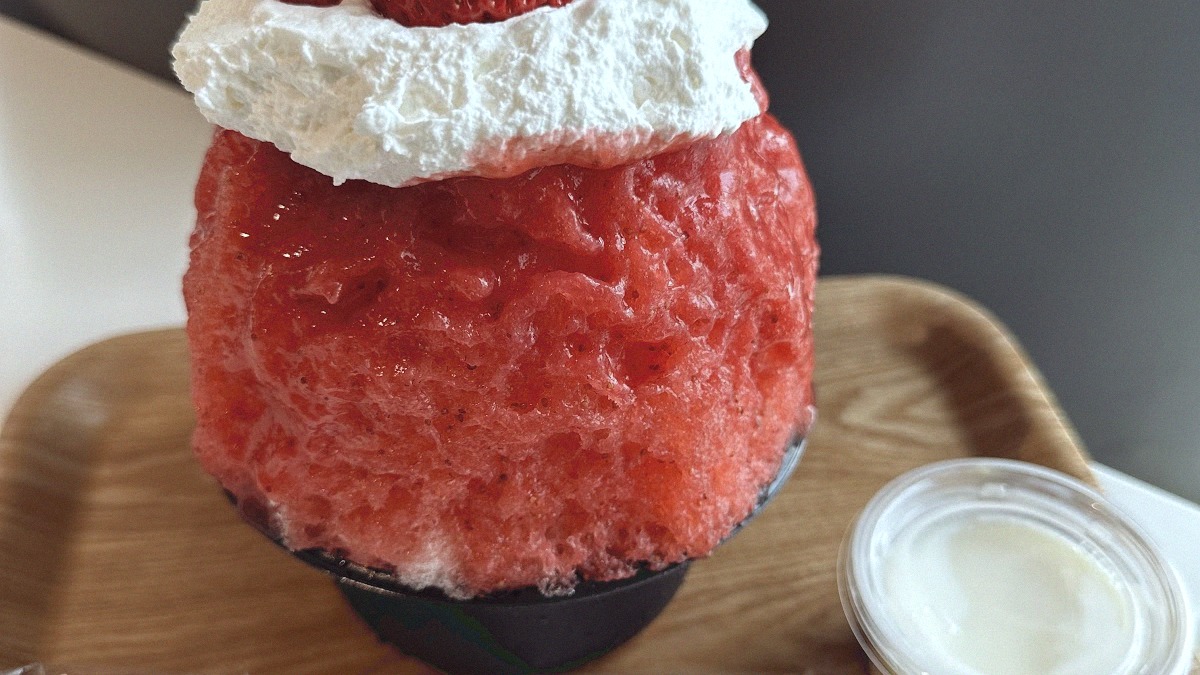
A Tokyo summer is not a heat you push through with whatever is cold and nearest. The city has a structured way of eating in July and August — specific dishes, on specific days, for a specific physiological reason — and most visitors miss all of it because nobody frames it as a system. They see shaved ice and read “snow cone.” They see eel on a menu and read “expensive.” Both readings miss what is actually happening, which is an old, deliberate strategy for eating against the heat.
This piece lays out that strategy: the idea the whole summer table is built around, the dish whose “tradition” is actually an 18th-century advertising stunt, the shaved ice that is a craft and not a novelty, and what to eat when across a Tokyo summer.
The Idea the Whole Summer Is Built Around
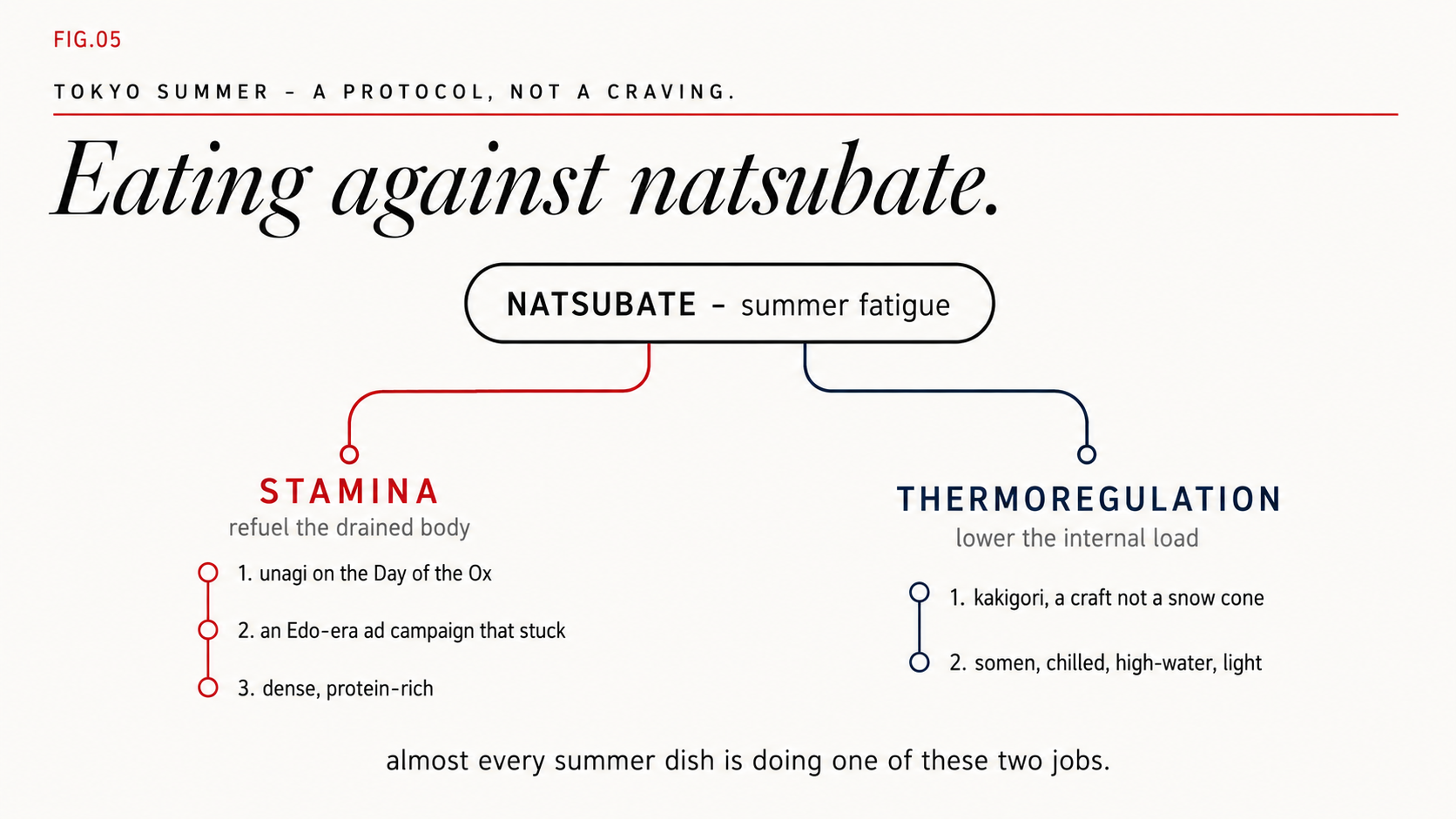
The organising concept is natsubate (夏バテ, summer fatigue) — the listless, appetite-killing exhaustion that Tokyo’s humid heat produces by August. Japanese summer eating is not random cooling; it is a response to natsubate, split into two strategies. One is stamina: dense, protein-rich food eaten deliberately to refuel a body the heat has drained. The other is thermoregulation: high-water, chilled, light dishes that lower the internal load and replace what sweat takes out. Almost every summer dish in Tokyo is doing one of those two jobs, and knowing which is how the menu suddenly makes sense.
This is why “just eat something cold” undersells it. The summer table is closer to a seasonal protocol than a craving. Locals do not eat unagi in late July because they happen to want eel. They eat it because the calendar tells them to, for a reason that turns out to be one of the great marketing stories in Japanese food.
The “Tradition” That Is Actually an Ad Campaign
The single most-observed summer ritual is eating grilled unagi (鰻, freshwater eel) on Doyo no Ushi no Hi (土用の丑の日, the Midsummer Day of the Ox), which in 2026 falls on a single date — July 26 (a year with only one ox day, the rare “no second ox” case; most summers have two) — at the hottest, most humid point of the year. The dates are fixed by the lunisolar calendar published each year by Japan’s National Astronomical Observatory (国立天文台, Kokuritsu Tenmondai) and listed in Japanese almanacs (accessed June 2026). The stated logic is sound: unagi is rich in protein, omega-3 oils, and vitamins — a textbook stamina food for a drained body. But the custom’s origin is not ancient reverence. It is an Edo-period sales tactic. By the standard account, an unagi shop struggling with poor summer sales asked the polymath Hiraga Gennai for help; he advised hanging a sign telling people that on the Day of the Ox they should eat foods beginning with the syllable “u” — unagi chief among them — as a remedy for the heat. The sign worked. The campaign became a national tradition. Tokyo still queues for it every July.
Knowing this does not cheapen the meal — it sharpens it. You are not performing an inscrutable rite; you are eating an excellent, genuinely restorative dish on the day a copywriter chose for it two and a half centuries ago, and the proof that the campaign was good is that it is still running. Eat the unagi. Just know you are also eating a piece of the world’s most durable advertisement.
We go deeper on the eel itself — the endangered-species question, why midsummer is not even its season, what you will pay, and where to eat it well — in Doyo no Ushi: should you eat eel in Tokyo?
The stamina logic is not folk belief alone. Japan’s Ministry of Agriculture, Forestry and Fisheries (農林水産省, Norin-suisan-sho, abbreviated MAFF) frames unagi as the canonical natsubate food, noting it is dense in vitamin A and the B-group vitamins (B1, B2, B6) the body burns through in heat — a single 100-gram serving reportedly covers an adult’s daily vitamin A. That is the nutrition the Edo copywriter was selling, even if he dressed it up as luck.
What you actually order matters too. The Tokyo default is kabayaki (蒲焼, eel split, skewered, charcoal-grilled and basted with a sweet soy tare) — and in the Kanto style the eel is grilled plain, then steamed to render the fat, then grilled again with the tare, which is why Tokyo unagi comes out softer and flakier than Osaka’s. The plain version is shirayaki (白焼, grilled without sauce, eaten with a little salt or wasabi) — lighter, and the better order on a brutal day. Nagoya’s hitsumabushi (ひつまぶし, chopped grilled eel over rice, eaten three changing ways) is the one to recognise if it appears on the menu.
Kakigori Is a Craft, Not a Snow Cone
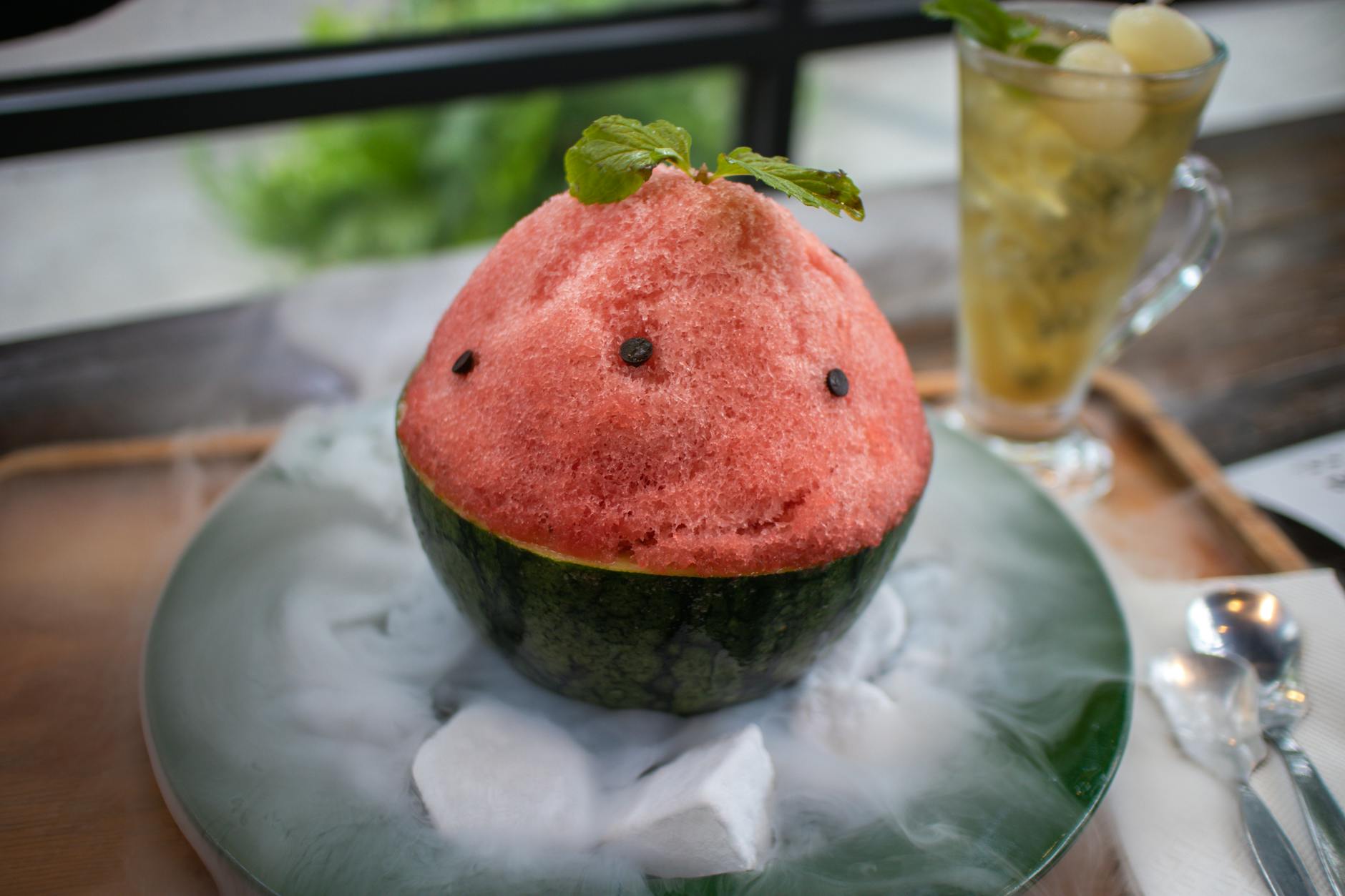
The summer dessert that visitors most consistently misread is kakigori (かき氷, shaved ice). The mental model — a paper cup of crushed ice with neon syrup — is the wrong object entirely. A serious Tokyo kakigori starts with pure water frozen slowly over 48 to 72 hours so the air is driven out and the block is dense and clear. It is then hand-shaved on a manual blade, with the bowl moved to fold air back in, producing a mountain of ice so fine it collapses on the tongue rather than crunching. The result has the texture of cold silk, not gravel. It is closer in craft-intent to a single-origin pour-over than to a fairground treat.
The lineage is long: kakigori appears in Heian-period (794–1185) records as an aristocratic luxury, when ice was cut in winter and stored in ice houses for summer; the first dedicated shaved-ice shop opened in 1862. The modern specialty-shop era — fruit reductions, real matcha, layered constructions, year-round operation — was opened in Tokyo by Himitsudo in Yanaka in 2011, which is why a summer kakigori queue in the shitamachi back-streets is not a tourist trap but the front line of an actual craft movement.
On the ground, the cue to look for is the koribata (氷旗) — a flag carrying the single red character kori (氷, ice) on white, which historically signalled a shop cleared to serve shaved ice and still marks one today. At Himitsudo, the build to order is the signature strawberry kakigori, made with house syrups from seasonal fruit and natural ice from Nikko in Tochigi; a single bowl reportedly runs roughly ¥700–¥2,000 depending on the topping (2026), and the summer queue can stretch to one to two hours on a busy day. The shop is closed Mondays — worth checking before you walk over.
What to Eat, and When
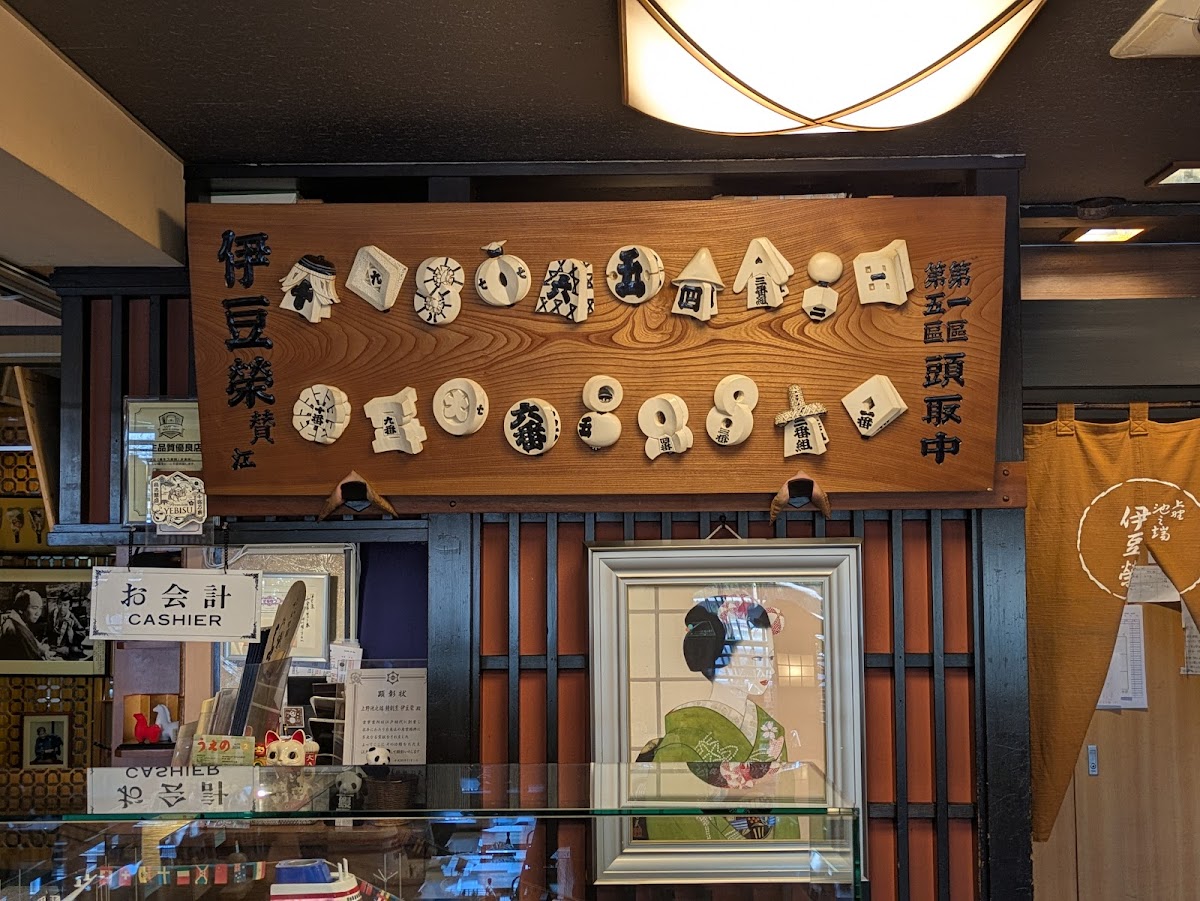
The practical summer sequence is legible once the two strategies are clear. The stamina axis: unagi, eaten any time but ritually on Doyo no Ushi no Hi in late July — Izu-ei Honten by Shinobazu Pond in Ueno traces back about 300 years across nine generations to the mid-Edo period (per the restaurant’s own account, accessed June 2026) and is the right room to eat the dish on its own day. Order the unaju (鰻重, grilled eel over rice in a lacquered box); its course unaju reportedly start from around ¥8,800 (2026). The thermoregulation axis: hiyashi chuka (冷やし中華, chilled ramen with vegetables, egg, and a soy-vinegar or sesame dressing), which appears on ramen-shop menus only in the warm months and disappears in autumn, so its presence is itself a season marker; and somen (素麺, fine wheat noodles chilled in ice water, dipped in mentsuyu), the lightest option for the days the heat kills your appetite entirely. The dessert axis: kakigori, all summer, sought out at a specialty shop rather than grabbed from a stand.
The same two axes absorb the rest of the summer table. On the cooling side, hiyayakko (冷やっこ, a cold block of silken tofu with ginger, spring onion and soy) is the lowest-effort cooling dish in any izakaya, and edamame (枝豆, young soybeans boiled and salted) does the same job while adding protein and the salt that sweat takes out. On the stamina side but lighter, anago (穴子, saltwater conger eel) is the leaner cousin of unagi — less fat, more delicate — and the better grilled-eel order when you want the protein without the richness of a full unaju. Each one slots cleanly into the stamina-or-cooling frame; that is the point.
Build a Tokyo summer day around the logic, not the novelty: a light cold-noodle lunch when the heat peaks, a craft kakigori in the worst of the afternoon, and — if the calendar lands on the Day of the Ox — unagi for the stamina dinner the city has eaten on that exact day since the 1700s. Summer eating here is a system with a reason; this is the seasonal half of the idea our piece on what shun means covers as a year-round principle.
FAQ
When is Doyo no Ushi no Hi (the Day of the Ox) in 2026?
July 26, 2026 — and only that one date. Most summers have two ox days (a first and a second, 一の丑 and 二の丑), but 2026 is a rare single-ox-day year. The date is set by the lunisolar calendar fixed by Japan’s National Astronomical Observatory (国立天文台) and listed in Japanese almanacs (accessed June 2026). You can eat unagi any day of summer; the 26th is just when the whole city does.
How much does kakigori cost, and what should I order?
At a specialty shop like Himitsudo, a single hand-shaved bowl reportedly runs roughly ¥700–¥2,000 depending on the build (2026); the signature strawberry version is the one to order. To find any shaved-ice shop on the street, look for the white flag with the red 氷 (“ice”) character.
What’s the difference between unagi and anago?
Unagi (鰻) is freshwater eel — fattier, richer, the stamina order. Anago (穴子) is saltwater conger eel — leaner and more delicate, the lighter eel for a hot day. And kabayaki (蒲焼) is the sweet-soy-basted, charcoal-grilled style; shirayaki (白焼) is the plain-grilled, salt-only version.
What should I eat in Tokyo in summer if I have no appetite?
Start with the cooling axis: somen (chilled fine noodles dipped in mentsuyu), hiyashi chuka (chilled ramen, on menus only in the warm months), or hiyayakko (cold tofu). These are built to lower the body’s load when natsubate has killed your appetite; save the unagi for when you want to refuel.
Sources & Further Reading
- 農林水産省 (MAFF / Ministry of Agriculture, Forestry and Fisheries) — 特集「鰻」 (feature on unagi) (Japanese primary source: unagi nutrition & the natsubate stamina-food framing, accessed June 2026)
- Eat-Japan — Day of the Ox: why eating unagi is a Japanese summer tradition (the Hiraga Gennai marketing origin)
- GaijinPot — The Eel and the Ox: summer unagi in Japan (natsubate; stamina-food logic)
- Time Out Tokyo — the most creative kakigori to enjoy in Tokyo
- byFood — Kakigori guide: Japanese shaved ice (slow-frozen pure ice; hand-shaving craft; Himitsudo 2011)
- The WA Story — Summer foods in Japan (hiyashi chuka and somen as seasonal markers)
- みんなの知識 ちょっと便利帳 — 夏の土用の丑の日一覧 (Japanese almanac: 2026 Doyo no Ushi no Hi = July 26, one ox day only; the underlying calendar is fixed by the National Astronomical Observatory of Japan / 国立天文台, accessed June 2026)
- Izuei Honten — official site (English) (the ~300-year, nine-generation founding figure and current unaju courses, accessed June 2026)