
How to Eat Yanaka
Yanaka is the part of Tokyo that didn't burn — pre-war streets that never left, not a restored theme. Its food isn't an attraction you locate; it's a pace you adopt. The four layers, and why you eat this district by walking and stopping.
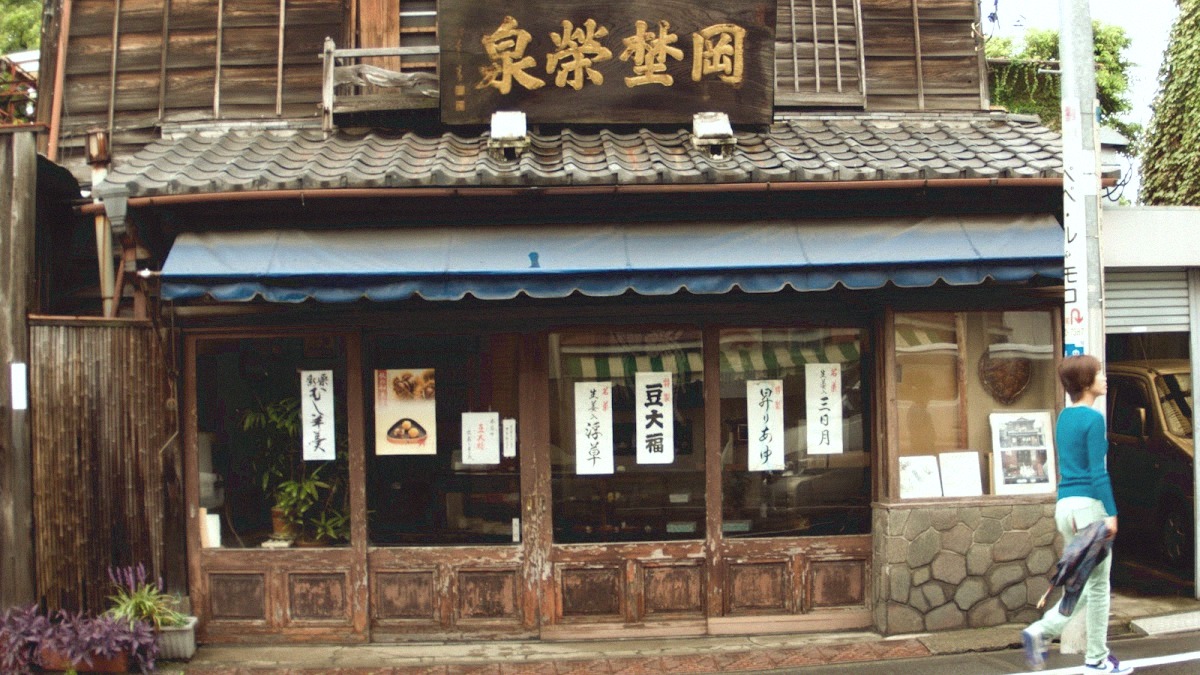
Most Tokyo districts ask you to decode them. Yanaka asks you to slow down. It is the part of the city that did not burn — it escaped the WWII firebombings that erased most of old Tokyo, so its pre-war streets, temples and shops are not a restored theme but simply the thing that was always there. Visitors who arrive with a tower-district metabolism — find it, photograph it, move — miss Yanaka entirely, because its food is not an attraction you locate. It is a pace you adopt.
This piece is that pace: why Yanaka eats the way it does, the layers it breaks into, the way to move through it that the district rewards, and what to skip.
Why Yanaka Eats the Way It Does
Yanaka began as a temple town — roughly seventy temples sit inside its boundaries — and grew around the priests, craftspeople and merchants who settled near them. That origin set the metabolism: residential, slow, craft-minded, built for people who live there rather than people passing through. Because the area survived the war and the bubble largely intact, that metabolism never got overwritten. Yanaka, together with neighbouring Nezu and Sendagi — the trio locals call Yanesen — is the rare central district where the food still serves a real neighbourhood at a real neighbourhood’s speed. Read every other pillar as a structure to navigate; read Yanaka as a tempo to match.
The Four Layers of Yanaka
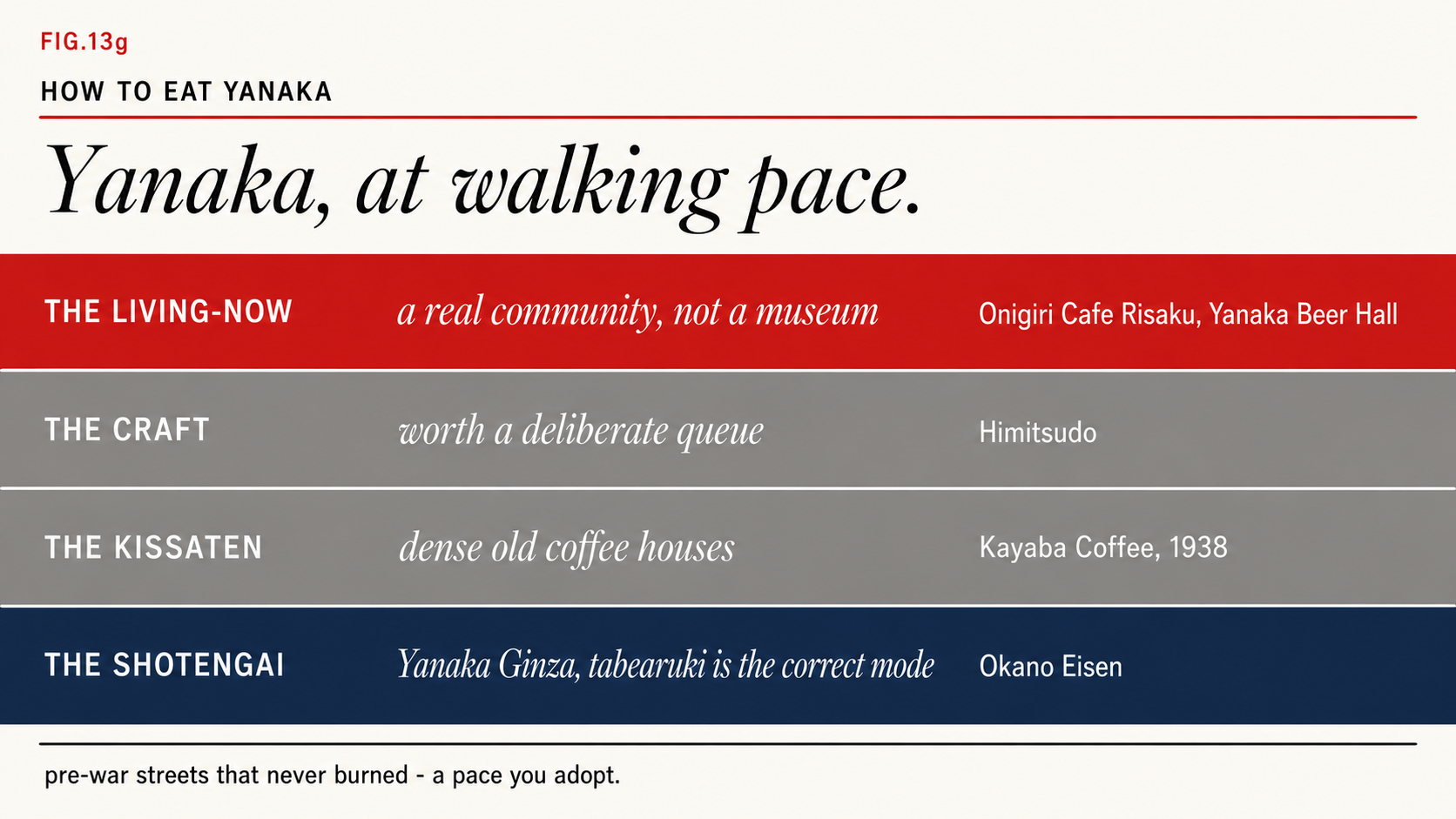
The shotengai layer. The spine is the Yanaka Ginza shotengai (商店街, shopping street) — a lantern-lined arcade of around sixty small shops where tabearuki (食べ歩き, eating while walking) is the correct mode: grilled squid, hot sweet potato, croquettes, senbei, eaten on the move, the way a shitamachi street has always been used. Okano Eisen is the kind of long-standing traditional-snack shop the street is built from. The kissaten layer. Yanesen is dense with old coffee houses, and Kayaba Coffee is the symbol — a 1916 wooden building, a kissaten from 1938, community-restored and reopened in 2009 with its Showa character intact. The sit-down here is not a break from Yanaka; it is Yanaka. The craft layer. The one thing worth a deliberate queue: Himitsudo, the shop that opened Tokyo’s modern kakigori era, proves Yanaka is a destination for a craft, not for a sight. The living-now layer. The proof it is a real community, not a museum: Onigiri Cafe Risaku in Sendagi is everyday Yanesen food, and the Yanaka Beer Hall is the modern layer settled into an old building rather than replacing it.
How to Actually Eat Yanaka
Eat it as a daylight walk, not an itinerary. Arrive without a reservation and let the shotengai set the rhythm — graze it slowly, a few hundred yen at a time, the squid and the sweet potato eaten standing. Make the kissaten the structural centre of the visit, not an afterthought: an unhurried hour at Kayaba Coffee is the single most Yanaka thing you can do, and rushing it defeats the entire district. Spend your one bit of patience on the craft layer — the Himitsudo queue is the exception that is worth it because the slowness is the product. Then eat where the residents do, in the living-now layer, before drifting out through the temple lanes. The sequence is almost the absence of one: walk, graze, sit long, queue once, eat local — and never compress it, because in Yanaka the unhurry is the cuisine.
What to Skip, and the One Rule
Skip treating Yanaka as a quick add-on between two bigger plans — half an hour here is worse than not coming, because the whole value is duration; skip looking for a signature restaurant to “do,” since the district’s food is the street and the kissaten, not a destination room; and skip arriving late, because Yanaka is a daytime, shop-shutter neighbourhood, not a night one. For the connective logic, the sibling pillar how to eat Asakusa is the instructive contrast — shitamachi that kept its temple and its crowds, versus Yanaka, shitamachi that kept its quiet — the coffee belts piece places the Kayaba kissaten layer, how Tokyo actually eats in summer is why the Himitsudo queue exists, and how to eat Ginza is the opposite-tempo pillar in the same cluster. The one rule for Yanaka: it is the one district you eat by walking and stopping, never by booking or chasing fame — its quality is the slowness itself.
Sources & Further Reading
- GO TOKYO (official) — Yanaka & Nezu: explore old Tokyo (the temple-town origin; shitamachi character — official)
- JNTO (official) — Yanesen (Yanaka / Nezu / Sendagi) (the Yanesen trio; survived war and disaster — official)
- Tokyo Cheapo — Yanaka: old-town Tokyo at its best (Yanaka Ginza shotengai; ~60 shops; the street-graze)
- Tokyo Localized — a guide to Yanaka, old-world Tokyo (Kayaba Coffee’s 1916 / 1938 / 2009 history)
- Japaan — Yanaka Ginza, Tokyo’s retro street-food scene (the tabearuki shitamachi fare along the arcade)