
What “Kodawari” on a Tokyo Restaurant Sign Actually Promises
The verb kodawaru once meant a flaw — being fussily hung up on trivia. Its "devotion to craft" sense is a recent, still-unfinished reversal, which is exactly why the word now sits on banners and menu headers the way "artisan" does in the West. So when you see kodawari on a Tokyo sign, the real question isn't what it means — it's whether this one earned it. Three tells to decide at the counter.
Here is the thing no one tells you about the word *kodawari* (こだわり, often glossed as “uncompromising dedication”): until about forty years ago, it was an insult. The verb it comes from, *kodawaru* (こだわる, 拘る), originally meant to be fussily hung up on something trivial — to let your mind get snagged on a detail that doesn’t matter. The flattering “devotion to craft” reading you see on travel blogs is a recent, still-unfinished reversal. So when you’re standing in front of a Tokyo shop and the word is printed on the sign, the menu header, or a banner by the door, it is not a guarantee of quality. It is a claim. The useful question is not “what does kodawari mean” — every explainer answers that to death — but “is *this* kodawari a real signal, or a sticker?” This piece gives you three tells to decide, at the counter, in about five seconds.
The word was a flaw before it was a virtue
Start with the kanji, because it gives the game away. The character 拘 in *kodawaru* means to constrain, to detain, to be held back — the same 拘 in 拘束 (*kosoku*, “restraint, custody”). The original sense of the verb was close to “to be hung up on trivia”: a person who couldn’t let a small thing go, who fussed over a detail no one else cared about. That was a character flaw, not a compliment. A Japanese-language reference desk run by the educational publisher Mitsumura Tosho lays this out plainly, answering a reader who asked whether “fussing over freshness” (*kodawaru*) was a bad thing — the honest answer being that, historically, yes, it carried that fault.
The shift is not finished, and you can measure it by age. The Agency for Cultural Affairs (文化庁, *Bunkacho*) runs an annual national survey on the Japanese language, and its 2015 edition found a generational split on *kodawaru*. Asked which phrasing they use, respondents in their thirties and younger favoured the newer, approving sense — being *kodawari* about your ingredients — by eleven to twenty-two points, while those sixty and older leaned the other way, toward the older sense of being hung up on the past. The word pulls in roughly opposite directions depending on who is hearing it. That alone should make you cautious about treating it as a fixed promise of excellence — it isn’t fixed even among native speakers.
Bubble-era marketing rehabilitated it — which is exactly why it’s on every banner
How does a word go from fault to virtue in one lifetime? Commerce. The positive sense tracks Japan’s premium-marketing decades, not some ancient craft tradition. A *kodawari* gift (“*kodawari* gift,” こだわりギフト) advertising usage shows up as early as 1982, documented in the language salon archive of the Mainichi Shimbun — meaning the word’s rehabilitation runs in parallel with bubble-era consumption, when “we obsess over this so you don’t have to” became a selling point rather than a confession.
That commercial origin is why the word is now everywhere. Japanese restaurant-marketing guidance tells shops, in so many words, to print *kodawari* on their *nobori* (のぼり, the tall vertical banners outside shops) and POP cards, paired with claims like *sanchi chokuso* (産地直送, “shipped direct from the producer”) and *jikasei* (自家製, “house-made”) — and crucially, to tie the word to the producer’s story and method, because that pairing generates customer sympathy. Read that again: the guidance treats *kodawari* as a persuasion device. It does the same job “artisan,” “small-batch,” and “house-made” do on a Western menu — sometimes earned, sometimes pure decoration, and printed the same way either way. The word on the banner is advertising copy. Whether the kitchen behind it earned the word is a separate question the banner cannot answer.
Real kodawari names one variable the maker refuses to swap
So here is tell number one, the one that does most of the work: genuine *kodawari* points at a single, specific variable the maker will not compromise on — and you can usually taste that decision. Not “we care about everything.” One thing. The origin of the bean. A particular stock. An in-house step that a competitor would outsource to save money.
The sharpest illustration in Tokyo is Bear Pond Espresso (Shimokitazawa), where the obsession is one shot of espresso and the rules built around it. The signature “Angel Stain” is capped at roughly ten servings a day and stops at 1:00 p.m.; the shop closes Tuesdays and keeps short, idiosyncratic hours. You cannot photograph the machine. None of this is decoration — it is a maker narrowing his attention to a single output and refusing to scale it. That is what the word means when it is real: a refusal, not a slogan. Compare that to the same five syllables printed on a mass-produced *nobori*, and you can feel the difference in weight.
The pattern repeats across Tokyo’s west-side coffee belt, which is useful because it shows *kodawari* is ordinary and distributed, not a sacred rarity. At The Roastery by Nozy Coffee (Harajuku), the obsession narrows to one named variable — single origin — which is exactly the kind of thing a genuine *kodawari* line should be pointing at. A few stations west, ONIBUS Coffee (Nakameguro) roasts by the river with the same logic; it reads less as a manifesto than as a normal standard of the neighbourhood. And at Dandelion Chocolate (Kuramae), the variable is the longer, costlier process itself — bean-to-bar, made slowly, when a shortcut plainly exists. In each case you can name the one thing the maker won’t outsource. That nameability is the test.
This is also the shape of the real craft economy the word points to, which is quieter than the banners suggest. Japan still has more than a thousand soy-sauce producers (around 1,000–1,200 in recent industry counts, and falling), most of them small artisan brewers, and traditional makers — Kikkoman’s heritage brewing among them — still run a process built on four ingredients (soybeans, wheat, salt, water) plus *koji* (麹, the fermentation starter), with the core method little changed for centuries. Genuine *kodawari*, in that world, usually means one maker declining to swap one such variable for a cheaper substitute. It is narrow by definition. A claim that gestures at everything is gesturing at nothing.
On a menu, a kodawari heading means “order this”
Tell number two turns the word into a practical ordering cue. On a menu specifically — as opposed to a banner — a *kodawari* heading usually flags the house’s signature items: the dishes the shop is proudest of. Gurunavi, one of Japan’s large restaurant-listing platforms, describes the *kodawari* section of a menu as exactly this, the restaurant’s house specials. So when you open a menu and see a line or a boxed-off section labelled こだわり, treat it as the kitchen pointing at itself and saying: this is what we want to be judged on. Order from there.
Ramen is the category where this gets tested hardest, because ramen is where the word is most worn out. Government export material has spent years framing *kodawari* as the uniformly admirable story of ramen — broth simmered for hours, ingredients sourced just so — which is precisely the marketing register that makes the word suspect. And yet sometimes it is earned. At Konjiki Hototogisu (Shinjuku), the obsession is a specific, identifiable stock decision — clam and truffle built into the bowl — that you can taste as a deliberate choice rather than a tagline. The word is real here. It is also printed on a thousand ramen banners where it is not. Both things are true, which is the whole point: the category cannot tell you. The specific dish in front of you can.
Don’t trust the word. Trust the noun next to it.
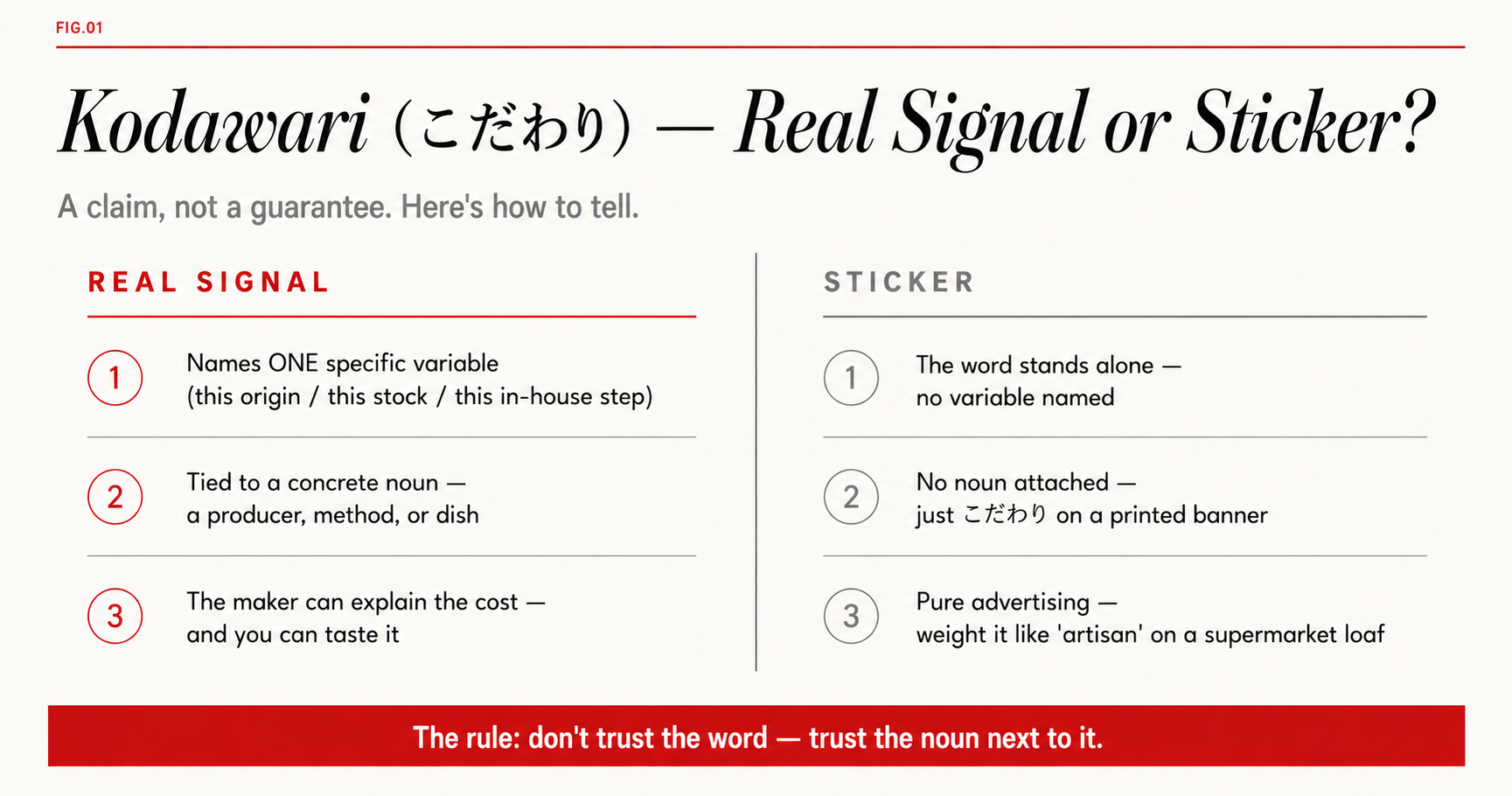
Which brings the three tells together into one rule you can use tomorrow. *Kodawari* on its own — sitting on a banner with no specific noun attached, no named variable, no producer or method beside it — is decoration, and you should weight it exactly as much as you’d weight “artisan” stamped on a supermarket loaf: zero. *Kodawari* tied to a concrete noun the maker can explain the cost of — *this* origin, *this* stock, *this* in-house step — is a real signal, and worth following. And *kodawari* as a menu heading is the house pointing you at its best dish, so order it.
The short version: don’t trust the word, trust the noun next to it. A word that was an insult forty years ago and is now sold as a virtue cannot, by itself, promise you anything. What can is the specific, nameable thing a maker refuses to give up — and the good news is that in Tokyo, from a Shimokitazawa espresso counter to a Kuramae chocolate workshop, that thing is usually right there for you to taste and judge for yourself. If you want a parallel skill for the rest of the board, our guide to reading a Japanese menu covers the characters that do the same decoding work, and what “omakase” actually means takes apart another word travelers trust too quickly.
Sources & Further Reading
- Mitsumura Tosho, “Kotoba to Manabi” language Q&A (the original negative sense of 拘る / 拘 as “constrain, detain”)
- Agency for Cultural Affairs (文化庁), FY2015 Survey on the Japanese Language, Q22 (the generational split on kodawaru: respondents in their thirties and younger favour the approving “kodawari about ingredients” usage by 11–22 points, while those sixty and older lean toward the older “hung up on the past” usage; accessed May 2026)
- Mainichi Shimbun Kotoba salon archive, “the era that accepts kodawari” (the 1982 “kodawari gift” advertising usage)
- WAVE restaurant-signage / nobori marketing guidance (kodawari as a printed persuasion device alongside sanchi-chokuso and jikasei)
- Gurunavi, “How to Decipher Japanese Menus” (the kodawari menu heading as the restaurant’s house specials)
- Kikkoman Soy Sauce Museum, “How Soy Sauce Is Made” (the four-ingredient process — soybeans, wheat, salt, water, plus koji — with a brewing core “not changed for centuries”; accessed May 2026). Producer count (more than a thousand small brewers nationwide, ~1,000–1,200 in recent years and declining) per Japan Soy Sauce Association figures compiled by Shokunin Shoyu.