
What If My Card Gets Declined in a Tokyo Restaurant and I Don’t Have Cash
In a small Tokyo restaurant, a "declined card" is almost never a billing problem — the shop simply never took cards. Here's the calm, four-step recovery: check the Suica or QR wallet you already have, walk one person to the nearest Seven Bank ATM inside a 7-Eleven while your bag stays, fall back to Japan Post Bank, and know that the worst case is still survivable. No fear-selling, just the minute-by-minute Tokyo playbook.
First, the reassurance you came here for: in a small Tokyo restaurant, this is almost never the disaster it feels like. Nobody is calling the police. Nobody thinks you tried to run. Leaving the table to find cash is normal here, and the owner has seen it a hundred times. You have four ways out, in rough order — check what you already have (a Suica or phone wallet may clear the bill), then one person walks to the nearest 7-Eleven for a Seven Bank ATM while a companion or your bag stays, then Japan Post Bank as a backup, and in the worst case the owner takes your name and you come back. The rest of this article is the minute-by-minute version of those four steps.

In Tokyo, It’s Usually Not a Decline — the Reader Never Existed
Here is the reframe that changes everything you do next. In the United States, a declined card is a billing argument: the server runs it again, the machine fails again, and you debate the bank. That mental model does not map onto a counter in Tokyo, because at most small places there was never a card reader to argue with. The “decline” you are imagining didn’t happen. The shop simply takes cash, and always did.
Take Harajuku Gyozaro (餃子楼, “dumpling house”), one block off Takeshita-dori. It is strictly cash — no cards, no IC, no QR — and six pan-fried gyoza cost ¥290 — squarely in the backpacker tier of our Tokyo food budget guide. There is nothing to decline at a place like this, because the whole operation runs on a coin tray and a hand-written ticket. The same is true across the alley districts: in Omoide Yokocho (思い出横丁, “Memory Lane”) in west Shinjuku, roughly six in ten stalls take cash only, and the counters are so small there is physically nowhere to put a terminal. Read the seven alley districts worth a night and you’ll notice the pattern — the smaller and older the stall, the more likely cash is the only language at the register.
This matters because it tells you not to waste the panic. There is no point asking the owner to “try it again.” The right question is the calm one: genkin dake desu ka? (現金だけですか, “is it cash only?”). If the answer is yes, you are not in trouble — you are in a logistics problem with four known solutions.
The 90-Second Triage Before You Stand Up
Before you go anywhere, check what’s already in your pocket. Two of the four recovery layers don’t require leaving the table at all, and people skip them because they’re embarrassed and not thinking clearly.
The first is an IC card. If you have a Suica (スイカ) or PASMO already loaded — physically, or in Apple Wallet or Google Wallet on your phone — it will clear the bill at any shop showing the green Suica logo or the brown-and-red “IC” sticker by the register. A surprising number of cash-leaning izakaya take IC even when they refuse credit cards, because the tap-to-pay terminal came bundled with their transit setup. The catch is real and worth knowing: an IC card balance caps at ¥20,000, and you can only top it up with cash — at station machines or, conveniently, at a convenience-store register. So a ¥4,500 bill is fine if your card is loaded; a ¥16,000 yakiniku dinner may not be.
The second is a QR wallet. If the shop shows a PayPay (ペイペイ) sticker, your home payment app may already work through it. PayPay now reads more than two dozen overseas cashless services from over a dozen countries — Alipay, and since September 2025, WeChat Pay among them — converting the bill into your home currency automatically. If you live somewhere those apps are standard, the sticker on the wall might be your fastest exit. Check both stickers before you stand up; the whole triage takes under a minute and can end the problem where you sit.
Leaving the Table Is Normal — One Person Walks, the Bag Stays
If the stickers don’t save you, this is the step the other guides won’t tell you, and it’s the one that matters most: in Tokyo, walking out to find cash is expected, not suspicious. Tell the owner plainly — sumimasen, genkin ga tarinai node, ATM ni ikimasu (すみません、現金が足りないので、ATMに行きます, “sorry, I’m short on cash, I’m going to an ATM”). If you’re in a group, one person goes and the others stay. If you’re alone, leave your bag, your coat, or your phone on the seat. The owner will nod. This is not a runner situation, and they don’t read it as one — Tokyo’s low-crime norms are exactly why nobody tenses up when you walk out the door. The relaxed reaction can itself feel strange if you’re braced for confrontation.
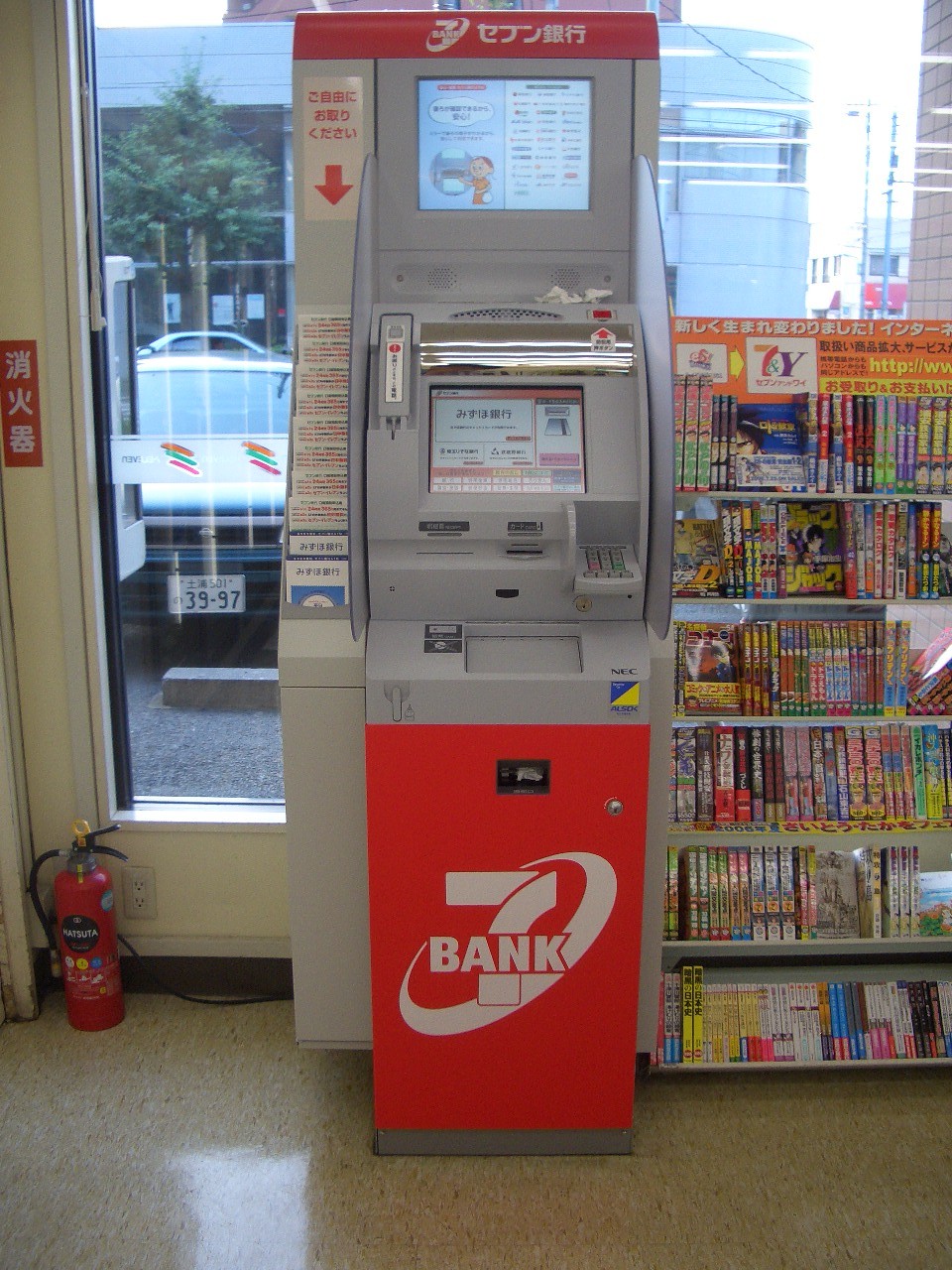
Now the part that trips people up: not every ATM takes your card, and the wrong machine wastes the one thing you’re short on — composure. The reliable one is Seven Bank, the ATM inside every 7-Eleven and in many stations. It’s open 24 hours and accepts foreign-issued Visa, Mastercard, American Express, JCB, UnionPay, Discover and Diners Club cards, with a per-withdrawal limit of ¥100,000 (which drops to ¥30,000 if the machine falls back to reading your magnetic stripe instead of the chip). Since 2022 it also offers to bill you in your home currency at the screen. There are more than 28,000 of these machines nationwide, which in central Tokyo means one is almost always within a few minutes’ walk. From the mouth of Omoide Yokocho, the west-Shinjuku 7-Elevens are a short walk away.
The honest frustration is that bank-branded machines — the ones at MUFG or AEON — often reject the exact same foreign card a Seven Bank ATM accepts seconds later. People get sent to the nearest ATM, hit a wall, and assume their card is dead. It usually isn’t. If there’s genuinely no 7-Eleven nearby, the second reliable network is Japan Post Bank (ゆうちょ, Yucho), whose ATMs take Visa, PLUS, Mastercard, Maestro, Cirrus, JCB, UnionPay and Discover, at a lower single-withdrawal limit of ¥50,000. Be aware it adds a ¥220 usage fee per withdrawal for many foreign cards — on top of whatever your own bank charges — so it’s the backup, not the first choice. Between those two networks, a working foreign card will almost always produce yen.
The Worst Case Is Still Survivable
Suppose all of it fails — no IC balance, no QR app, and your card won’t read at any machine you can reach. This is rare, but it happens, and it’s still not a catastrophe. Owners at small shops have a well-worn fallback: they take your name and a way to reach you, and you come back with the cash. It is awkward, not dangerous. The amounts in play are small — a counter dinner that breaks the bank is usually ¥3,000 to ¥6,000, not a number anyone will pursue you over — and the social contract here assumes you’ll return, because in a neighborhood where the same regulars come for decades, almost everyone does.
We won’t pretend it’s always painless. The frictions are real and stack up at the worst moment: the magnetic-stripe fallback can quietly halve your withdrawal limit, the IC cap means a big bill won’t clear on tap, and an owner with no English and a line out the door is genuinely stressful to negotiate. But none of those frictions is the same as being stranded, and none of them is the disaster the panic insists it is. The embarrassment is the worst part, and the embarrassment passes by the time you’ve found the next ATM.
Which leaves the one habit that costs nothing and ends the whole problem before it starts: carry ¥3,000 in small notes and coins before you sit down at a cash-only counter. Not ¥10,000 notes that a tiny stall can’t break — ¥1,000 notes and a handful of coins. At a street stand like Asakusa Menchi (浅草メンチ) on Denboin Street, where a juicy menchi-katsu runs around ¥400 and there’s no register at all, exact-ish change is the entire transaction. The same small-cash habit covers a round at Hoppy Street (ホッピー通り) near Senso-ji or a couple of skewers at a Koenji counter like Yakitori Nonki (やきとり のんき). If you want the full picture of why so much of great Tokyo stays cash-only — and how to never get caught short — read Cash-Only Tokyo. The short version: keep a small fold of cash for the counters, and the moment you fear here mostly stops happening.
Sources & Further Reading
- Seven Bank — Overseas Cards Usable at ATMs (foreign-card brand list, ¥100,000 per-withdrawal limit, ¥30,000 magnetic-stripe limit, 24-hour access; accessed May 2026)
- Seven Bank — ATM network (more than 28,000 ATMs nationwide — 28,416 reported end of January 2026; figure is drift-prone, accessed May 2026)
- PayPay Corporation — WeChat Pay integration press release (Sept 4, 2025) (PayPay QR now reads 20+ overseas wallets including WeChat Pay; accessed May 2026)
- Japan Post Bank — International ATM Service (Visa/PLUS/Mastercard/Maestro/Cirrus/JCB/UnionPay/Discover accepted, ¥50,000 single-withdrawal limit, ¥220 usage fee for certain foreign cards; accessed May 2026)
- JR-EAST — Suica (¥20,000 balance cap, cash-only top-up at machines and konbini; accessed May 2026)
- Truly Tokyo — Harajuku Gyozaro (cash-only policy, ¥290 for six gyoza; accessed May 2026)
- Asakusa Menchi — official site (Asakusa Menchi on Denboin Street; current menchi-katsu price ~¥400, drift-prone, accessed June 2026)