
How to Eat Shimokitazawa
Seven minutes from Shinjuku and the opposite metabolism. When its railway was buried and prime land opened, Shimokitazawa chose not to build towers. The deliberate inverse of Shibuya — the four layers, and why you eat it without a map.
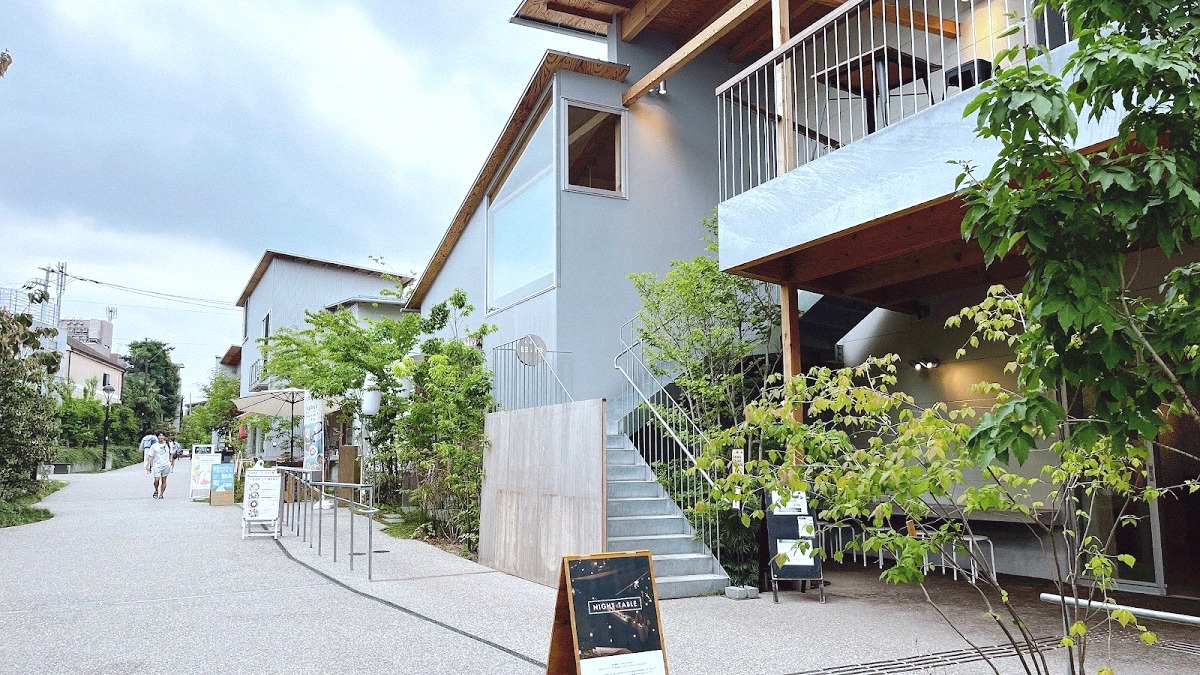
Shimokitazawa is seven minutes from Shinjuku and a different metabolism entirely. It is the district that, when its railway was buried underground and a decade of prime redevelopment land opened up, chose not to build towers on it. That single decision — to rebuild low, indie and human-scale on purpose when it could have gone vertical — is the whole key to how the place eats. Shimokitazawa is the deliberate inverse of Shibuya: same era of reconstruction, opposite answer.
This piece is that answer: why Shimokitazawa eats the way it does, the layers it breaks into, the way to move through it the district rewards, and what to skip.
Why Shimokitazawa Eats the Way It Does
Shimokitazawa grew as a bohemian, youth-driven arts quarter — vintage shops, record stores, live houses, and a theatre culture anchored since 1982 that earned it the name “Tokyo’s theatre town.” Its food formed to feed that crowd: owner-run, cheap enough for a working artist, idiosyncratic, and indifferent to scale. When the post-railway redevelopment came, the district kept that ethos on purpose, building low-rise complexes that house independent shops rather than chains. So Shimokitazawa’s food is organised by a refusal — the refusal to get big — and reading it means looking for the owner behind the counter, not the brand on the door.
The Four Layers of Shimokitazawa
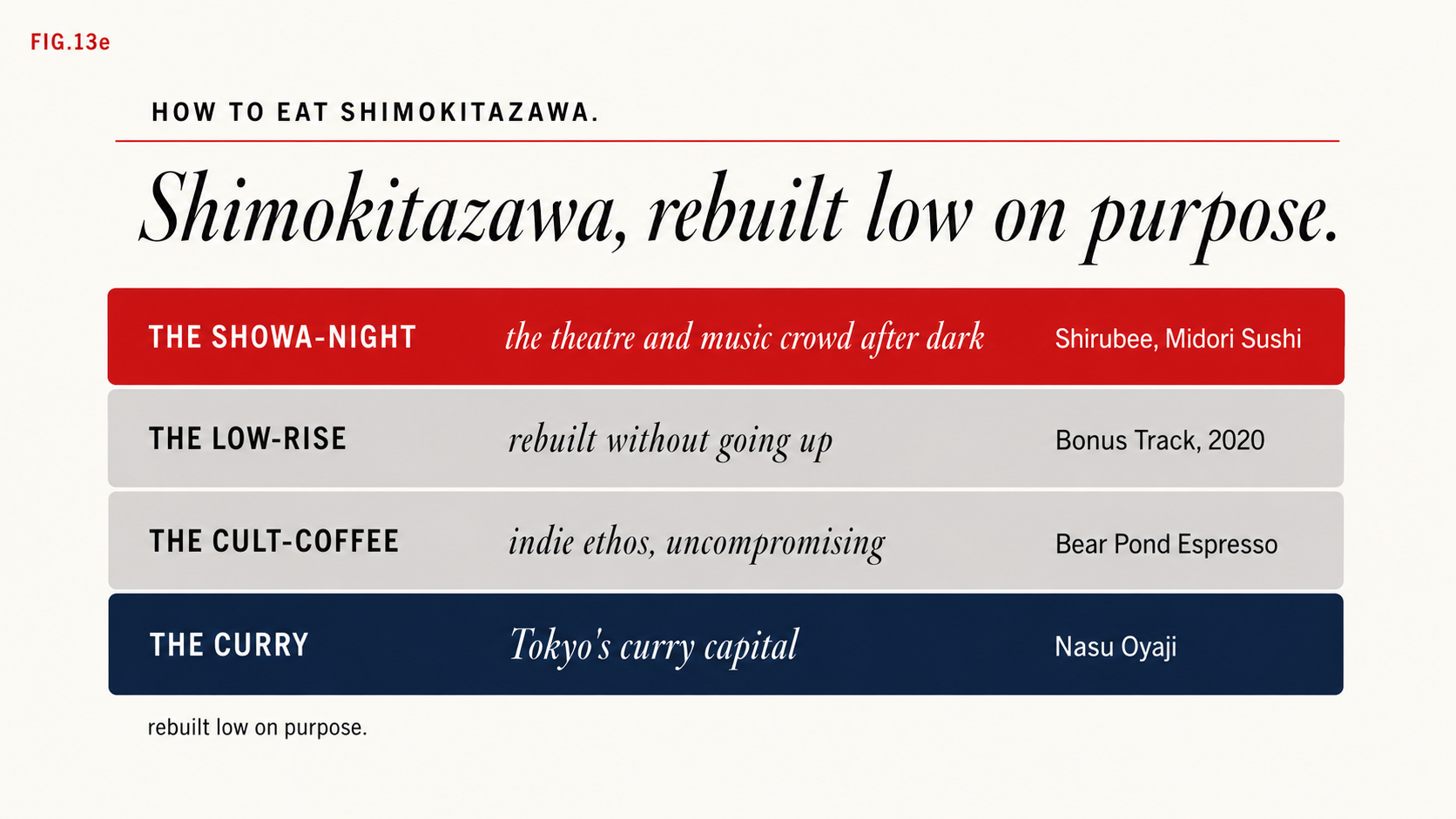
The curry layer. Shimokitazawa is Tokyo’s curry capital — an obsession deep enough to fill an annual festival of over a hundred participating shops with Japanese soup curry, Indian, Nepalese, Sri Lankan and more. Nasu Oyaji and its signature eggplant keema is the anchor and the proof that the best version here is a tiny owner-run room. The cult-coffee layer. The district’s indie ethos distilled to its most uncompromising: Bear Pond Espresso is the strict, small, world-known room where the espresso is made on the maker’s terms, not the customer’s — Shimokitazawa’s character in a single cup. The low-rise-redevelopment layer. The thing that explains the district: Bonus Track, opened in 2020 on the former Odakyu Line tracks, is a deliberately low complex of independent shops around a picnic plaza — the redevelopment that proves Shimokitazawa rebuilt without going up. The Showa-night layer. Where the theatre and music crowd lands after dark: Shirubee is the faux-Showa izakaya built for long nights, and Midori Sushi nearby is the accessible big-cut counter when the night wants something more substantial.
How to Actually Eat Shimokitazawa
Eat it without a map. Shimokitazawa has no grid — the lanes tangle on purpose, and the correct mode is wandering, not navigating. Start with the curry layer as the one fixed point of the day: pick a single owner-run room, Nasu Oyaji or whatever the wander surfaces, and commit. Submit to the cult-coffee layer on its own terms — Bear Pond is not a grab-and-go, it is the district asking you to slow down and accept how someone else does it. Spend the soft middle of the day in the low-rise layer, where Bonus Track is built precisely for an unhurried craft beer in a plaza rather than a transaction. Then let the Showa-night layer take the evening at the theatre crowd’s pace. The sequence is loose by design: one fixed curry, coffee on the maker’s terms, an idle low-rise hour, a long izakaya night — strung together by walking, never optimised.
What to Skip, and the One Rule
Skip trying to do Shimokitazawa efficiently — a tight, mapped, box-ticking pass is the single surest way to get nothing from it; skip looking for the famous big restaurant, because the district’s whole point is that there isn’t one; and skip treating Bonus Track or Reload as malls, when they are the argument the district is making about scale. For the connective logic, how to eat Shibuya is the deliberate contrast — the same redevelopment decade, rebuilt up there and down here — the coffee belts piece places Bear Pond in Tokyo’s wider specialty scene, chain vs independent is why an all-independent district behaves differently, and the sibling low-rise pillar how to eat Yanaka is the same unhurried-tempo logic on an older neighbourhood. The one rule for Shimokitazawa: eat it without a plan and without a map — the quality is the wander, and optimising it is the one way to fail it.
Sources & Further Reading
- GO TOKYO (official) — Shimokitazawa, Tokyo’s bohemian district (the bohemian/theatre character; the low-rise redevelopment — official)
- JNTO (official) — Shimokitazawa (the indie shopping and music-district identity — official)
- Tokyo Cheapo — Shimokitazawa Curry Festival (the 100+ shop curry density that makes it the curry capital)
- MATCHA — Shimokitazawa: things to do, shopping, food (Bonus Track / Reload; the post-railway low-rise complexes)
- ROADBOOK — Shimokitazawa, Tokyo’s indie mecca (Bear Pond Espresso; the owner-run, anti-scale food ethos)