
Is Sukiyaki Worth It in Tokyo? What the Historic Beef Houses Actually Charge
A real 2026 menu from Asakusa Imahan, decoded: what your sukiyaki yen is actually buying — the A5/A4 grade the menu hides in polite words, the server who cooks each slice, and an 1895 house — plus how to tell the three separate Asakusa Imahans apart, and why the ¥5,390 lunch door buys all three for half the dinner price.
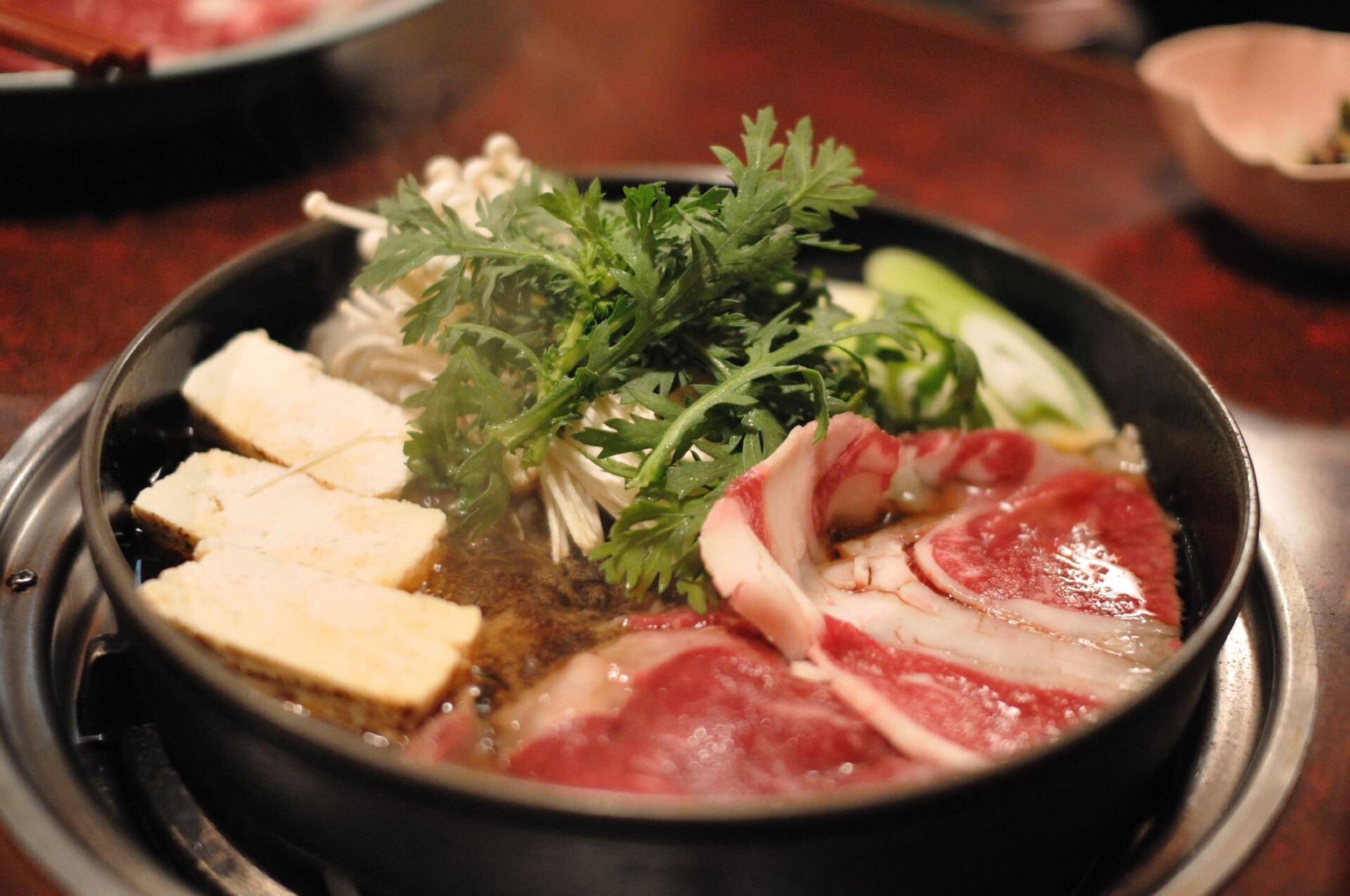
Yes, sukiyaki at a historic Tokyo beef house is worth the money — but only once you know what the money is actually paying for, because it is not, as most travelers assume, simply the beef. The bill is three stacked premiums: the grade of the meat (the A5/A4 label the rest of the menu stays silent about), the labor of a server who cooks each slice at your table, and well over a century of one house doing exactly this. And there is a back door most guides never mention: the lunch set buys the same kitchen, the same grade, the same hands, for roughly half the dinner price.

What you think you are deciding is “is sukiyaki overpriced.” What you are actually deciding is which door you walk through. So here is a real, current menu from one named house — Asakusa Imahan — decoded line by line, with verifiable 2026 prices, so you can tell whether your money is buying protein or occasion before you sit down. One warning before the numbers: Asakusa has three separate, similarly named beef houses, and confusing them is the single easiest way to book the wrong restaurant.
First, the three Imahans — because you will book the wrong one
This is the trap. In and around Asakusa there are three legally separate companies, all named some version of Imahan (今半), all tracing their lineage to 1895 (Meiji 28), all serving sukiyaki within walking distance of each other. They are not branches of one chain. The houses themselves are explicit that they are entirely different businesses with different kitchens, different prices, and different owners.
The three are: Asakusa Imahan (浅草今半), whose Kokusai-dori flagship is the subject of this piece and the originator of beef tsukudani (佃煮, soy-simmered beef preserve); Imahan Honten (今半本店), a separate company near the temple; and Imahan Bekkan (今半別館, “the annex”), a third, also separate, set inside an older building with a garden. When a guidebook, a Tabelog listing, or a price quote says “Imahan,” check the full name before you trust the number — a figure from one house tells you nothing reliable about the other two. Everything below is Asakusa Imahan’s Kokusai-dori flagship, sourced from the house’s own published menu, so you can hold the actual restaurant to the actual price.
The grade is the biggest line, and the menu hides it inside a word
At Asakusa Imahan, the dinner sukiyaki (すき焼き) — thin beef simmered in warishita (割り下), a sweet-soy cooking stock — is sold as graded multi-course gozen (御膳, “set”) and kaiseki (懐石, “course”). The entry “frost-marbled” sukiyaki gozen runs about ¥11,000; the premium frost-marbled gozen climbs to roughly ¥12,100; the premium kaiseki sits near ¥17,600; and the house’s named multi-grade and Kobe-beef courses run up into the ¥19,800–¥33,000 band. The single biggest line on every one of those bills is the beef itself, and the gap between the ¥11,000 set and the ¥17,600 course is, more than anything, a gap in one number: the grade.
That grade is not a marketing word. Every Japanese beef carcass is assessed by the Nihon Shokuniku Kakuzuke Kyokai (日本食肉格付協会, the Japan Meat Grading Association) under a standard approved by the agriculture ministry. It produces a two-part label: a yield grade of A, B, or C (A is the highest ratio of usable meat off the carcass), and a quality grade from 5 down to 1. The catch worth knowing — the part the menu will never explain — is that the quality number is the worst of four separate sub-scores: marbling, meat color and luster, firmness and texture, and the color and quality of the fat. So “A5” means top yield and top marks on all four axes at once; a single weak fat color drops the whole carcass to A4 no matter how good the marbling.
Here is the part that should change how you read the menu: A5 does not mean “tastes best.” It is a yield-and-quality certificate, not a flavor verdict — a distinction that matters when a course charges you more for a higher grade than your palate may even register, because above a certain marbling level the differences narrow to something only a trained buyer reliably tastes. The price of that label follows from how rare it is. Only about 1–2% of Japanese cattle reach A5. The animals behind it are fed for roughly 28 to 36 months, against 18 to 24 for conventional beef, and that extra year of feed pushes the cost per head several times higher. So the climb from the ¥11,000 set to the ¥17,600 course is not the restaurant’s markup wandering upward — it is you stepping up the grade ladder, paying for marbling that took an extra year to build into the muscle. That is the first premium, and it is the one the menu actually itemizes for you, if you know that the polite words “frost-marbled,” “premium,” and “select” are standing in for grade.
The second premium is the hands, not the hotpot
Walk into a budget all-you-can-eat sukiyaki place and you cook the beef yourself: the pot lands on the burner, the staff leaves, you fish slices out of the broth at your own pace and hope you pulled them in time. At a historic house, that job is done for you. A server in kimono kneels at the table, controls the heat, lays in the beef one or two slices at a time, adds the warishita in stages, and pulls each piece at the moment it turns — never letting a slice overcook in a crowded pot, never letting the broth reduce to salt. This is the line on the bill nobody prints. You are paying a labor premium for a person whose entire job, for the length of your meal, is to cook a single expensive ingredient correctly, slice by slice.
It also explains a number that looks like a surcharge and isn’t. Asakusa Imahan adds a 10% service charge on spending over ¥5,500 per person — not a Western-style tip (Japan doesn’t tip; see our piece on tipping in Japan), but the institutional way a beef house prices the table-side labor into the bill instead of leaving it to chance. The service is the product as much as the beef is.
This is also where the three houses split, and where “worth it” stops being a yes-or-no. Imahan Bekkan — the third of the three separate 1895 companies, not a branch of Asakusa Imahan — sells you the setting and the service as the main event: full table-side cooking throughout, inside an older building with a small garden near Senso-ji (浅草寺). Asakusa Imahan’s Kokusai-dori flagship sells you the grade ladder and the kitchen’s full range, from an ¥11,000 set up to its Kobe-beef courses. Same dish, same neighborhood, two different things your money is buying: one is access to a deeper graded menu, the other is an occasion in a room built for it. Knowing which you want — and which company you are actually booking — is the whole decision.
The third premium is the history, and it explains the rest
The reason a beef hotpot can carry a five-figure price without being a tourist invention is that it is not new — it is one of Tokyo’s oldest restaurant formats, and these houses have been running it continuously. Sukiyaki is a Meiji-era Tokyo creation. For roughly 1,200 years, eating beef was effectively taboo in Japan; that ended in practical terms in 1872, when newspapers reported that the Emperor Meiji had eaten beef and broke the prohibition in public. The year before, the writer Kanagaki Robun (仮名垣魯文) published Aguranabe (安愚楽鍋, “the cross-legged hotpot”) and declared that anyone who didn’t eat gyunabe (牛鍋, “beef pot”) was unenlightened. A boom followed: by 1877, Tokyo reportedly had more than 500 beef-hotpot eateries.
The Tokyo version is the one you’ll eat in Asakusa, and it differs from the Kansai style in a way you can verify at the table. Kanto-style cooking simmers the beef in warishita stock rather than searing it sugar-first the way Osaka does — so the beef comes out more tender and the broth, not caramelized sugar, carries the dish. The Tokyo name itself is a survivor of disaster: in Kanto the dish was called gyunabe well into the twentieth century, and the term consolidated into “sukiyaki” only after the 1923 Great Kanto earthquake leveled the old beef-house district and the rebuilt shops reopened under the Kansai word. That history is why the price reads as continuity rather than markup. Asakusa Imahan traces its lineage to the 1895 founding house (its own Kokusai-dori restaurant dates to 1928), and the surviving historic Tokyo beef houses generally fall between 1895 and 1912 — the late-Meiji window when gyunabe settled from a fad into an institution.
So when you pay, you are buying into an operation that has been doing precisely this — graded beef, table-side, in warishita — for over a century, through an earthquake, a war, and the entire arc of modern Tokyo. That is the third premium, and it is the only one you cannot get anywhere else at any price: a new restaurant can buy A5 and hire a skilled server tomorrow, but it cannot buy 1895.
The lunch door buys all three for roughly half
Here is the move that settles the “worth it” question for most travelers: the same kitchen opens a cheaper door at midday. At Asakusa Imahan, the lunch sukiyaki sets are published plainly — the suki-yaki hiruzen (すき焼昼膳, “sukiyaki lunch set”) at ¥5,390, and the fuller suki-yaki hirukaiseki (すき焼昼懐石, “sukiyaki lunch course”) at ¥8,250. Lunch runs roughly 11:30 to 14:30. You still get graded beef, you still get the table-side cooking, and you get the same 1895 house. What you give up is the leisure of a long dinner and the largest portions — not the quality, and not the experience that makes the dish worth knowing.
Run the math on the house’s own numbers and the case makes itself. The ¥5,390 lunch set is still well under half the ¥11,000 dinner set and about a quarter of the ¥19,800–¥33,000 top courses. The ¥8,250 lunch course still comes in under that ¥11,000 dinner entry. Even the lunch-only Meiji sukiyaki-don (明治すきやき丼, a sukiyaki rice bowl, capped at 20 servings a day) lands around ¥3,300 — a way to taste the kitchen for the price of a good ramen with extras, though as a donburi it is a different format, not the table-side set. The point is structural: midday is when a graded-beef, table-side-cooked sukiyaki at a 130-year-old house stops being a special-occasion number and becomes an ordinary lunch you can walk in and order.
And Asakusa Imahan is not unusual here. Across Tokyo’s old beef houses, the lunch-versus-dinner gap is the rule, not the exception — at Ginza’s Yoshihashi (吉葉), for instance, a sukiyaki lunch starts a tier below its dinner courses for the same structural reason: smaller portions, a room that turns faster at noon. Wherever you go, the lesson holds. If you want the full evening, the dinner price is what it is and it buys what it claims. If you want the dish without the five-figure outlay, the lunch door is open.
So the honest verdict: sukiyaki at a historic Tokyo house is worth it, and the price is legible once you stop reading it as the cost of beef. It is the cost of a grade only 1–2% of cattle reach, the hands of a server cooking each slice, and the continuity of a house that has done this since 1895. Decide which Imahan you mean, decide whether you want the occasion or the menu range, and decide which door — dinner or lunch — fits your day. For where this sits in a wider day of eating, see our 2026 Tokyo budget guide; for how a beef house fits the neighborhood’s layered history, how to eat Asakusa puts it in order.
Sources & Further Reading
- Japan Meat Grading Association (日本食肉格付協会) — beef carcass trading standard (the A–C yield grade, 5–1 quality grade, and the four marbling/color/firmness/fat sub-scores scored worst-of-four)
- MAFF (農林水産省) — how beef grading works (the ministry-approved grading mechanism behind “A5”)
- Asakusa Imahan — official site, “Since 1895” (the house’s lineage as originator of beef tsukudani, and its sukiyaki menu structure)
- Asakusa Imahan — grand-menu price revision notice (the verifiable dinner gozen/kaiseki/Kobe figures: ¥11,000 / ¥12,100 / ¥17,600 / up to ¥33,000, and the 10% service charge over ¥5,500; menu as published, accessed May 2026)
- Asakusa Imahan — Kokusai-dori Honten (the published lunch sets: すき焼昼膳 ¥5,390, すき焼昼懐石 ¥8,250, 明治すきやき丼 ¥3,300, and lunch hours; menu as published, accessed May 2026)
- Plenus 米食文化研究所 — roots of meat-eating in Japan (the 1872 lifting of the beef taboo and the Meiji gyunabe boom)
- Food in Japan — gyunabe and the Kanto vs Kansai distinction (simmered warishita style vs sugar-seared, and the gyunabe-to-sukiyaki naming shift after 1923)